
Dacic: The territorial integrity of Ukraine or any country cannot be more important than the territorial integrity of Serbia
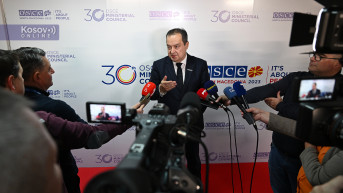
Minister of Foreign Affairs of Serbia, Ivica Dacic, stated this evening in Skopje, after participating in the plenary session of the OSCE Ministerial Council, that Kosovo would never become a member of that organization because Serbia would never agree to it, emphasizing that the territorial integrity of Ukraine or any other country could not be more important than the territorial integrity of Serbia.
Considering that the Minister of Foreign Affairs of Albania mentioned during the session that Kosovo should become a member of the OSCE, Dacic reminded journalists in his statement that decisions in that organization were made by consensus, and Kosovo would never be able to become its member because Serbia would not agree to it.
"Given that the question of territorial integrity has been mentioned many times today, we cannot pretend that the territorial integrity of Ukraine or any other country is more important than the territorial integrity of Serbia. It is hypocritical for anyone to talk about the need to protect the principle of territorial integrity and then openly propose violating the territorial integrity of Serbia", Dacic concluded.
He added that Serbia's Ambassador to the OSCE, Zarko Obradovic, was in constant communication with representatives of friendly countries, keeping them informed about the situation in Kosovo.
In that regard, he recalled that the OSCE Mission had organized elections in Kosovo after the signing of the Brussels Agreement, and now, he said, Albin Kurti refused to invite them to the elections in Kosovo while not allowing the Serbs to vote in parliamentary elections.
"So, this is how far we have come in disrespecting the agreements from Brussels", Dacic noted.
He also pointed out that the problems that existed, had almost paralyzed the work of the OSCE, as a consequence of everything happening in international relations, the war in Ukraine, mutual blockades, etc.
"The only time a decision was made in the OSCE without consensus was the case of Yugoslavia when the principle of 'consensus minus one' was introduced. Then and never again. Now, almost all decisions have been paralyzed, and that's why the idea of Western diplomats and countries was to enable Lavrov to attend the meeting, because obviously, without Russia, certain decisions cannot be made", Dacic pointed out.
The only decision made is that Malta will chair the OSCE next year, but for three or four years, there has been no political decision, declaration, or resolution, due to a lack of consensus.
"Now, even a decision regarding the budget cannot be made, or the mandates of the Quartet - the Secretary General, the Director of ODIHR, the Representative on Freedom of the Media, and the High Commissioner on National Minorities. There is a general paralysis of the organization, and we advocated finding common ground because the OSCE was established to be a platform for overcoming and preventing conflicts and early warning to prevent them from happening", Dacic added.
Unfortunately, he noted that time had brought a different political scene on the international stage, and today various opinions and condemnations were heard, but without an agreement.
"Importantly, there should be some agreement on this continent. It doesn't have to be love, but there should be an agreement, especially when it comes to security. If peace is desired, everyone needs to participate, sit at the same table, find solutions, and bring the dialogue to some agreement that would allow a cessation of war. We will try to help with that to the maximum, but I am sure it depends on the great powers", Dacic said.
When asked if the confusion in the OSCE indicated that it was still the "beginning of the end" of the war in Ukraine, Dacic replied that it was possible, but he still did not believe that such a thing was realistic because it would be difficult for the opposing sides to agree on what the end of the war would be.
"In the current situation, the only realistic thing is to achieve a temporary ceasefire, and for that, the consent of all parties is still needed. But I hope it might mean that this is the beginning of a different view of the crisis", Dacic said, recalling that last year in Poland, the hosts had not even invited Russia, while this year some ministers from Western Europe asked the hosts for that.
On the observation that Antony Blinken and Sergey Lavrov did not meet, but that this could be a message of the beginning of the dialogue, Dacic said that they should meet more often because that was a way to overcome problems.
"If they had met more often, wars would certainly not have occurred", Dacic noted.
I met with Lavrov, but we did not have a bilateral meeting
Dacic also said that during his stay in Skopje, he had met with Russian Foreign Minister Sergey Lavrov, but there had been no bilateral meeting.
"We did not have a bilateral meeting. I am here briefly, I cannot stay longer. We met, but we did not have a bilateral meeting", Dacic said in response to a journalist's question about whether he had met with Lavrov.
On the postponement of re-registration: Pristina will always do everything to evade the agreement
When asked about the situation in Kosovo and Pristina's decision to extend the re-registration of vehicles, Dacic said he did not have details about it but was sure that the Government in Pristina would do everything it could to evade any possible agreement and impose its narrative, which would lead to further escalation.
"That is a warning to the international community", Dacic said.
Ministers of Foreign Affairs of Southeast Europe signed a declaration on fighting corruption
Ministers of Foreign Affairs of Serbia, Montenegro, North Macedonia, Bosnia and Herzegovina, and Albania signed a Joint Declaration on the fight against corruption today in Skopje.
The heads of diplomacy, Ivica Dacic, Filip Ivanovic, Bujar Osmani, Elmedin Konakovic, and Igli Hasani, put their initials on the document. In the Joint Declaration, they highlighted the promotion of digital tools for early detection of crime, corruption prevention, and increased transparency. They also emphasized the effective use of tools for asset recovery and increased capacity to reduce risks associated with digital assets, such as cryptocurrencies, in the context of money laundering.
In a statement to the press, Dacic said that this was more like a "tick-marked" obligation in the international community, but it remained a significant question about what it would change, even though Serbia would contribute its maximum.
"This should be signed first by those who are the breeding ground for corruption, the big countries that have transferred and legalized corruption, so it is legal when someone lobbies there, and here it is theft and corruption... I would like us to be an example in the fight against corruption, and we can do a lot, just not to make it appear that there is more corruption in the Balkans than where it originated", Dacic said, adding that there were three or four countries in the region that should have signed this document earlier.

0 comments