
Djuric: Admission of Kosovo to the NATO PA sends a bad signal, Kurti's regime rewarded for violating the rights of Serbs
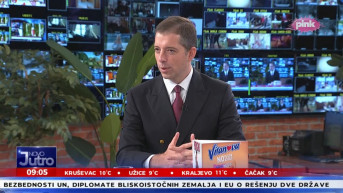
Serbian Foreign Minister Marko Djuric announced today that the Constitutional Court of Kosovo had failed to obtain the necessary two-thirds majority for membership in the European Association of Constitutional Courts, pointing out that the Constitutional Court of Serbia, together with the Government of Serbia, had managed to thwart that intention. Djuric also stated that the vote on the Srebrenica Resolution in the UN was important for Serbia and on the issue of Kosovo, and he commented that the status of Kosovo as an associate member of the NATO PA sent a bad signal that Kurti's regime had been rewarded for the immoral violation of all rights of Serbs in Kosovo.
The Serbian Foreign Minister said for Pink TV that at the end of last week, a session of the European Association of Constitutional Courts had been held, during which the Constitutional Court of Kosovo had attempted to join the membership.
"That initiative was rejected, Serbia managed to prevent Kosovo's membership. This is not insignificant. They tried to push it through quietly, but our teams spoke with constitutional courts across Europe. Kosovo failed to secure the required two-thirds majority," Djuric said.
Speaking about the vote on the Srebrenica Resolution at the UN General Assembly, Djuric said that the 107 countries that in some way sided with Serbia on such a difficult topic add value, indicating that in the future, anyone thinking of going against Serbia would have to think twice.
"This is important for us regarding Kosovo and Metohija because if we managed to gather a majority on such a difficult topic, on the topic of Kosovo and Metohija, they cannot come anywhere near the result of 84 votes for the Resolution, and let me remind you that there are 193 countries with voting rights in the UN. I think all this, despite our struggle, sends a strong signal," Djuric said.
According to him, the Ministry of Foreign Affairs is conducting an analysis and already has a clear picture of how each vote was obtained.
"This is a significant national resource for future cases that shows how to lobby," he said.
Commenting on the fact that the Kosovo Assembly received the status of associate member in the NATO Parliamentary Assembly, Djuric clarified that there was a difference between this and full membership in the Alliance. As he also explained, this status does not entail a legal obligation for other members to intervene militarily.
However, a very bad signal has been sent, the head of Serbian diplomacy emphasizes, noting that in this way, Kurti's regime has been rewarded for the arrest and harassment of dozens of Serbs, the eleven-month ban on Serbian goods, illegal expropriation, the seizure of Serbian churches, and the plundering of banks.
"This is a signal that some countries have begun to replace the doctrine of human rights respect, which supposedly supported this project 25 years ago, with the advancement of Kosovo's sovereignty and independence, and I am not interested in the excuse of the war in Ukraine. The fact is that it is immoral to reward someone who constantly resorts to human rights violations. This damages the already not-so-good image of the alliance in our country, even though Serbia has made efforts to establish the best possible partnership relations with NATO," Djuric said.
He reminded that Kosovo had also lost the opportunity to become a member of the Council of Europe.
"Kurti's regime was sidelined there; for now, it has been shelved, and I don't believe they will be able to try again before next year, and I must remind you that in the past few years, 28 countries have withdrawn their recognition," the head of Serbian diplomacy said.
Commenting on the reactions from Bosnia and Herzegovina regarding Serbia's fight in the UN over the Srebrenica Resolution, Djuric said they also showed that the Resolution had suffered a complete moral and political collapse.
"Serbia can gather a majority in the UN on the toughest issue, and not just in terms of the number of countries, but also in terms of the population in those countries. Therefore, the nervousness in some political circles in Sarajevo is not surprising; Konakovic does not represent the majority of Bosniaks, and I know that most people in Sarajevo and the Federation of Bosnia and Herzegovina want normal relations with Serbia and Belgrade," Djuric said.
As he added, Serbia was helped in its fight in the UN by the radical statements of some politicians because they showed that it was not an attempt to foster memory of the victims and reconciliation but to stigmatize the Serbian side with eternal responsibility.
Commenting on Zoran Milanovic's statement that the Mothers of Srebrenica organization has become a political organization, as well as that what happened in Srebrenica and Jasenovac is not the same, Djuric said it was correct of him to state something that's a fact.
"Milanovic sometimes says something factual and current, and that is to be respected, but it is not to be respected that Serbian officials still cannot lay a flower in Jasenovac, and we are ready to work with them to improve those relations," Djuric said.
He emphasized that, unlike many, the Serbian president had shown respect for all victims on several occasions, having gone to Srebrenica in 2015.
"And now when we hear Konakovic's cynical invitation to come draped in a Serbian flag, it sounds quite threatening. I am sorry about that, we do not want to quarrel, we are in the business of making friends," he emphasized.
The Srebrenica Resolution provided Serbia with an opportunity to bring the truth about the suffering of Serbian victims to light, Djuric said, adding that this is part of the effort to bring this truth to the attention of the international public.
And this is not, as he said, because we are making distinctions among the victims, but to counter those who want to create divisions and sweep Serbian victims under the rug.
As he pointed out, it is a paradox that Serbs, as a nation that lost 1.3 million people in the Great War and more than a million people in the Second World War, which was the only one in Southeast Europe to initiate an anti-fascist uprising in which others participated, should now be labeled as genocidal.
"Serbs contributed the largest number of anti-fascists, even Nedic's government did not have a single unit fighting alongside Hitler, and now we should be labeled as a genocidal nation, equated with the Holocaust and the genocide in Rwanda," he said.
Stating that funds will be allocated every year to propagate a one-sided story about Srebrenica, Djuric said that Serbia's fight does not end.
"Our fight for the truth will not stop, we will have to continually remind people of the truth about these events, and we will also publish a document in which the victims in Bosnia and Herzegovina will be equally represented," he said.
He also mentioned that there were already indications in the UN of certain countries initiating resolutions on various crimes and that Serbia would support them.
Speaking about the role of Montenegro during the vote at the UN, Djuric said that no one was closer than the people from Serbia and Montenegro and that no one would be able to disturb that.
Commenting on the opposition in Serbia, which criticizes the fight of the Serbian president and the delegation in New York, Djuric said that he was shocked at how people did not understand the damage they were causing when someone was against national interests.
"If they acted a little more responsibly, maybe someone would take them more seriously. What irritates me is when I see that they actively work to thwart the efforts of the Serbian government," Djuric said, pointing out that they were now criticizing the humanitarian aid sent to Honduras, emphasizing that Serbia was obliged to allocate 0.7% of its GDP for humanitarian aid as part of the pre-accession negotiations with the EU.
0 comments