
Djuric: Voting on the Resolution a signal to those trying to push Kosovo into the UN
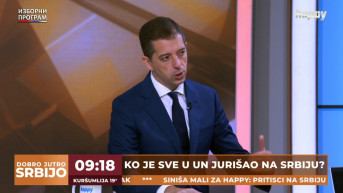
Serbia's Minister of Foreign Affairs, Marko Djuric, emphasized that the additional benefit of voting on the Srebrenica Resolution at the UN General Assembly also related to the issue of Kosovo because, as he explained, Serbia's success in persuading 107 countries to support it on such a difficult topic as genocide sent a signal to those who might try to push Kosovo into the UN that they would face significant resistance.
Djuric stated on Happy TV that this vote was important for the economy and that it would make others think twice before acting against Serbia in the future.
"From this, we gain a kind of lasting benefit. We have raised Serbia's profile in the international community and refreshed and strengthened contacts with many small and island nations. Every country is important to us, and we are making friends, which is crucial for us regarding Kosovo and Metohija, but also for economic matters. We wouldn't have gotten the EXPO, but we won Malaga in Spain, Minnesota in the US, Thailand..." Djuric said.
Commenting on how Kosovo politicians previously claimed that Serbia was lobbying against Kosovo's independence by distributing weapons worldwide, Djuric said that this had not paid off for them, pointing out that 27 states had withdrawn their recognition of Kosovo's independence in recent years.
"They claimed to have 116, 117, but at most, they had 112. Now it has dropped to 82, which is less than half of the UN member states," the Serbian foreign minister said.
As he noted, things are changing and Serbia has strengthened its support through action.
"This is the worst topic that can be presented at the UN, about a terrible war crime that occurred, which no one disputes, where we had to move from a defensive to a more positive position. We explained in detail that it was politically exploited, there was no agreement in Bosnia and Herzegovina, the Dayton Agreement was trampled. This is an attempt to divide Serbs and Bosniaks, to turn the region towards the past, this is an attempt to cause great harm, and UN rules were also violated," Djuric stated.
Speaking about the voting process and the behavior of the co-sponsors before the final vote, Djuric confirmed that some advocates of the Resolution had tried to deceive member states before the vote with false claims that Serbia would vote for the Resolution or at least be neutral, while "putting on a circus" for internal needs.
"But the truth could not have been more different, we went and knocked on the doors of every member, even the co-sponsors, and we had several co-sponsors who did not vote. That shows how much pressure was on countries to vote for the Resolution," he said.
He emphasized that Serbia had organized an unprecedented diplomatic action led by President Aleksandar Vucic as the driving force, involving the entire Ministry of Foreign Affairs and the rest of the Serbian Government.
Commenting on the voting procedure and adoption method, Djuric said it was just one of the tricks used by the proposers to get the Resolution adopted.
"They classified it under the theme 'culture of peace', as a cultural topic, as something on which, since it is not a matter of global security, an absolute majority should not vote, but a simple majority of those present and those who vote 'for' or 'against'. However, I would not rejoice if I were in their place because 5.3 billion people live in countries that do not accept the Resolution," Djuric emphasized.
As he stated, Serbia will continue to work on improving relations with countries in the region and in Europe, noting that European Parliament elections are coming up in early June, as well as elections in some European countries.
Serbia will fight to gain new friends and allies on the European continent, Djuric said, adding that Serbia will act responsibly.
"Maybe we don't like how some countries voted, but that doesn't mean we won't fight for better relations," he said.
Djuric expressed satisfaction that Greece and Cyprus had abstained as representatives of the brotherly Serbian nation despite the enormous pressures they had faced.
He mentioned that they had also talked with Montenegro.
"I'm sorry they didn't support us, but I am convinced that the vast majority of Montenegrin citizens were on our side," he said.
Asked to comment on German Foreign Minister Annalena Baerbock threatening countries with punishment if they do not vote for the Resolution, Djuric emphasized that he would not say anything negative because it would not be in Serbian interests.
"We must speak in our interest, not what is popular. Germany is a significant economic partner for us; we must avoid such things recurring. We all feel bad about how certain co-sponsors, including Germany, behaved," he said.
He noted that the goal of the Resolution had been to label the Serbian people as genocidal and to force Serbia to conduct foreign policy as someone else wished.
Since neither Serbian President Aleksandar Vucic nor the rest of the leadership agrees to this, as the head of Serbian diplomacy said, Serbia will be targeted and labeled as an authoritarian country.
When asked to comment on the statement by Bosnia and Herzegovina's Foreign Minister, Elmedin Konakovic, who said that the adopted Resolution was an opportunity to renew the lawsuit, Djuric said that this statement had greatly helped the Serbian delegation prove and show that the Resolution's goal was neither reconciliation nor respect for victims.
"That statement helped us, we could show everyone that it was not about reconciliation, or respect for victims, but about revenge aimed at stigmatizing the Serbian people. For us and our position, there was no greater gift. Nevertheless, I am very sorry about such a position in Bosnia and Herzegovina because we must be incomparably more responsible in our relations with each other," Djuric said.
As the Serbian foreign minister emphasized, Serbia will strengthen its diplomatic friendly relations with the rest of the world, and as he highlighted, this is extremely important for Serbia regarding Kosovo and issues related to the legacy of the 1990s.
"We have an incredible network of friendships with member countries of the Non-Aligned Movement. Our task is to turn this into a comparative advantage, which will benefit not only Serbia but also the region and the EU," Djuric said.


0 comments