
Djuric from Bled: Serbia is a country of the future, the Balkans must be part of the European Project

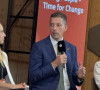
Following his participation at the Bled Strategic Forum, Minister of Foreign Affairs of Serbia Marko Djuric stated that this year’s presentation of Serbia focused on demonstrating that, despite global, regional, and national challenges, Serbia is a country of the future. He added that at the panel “No Region for Youth – Time for Change” he also raised the issue of the position of Serbs in Kosovo and Metohija and the difficulties they are facing at the beginning of the school year.
“Serbia is a dynamically developing country, one that plans its policies far in advance and sees the preservation of stability, independence in both domestic and foreign policy, as well as economic development, as the central pillars of its policies,” Djuric said.
The Minister participated in a panel on the contribution of young people to the transformation of the region and the impact of European integration on whether young people stay in or leave the region.
“It is not a simple topic for us at this moment, as you can imagine, but with a very clear message that in Serbia we are fighting to create greater economic and social mobility for young people. At the same time, a note of honesty from my side—it is essential that Europe, alongside the reforms we are carrying out, embraces Serbia and the Balkans as equal members of its community,” Djuric emphasized.
He warned that if the Balkans are not fully integrated, an opportunity for the region’s development potential will be lost.
“If Europe does not consolidate its core and decision-making mechanisms, and if the Balkans are not fully integrated, the chance will be missed for the region—which has the capacity to perhaps become the driver of the greatest economic growth in Europe—to be a constituent part of the European project,” he underlined.
He added that this would not be a good outcome for the region, but equally that Europe itself must decide “whether it will continue consolidating its internal structures.”
“Europe is faced with the choice of whether it will continue to strengthen its internal structures and give space to countries like Serbia—which in the past 10 years has more than doubled its GDP—or whether it will simply become a kind of theme park where people gladly come as tourists, to see old buildings and enjoy good food, but without much potential for scientific, creative, intellectual, economic, or any other type of growth and development,” the Minister stressed.
Given that the panel was attended by many young people, Djuric said he wanted to send a message that there are no shortcuts to building a strong institutional framework and that it is crucial not to leave space for political forces that wish to manipulate the energy of youth for their own selfish goals, as, unfortunately, has happened in the recent past.
He added that he raised the issue of the position of Serbs in Kosovo and Metohija, including developments concerning the Serb List, and the very difficult circumstances faced by Serbs whose children are starting the school year in the province.
“I spoke about the attack on pupils who, merely for wearing Red Star Belgrade jerseys, had them confiscated by the police, who also treated them in an unacceptable manner. I used this as an example of what Serbs are going through in many places in Kosovo and Metohija at the start of the school year, in the context of youth. Since others prefer to speak of politics and youth in a different context, I want to point out that Serbian students in Kosovska Mitrovica do not have their diplomas recognized in Pristina equally with those of other nationalities, and this is something that very much needs to be addressed,” Djuric underlined.
He also remarked that some participants, both in statements and on panels, spoke a great deal about Serbia—even at panels where Serbian representatives had not been invited or scheduled to take part.
“I believe the best way forward is for us to treat one another with respect, and simply for each to first put their own house in order before seeking flaws in others. Because it is precisely the younger generations in the Balkans who expect us to show far greater responsibility and to build far better cooperation,” he said.
In conclusion, Djuric stressed that Serbia remains committed to dialogue and stability.
“Serbia will continue to be a country committed to both external and internal dialogue, a country that will safeguard stability, and a country that will remain on the course chosen by its people through their legitimate representatives—one which President Vucic has managed to materialize for all of us in the past decade, more than doubling GDP, as I mentioned. Serbia will continue to be the engine of growth and development of the Balkans,” Djuric concluded.

comments