
Djuric: The endangerment of Serb rights is a stain on the international presence in Kosovo
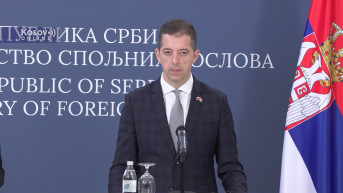
Since Albin Kurti's rise to power in Pristina, the Serbs in Kosovo have been experiencing the most difficult moments in the last two and a half decades, and the endangerment of the human and political rights of the Serbian community is a stain on the reputation of the international actors present in Kosovo, Serbian Minister of Foreign Affairs Marko Djuric emphasized in an interview with "Frankfurtske Vesti."
"Serbia will continue, on the firm foundations of international law, to fight for the protection of its state and national interests through all available political and diplomatic means. Since Albin Kurti's assumption of leadership in the provisional self-government institutions in Pristina, the Serbian people have been going through the most challenging times in the past two and a half decades. The violation of the human and political rights of Serbs in Kosovo and Metohija is not only evidence of Kurti’s regressive ethno-nationalist agenda but also a stain on the reputation of the international actors present in our southern province, as they have failed to implement all measures available to deter Pristina from its unilateral, aggressive, and fundamentally anti-European actions," Djuric stressed.
He highlighted that Serbs in Kosovo are resilient people, determined to defend their right to exist, but he underscored the disgrace of one group in contemporary Europe being subjected to such challenges.
"Serbia will continue to fight for its people in the southern province both domestically and internationally because what has so far been a key national and identity issue for us has also become a humanitarian problem. We will do everything necessary to help our citizens and compatriots persevere in these difficult times," the minister announced.
Djuric pointed out that Serbia conducts its international relations as a credible partner, with representatives who do not say one thing publicly and another in closed meetings.
"We have successfully established ourselves as an international actor with whom interlocutors may not always agree but whom they can trust. Serbia is a politically independent country, and as such, it has the legitimate right to advocate for its interests in the international arena. Lately, we have been articulating our interests more effectively, and our voice is increasingly heard. This progress is also due to the personal and professional reputation President Aleksandar Vucic has built on the international stage," Djuric explained.
When asked whether and how it is possible to change the stance of countries that have recognized Kosovo's independence, he emphasized that nearly 30 countries withdrawing their recognition of Kosovo’s unilaterally declared independence proves that the matter is far from settled.
"Even among the recognizers, there are countries we classify as passive recognizers, which are countries that have formally recognized the self-declared 'Kosovo' but have not established diplomatic relations or vote in favor of Pristina in international forums. For years, Serbia has steadfastly defended its positions by invoking international law, and this persistence has paid off. Serbian diplomacy, working bilaterally with numerous states, is largely responsible for this outcome, as are many unsung heroes of the struggle to preserve Serbia’s territorial integrity and sovereignty," Djuric noted.
Regarding whether the return of Donald Trump is good or bad news for Serbia, the minister responded that Serbian political structures and diplomacy have, for years, been building a strategic dialogue with the US and a network of interlocutors ready to hear our arguments and share a vision of a modern, prosperous Serbia – a future pillar of stability and economic development in the Western Balkans.
"We have continuous and productive cooperation with people in Trump’s immediate circle, and I am confident that this cooperation will continue. There is potential to elevate Serbian-American relations to the highest level in history during Trump’s presidency. However, we should temper expectations that US policy toward Serbia will undergo any rapid or radical changes. We will build our relations patiently, step by step, as reliable partners," Djuric stated.
The Serbian Minister of Foreign Affairs, speaking about the year 2024, stated that it was marked by numerous political challenges stemming from the increasingly complex global political and economic situation.
"Despite everything, Serbia has managed to maintain internal stability and achieve one of the highest economic growth rates in Europe. This was not by chance but the result of hard work and responsible strategic planning by Serbia’s president and government. We have largely shielded ourselves from the tectonic shifts fundamentally altering geopolitical relationships, with significant contributions from the Ministry of Foreign Affairs," Djuric added.
When asked what he would particularly highlight as the main challenges and successes of Serbian diplomacy in 2024, he said that the key success was that Serbia managed to resist pressures to deviate from the path of conducting independent domestic and foreign policy and to avoid being directly instrumentalized in an ongoing uncertain geopolitical struggle.
“Serbia and its diplomacy have demonstrated that they possess a much greater foreign policy capacity than what was attributed to us. This was evident in the fact that in 2024, Pristina did not achieve significant successes on the international stage and in the fact that a large part of humanity opposed the stigmatization of Serbia and the Serbian people concerning the UN General Assembly resolution on Srebrenica. It is important to emphasize that we have transitioned from a period of reactive foreign policy into a phase of proactive engagement, which is best seen in the new substance given to traditionally good relations with African and Far East countries, primarily with China as a growing economic and political superpower. Serbia is increasingly positioning itself as an effective and reliable bridge between what is described in modern political terminology as the Global North and the Global South,” Djuric explained.
When asked how major global issues reflect on small countries like Serbia, he pointed out that we live in a time when, out of fear of what lies ahead, states are forming coalitions and blocks, which, he expressed concern, complicates the possibility of de-escalation.
“Serbia has paid a high price in history for major global and regional conflicts, and our people have more than once been brought to the brink of biological survival. Our undeniable interest is that this time, as much as possible, we remain on the sidelines of conflicts between major powers and, by pursuing an independent policy and maintaining military neutrality, reduce the economic and technological gap between us and the most developed European countries. Of course, we cannot be entirely immune to what is happening around us, but this time we will not be an actor of destabilization in international relations. Instead, we will be a country that is in every way ready to contribute to the building of peaceful international cooperation,” Djuric said.
When asked what the key goals of Serbian diplomacy will be in 2025, he announced that Serbian diplomacy will continue to focus on the protection of key state and national interests, with the foremost being the protection of our territorial integrity and sovereignty.
Next year, he reminded, the world will mark the 80th anniversary of the founding of the United Nations, and this will, in his opinion, be an opportunity for Serbia, either independently or in cooperation with international partners who share our values, to participate in efforts to breathe new life into the principles on which the global order, as outlined in the UN Charter, is based.
“This will also be an opportunity to revisit the arguments with which Serbia defends its interests regarding Kosovo and Metohija. We will also continue to make significant strides in the process of European integration, which is our key foreign policy goal, as well as in easing tensions and enriching cooperation with our immediate neighbors. A proactive and constructive regional policy is not only an important segment of our broader European policy but also a prerequisite for Serbia's stability and continued economic development. Next year will, I hope, also be an opportunity for us to make substantial progress in reforming and rejuvenating Serbian diplomacy, as this is an important functional goal and a prerequisite for addressing all the upcoming challenges with adequate human resources. Part of this process includes the expansion of the diplomatic-consular network,” Djuric emphasized.
The next year, he believes, will perhaps be the most challenging in modern human history.
“If serious regional conflicts and tensions do not start moving toward peaceful resolution, tensions in international relations will reach a boiling point, which will inevitably present new challenges for Serbia as well. However, Serbia has a president and a government that think strategically years in advance, and our country will do everything possible to preserve the peace, stability, and developmental momentum that we have all witnessed in recent years. Our peaceful policy of fostering friendships and partnerships around the world will also be tested in this grim scenario, as the process of geopolitical polarization intensifies. The world is at a crossroads, but Serbia will be ready for any development in international relations,” Minister Djuric concluded.
0 comments