
Djuric: Kosovo is an inseparable part of Serbia; sustainable solution possible only through willingness to compromise
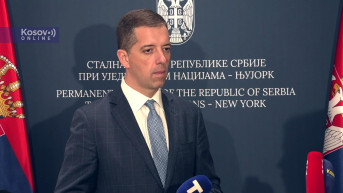
Serbian Foreign Minister Marko Djuric stated that Kosovo is an inseparable part of Serbia’s territory, and finding a lasting and sustainable solution is only possible through open and constructive dialogue and a willingness to compromise, as reported by Greek Kathimerini.
He said that Serbia will be ready for full EU membership by the end of 2026 and thanked Greece for being one of the most consistent advocates for EU enlargement to the Western Balkans.
“Normalizing relations between Belgrade and Pristina and finding a lasting and sustainable solution to the issue of Kosovo and Metohija is a process that can yield concrete results only if solutions are sought through open and constructive dialogue and a readiness to compromise. For Serbia, the southern province of Kosovo and Metohija is an inseparable part of our territory. However, this does not mean that Belgrade and Pristina, despite their disagreement on this fundamental issue, cannot agree on matters of common interest, work to overcome a history of conflict, and create a better social, political, and economic environment for the benefit of all citizens,” Djuric said.
He added that the Kosovo issue is not only a permanent political challenge but also a security challenge.
“The issue of Kosovo and Metohija is a complex international legal matter, in addition to being a constant political and security challenge. This cannot be resolved without dialogue, contrary to the approach envisioned by Albin Kurti and his like-minded associates in Pristina. In recent months, Kurti has explicitly rejected dialogue and everything he has agreed to, such as the formation of the Community of Serb Municipalities. He is demonstrating force in an attempt to create a new reality on the ground. Such a stance is detrimental not only to the people of Kosovo and Metohija but also to the region, which is, at this moment, effectively held hostage by Pristina's regressive ethnonationalist policies,” Djuric emphasized.
He reiterated Serbia’s clear ambition to be ready for EU membership by the end of 2026.
“Serbia has a clear ambition to fully complete its reform agenda by the end of 2026 and be ready for full EU membership. However, unresolved issues such as Kosovo and Metohija and the need for EU member states to establish a strong and long-term strategic consensus on the future of enlargement remain obstacles on this path,” Djuric said.
He highlighted Serbia’s role as a reliable guarantor of regional stability and a potential driver of economic development in the region. On the broader geopolitical front, he noted that enhancing relations with the United States and transforming them into a true strategic partnership is one of Serbia’s foreign policy priorities.
“With President Donald Trump’s administration, we have had very active communication on this topic, and I view the future of Serbian-American relations with great optimism. I hope that the new administration in the White House, once formally inaugurated, will take concrete steps to bring the war in Ukraine to an end. It is in everyone’s interest to de-escalate regional crises so the world can return to dialogue, productive cooperation, and mutual progress,” Djuric said.
Speaking about the relations between Serbia and Greece, Djuric emphasized that the two countries have a long tradition of friendly relations, based on the cultural and historical closeness and solidarity of the two peoples and that Greece is today one of the EU countries with which Serbia has the closest relations. As he said, this is a result not only of the mentioned traditional closeness but also of the fact that our countries respect international law and mutually support each other on issues of the highest state and national interest.
“Serbia is also a great friend and a brotherly state to Cyprus. We are open to participating with Greece in trilateral and quadrilateral formats to address issues of common interest in a coordinated manner. It is very important for us that Greece, as a friend of Serbia, continues to show understanding regarding the southern Serbian province of Kosovo and Metohija, which is a key national and state issue for us,” Djuric said.
Speaking about Turkey's role in the Balkans, he emphasizes that the country recognized the unilaterally declared independence of Kosovo and that on this issue, we have fundamentally different views. However, as he said, Turkey is a regional power, a country with a young population and great economic potential, and as such, it is an important and indispensable political factor in this part of the world.
“Some of our citizens of Islamic faith have cultural and religious ties to Turkey, serving as an important bridge of cooperation between our two countries. Serbia has an interest in maintaining stable and high-quality political and economic relations with Turkey. As long as Turkey constructively serves as a geographic, political, and energy bridge between Europe and Asia, and as long as its political and economic presence in the Balkans contributes to stability rather than destabilization, we will have real grounds and interests to continue improving bilateral cooperation,” Djuric concluded.


0 comments