
Djuric: Important message sent that a government carrying out violence against Serbs will not be admitted to the Council of Europe
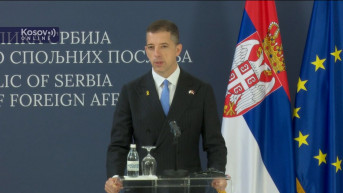
Serbian Foreign Minister Marko Djuric stated that it is very important that Kosovo did not become a member of the Council of Europe at the recent meeting of the Committee of Ministers of the Council of Europe in Chișinău, because this sent a message that a government carrying out violence against Serbs will not be admitted to that organization.
“For us, it is extremely important to protect national interests regarding Kosovo and Metohija, especially under circumstances in which a policy of discrimination and exclusion of Serbs from social and institutional life in Kosovo and Metohija is being implemented. Particularly in such circumstances, it is important to send a message that a government carrying out violence against Serbs will not be admitted to the Council of Europe, and that message has been sent,” Djuric told TV Prva.
He stated that the fact Kosovo did not become a member of the Council of Europe is even more significant considering that two-thirds of the member states of that organization have recognized the “so-called independence of Kosovo” and that certain countries at the meeting in Chișinău called for Pristina’s membership.
“It is our belief, alongside our firm position on the inviolability of Serbia’s territorial integrity, that the prerequisites for such a move have not been met, above all those relating to the establishment of the Community of Serb-majority Municipalities, and the inclusion of Serbs in institutions at various levels. Not only have they not been met, but the government of Albin Kurti is moving in the opposite direction, as yesterday Serbs in Kosovo and Metohija were detained solely because of political unsuitability, due to pressures on the eve of the extraordinary parliamentary elections,” Djuric emphasized.
He also underlined the importance of the message from Serbian Interior Minister Ivica Dacic that all those who participated in yesterday’s arrests would be prosecuted and sanctioned in accordance with Serbian law.
“People within the so-called Kosovo institutions who participate in massive and serious violations of the human rights of non-majority communities should know that the Republic of Serbia is keeping its eyes open. We are carefully monitoring the situation, and they can expect reactions from our prosecutors’ offices, courts, and police authorities. Concern for people is the common thread running through our policy, because when we insist that Pristina should not become a member of the Council of Europe under these circumstances, we are caring for our people in Kosovo and Metohija, just as the state does when it increases allocations for our people through the work of the Office for Kosovo and Metohija,” Minister Djuric pointed out.
He conveyed that he had spoken with the Director of the Office for Kosovo and Metohija, Petar Petkovic, who is constantly in contact with representatives of Serbian institutions in Kosovo, and added that the state increases its allocations year after year, which, he said, is the reason why, despite the repression of Albin Kurti, the Serbian people remain and endure.
Responding to remarks about the constant attacks on Serbian education and healthcare institutions in Kosovo, Djuric said this was undoubtedly true, but that he had no doubt Serbs in the area would survive and continue functioning, because that is the firm determination of both the Serbian state and society as a whole.
“If, in this polarized moment, there is one thing we all agree on, it is that we must help our people in Kosovo and Metohija, and that is exactly what we are doing,” Djuric said.
The minister said it is not only exhausting and unpleasant to hear certain countries argue that problems would be easier to solve if Kosovo and Kurti’s government became members of the Council of Europe — although that certainly is the case — but that it is also not easy to work with countries that have key influence and build a case strong enough to convince them that, if nothing else, such a move at this moment could only cause harm.
“However, in this specific case, it helped that Serbia has built a significantly higher level of understanding with certain European countries, thanks to the efforts of everyone involved in the country’s diplomatic activities. If President Aleksandar Vucic speaks dozens of times in a single year with the President of France, and then that country shows greater understanding for Serbia on the issue of Kosovo and Metohija, then that is no coincidence. That is one example, but fortunately there are more,” Djuric stated clearly.
The head of Serbian diplomacy stressed that it is important to preserve Serbia’s complex geopolitical position, which allows the country to boast that it is the only country in Europe to have both a Free Trade Agreement with the EU, access to the Eurasian bloc, and a Free Trade Agreement with China, which he described as a generational opportunity.
“We continue to work further. During my visit to Israel we agreed to accelerate work on a free trade agreement, while during my recent visit to Uzbekistan we agreed to conclude such an agreement as well. Uzbekistan is a country that has attracted 42 billion dollars in foreign investment and sees Serbia as a strategic partner because of its independent foreign policy, geographical position, and respect for the principles of international law. There are different ways to safeguard the standard of living, security, and stability of a country, and Serbian diplomacy, through its network of embassies and diplomatic activities, creates a favorable environment for Serbia’s development,” Djuric said.
Recalling that 28 countries have withdrawn recognition over the past ten years, while four or five states have recognized Kosovo’s independence, Djuric stressed that international circumstances are moving in favor of Serbia’s arguments.
“The inviolability of borders is the only guarantee of global stability at a time when the world is increasingly moving toward multipolarity. Serbia has more and more allies on this issue,” Djuric underlined.
He also assessed as powerful the statement by his Czech counterpart, who publicly said that the decision of previous Czech governments to recognize Kosovo had been wrong, and went a step further by saying that Kosovo is a Serbian, not an international, issue. He recalled that this was also confirmed by a representative of the Czech parliament just a few days later during a visit to Serbia.
“We have clearly recognized these messages,” Minister Djuric emphasized.
The Serbian foreign minister also said that a new generation of leaders is emerging even among the “hardest-line recognizers,” who no longer share the earlier enthusiasm regarding Kosovo.
“But we should have no illusions. The situation on the ground is what it is. We do not want to use inappropriate methods to exert pressure, but we do want to protect what is ours. The Serbian Church and monasteries functioned and survived for centuries, even during Ottoman times, and now we have a situation in which the movement of Serbian clergy is being restricted, including that of the Serbian Patriarch. That is unacceptable and something the international community must be informed about in detail. We care for Serbian holy sites through the struggle for truth as well,” Djuric explained.
Regarding the upcoming elections in Kosovo, he said he was not worried because he has firm confidence in the Serbs in Kosovo.
“I spent eight and a half years of my life working in Kosovo and Metohija and with our people there. I know how important it is for them to preserve the umbilical cord connecting them with mother Serbia. People know very well that, when it comes to political orientation toward institutions in which Albanians are the majority, and with increasingly radical groups associated with Kurti, there is no room for division. The divisions are orchestrated. Kurti is trying to divide the Serbs, which is why we have certain Serbian lists that he promotes. It is extremely important that Serbs win all 10 mandates and are not imposed with someone who is Kurti’s puppet,” Djuric stressed.
He called on Serbs to turn out in as large a number as possible and support the preservation of economic, institutional, and overall ties with Serbia.
He said they should be proud that, through the Serb List, they had created a “hard nut to crack” that even the aggressive policies of Albin Kurti had failed to break.
Djuric added that the survival of the Serbian people in Kosovo also depends on how stable Serbia itself is, which is why it is important to preserve stability in Belgrade and maintain focus on positive developments that make a difference, such as economic growth and development.
“We must weigh very carefully what we do in the coming months, not only in Kosovo and Metohija, but also in central Serbia,” Djuric added.
He also stressed that Serbia, thanks to President Vucic having recognized the symptoms of the global crisis early on, had managed to preserve energy security, fuel availability, and stable prices, despite the fact that the Serbian oil company is under sanctions.
Regarding the European Union, Djuric emphasized that Serbia is making significant efforts to improve its position on the European path. He recalled that he visited Brussels last week and that President Vucic had an important conversation with Ursula von der Leyen, all of which were important talks aimed at positioning Serbia on its European path.
“The initiative launched with Albania, for our countries to join the Schengen area as soon as possible, is important because it shows that we advocate for a region of cooperation, without tensions and borders. If we look at the essence of our message, it is oriented toward cooperation. We are aware that we have eight neighbors and that our stability and peace depend on relations with them. We will continue to develop good neighborly cooperation with everyone. That is the central point of our foreign policy,” Minister Djuric underlined.
He pointed out that the situation in the world will not become any simpler and that, under such circumstances, countries like Serbia are building networks of friendships that make them stronger.
“That is why we strive to be present everywhere. We have managed to achieve a certain level of respect for our country in the international arena, leading to a situation where the Chinese president, after meeting with the American and then the Russian president, also hosts the President of Serbia. That is an expression of respect both toward the President of Serbia and toward our country. That visit is also an additional opportunity to profile Serbia as a bridge between civilizations. I am convinced that mutual support for territorial integrity and sovereignty will be reaffirmed,” Djuric said, recalling that China is a permanent member of the UN Security Council.
He announced that at the same time President Vucic is visiting China, he himself will hold talks at the UN with his Chinese counterpart.
Before that, he said, he would carry out an important visit to Canada, something Serbia has not had in several decades.
Regarding EU funds, Djuric said Serbia is grateful to European taxpayers for the vision of investing money in the Western Balkans region.
He recalled that there had been numerous political games and public manipulations concerning the alleged decision by Brussels to freeze funds, adding that certain officials had tried to use that to “direct” Serbian public opinion.
“Thanks to the strength of its economy, Serbia has managed to triple its GDP. European funds are very welcome, but it is far from the case that we cannot stand on our own feet. This topic should not be manipulated,” Djuric said.
0 comments