
Djuric: Kosovo will not become a member of the Council of Europe today
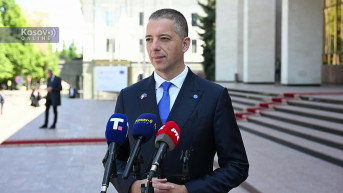
Serbian Foreign Minister Marko Djuric addressed the press from Chisinau, where he is participating in the 135th ministerial meeting of the Council of Europe Committee of Ministers, saying that he brings good news from friendly Moldova that Kosovo will not become a member of the Council of Europe today and that the principle of territorial integrity and sovereignty will prevail.
“Kosovo will not become a member of the Council of Europe today. The principle of territorial integrity and sovereignty in this hall behind us will prevail today. It is very important that the voice of Serbia will be heard clearly, unambiguously, and in full capacity, a voice that equally recognizes the territorial integrity and sovereignty of all European countries. The Council of Europe is an organization based on the need to preserve peace, stability, but also territorial integrity,” he said.
He stressed that the discussion on this topic was difficult and intense.
“Some European ministers openly called for Pristina’s membership in this important organization and, although Kosovo will not become a member of the Council of Europe today, the danger has not been eliminated. In this organization, two-thirds of countries recognize Kosovo’s unilaterally declared independence, and there is generally a majority here that can, when it decides it wants to, admit so-called Kosovo into its membership. However, at a time when the rights of Serbs and other non-majority communities are being violated in our southern province, when there is a prolonged crisis marked, among other things, by the exclusion of Serbs from the government and other segments of public life, there are strong pressures, and I said on behalf of Serbia that the government sitting at this table is systematically violating the political, collective, cultural, and all other rights of Serbs in Kosovo and Metohija, and that is the government of Albin Kurti today,” he said.
He said he emphasized Serbia’s responsible approach, which seeks dialogue, normalization of relations, reconciliation in the region, and a European future for the entire region.
“We cannot influence the past, but we can influence the future, which should be European for both Serbs and Albanians in Kosovo and Metohija. I called for the fastest possible admission of the region to the EU, because many problems would be solved in that way, especially if we were to establish Schengen borders, so that people could travel and work freely. That would increase security in Southeast Europe. I think we have a strong and solid case. I tried to be diplomatic when it comes to countries that themselves recently had problems with territorial integrity and sovereignty. It is one country that has territory in the Arctic Circle and that recognizes Kosovo. I reminded them that we support their territorial integrity, although they apparently do not support ours. But we must not forget that the principle must apply to everyone. If they do not protect Serbia, they will not be able to protect themselves either,” he said.
When asked how Kosovo’s application for membership in the Council of Europe ended up on the agenda at all, even though it was not planned, Marko Djuric said that a number of European ministers raised the issue of Pristina’s membership in the Council of Europe.
“Fortunately, there is no majority for such a thing today. That is good news from Chisinau. Our delegation presented detailed arguments and pointed to the position of our people. We raised our voice in a well-argued manner in terms of the rights on which the Council of Europe was founded. This hall is not the place for governments like the one in Pristina, which have shown through their actions that they do not respect the statutes of the Council of Europe,” he said.
He added that he had a very constructive and notable session on migration, which is the most important political issue for most European countries.
“I participated in a meeting led by the British Foreign Secretary and the Belgian minister, with the participation of our Czech friend, Mr. Macinka, and several other ministers. Serbia has something to be proud of, because we have received millions of migrants across our territory. More than 700,000 Ukrainian citizens have passed through our territory, and many have stayed. We are talking about more than 200,000 Ukrainian and Russian citizens who are temporarily staying in our territory. We opened our doors, our hearts, and our country to them. So far, we have granted around 400,000 citizenships to refugees from the former Yugoslavia, people who were expelled from their homes. We still have 230,000 internally displaced persons from Kosovo and Metohija, and I spoke about that. I also said that Kosovo and Metohija has one of the lowest return rates in Europe,” he said.
As he said, he had an excellent conversation with the Georgian foreign minister, and they also discussed the upcoming visit of President Aleksandar Vucic.
“That is a country close to us that supports us in everything, including the issue of Kosovo and Metohija, and we recently established flights to Tbilisi, which are very popular. Economic cooperation is growing, and we share similar views on many issues. I also had a good conversation with the Ukrainian foreign minister. I thanked him for the fact that his country supports our territorial integrity and sovereignty, just as we do in their case and everywhere where that principle applies. I also had meetings with a number of other ministers from the wider region. We will continue working on that,” Djuric concluded.
Moldova has chaired the Council of Europe Committee of Ministers since November last year, and this year’s session was held under the slogan “For a Europe of peace and resilience.”
Moldova is concluding its six-month presidency with this meeting, which will be taken over by Monaco.
0 comments