
Djuric: Kosovo has not become, and will not become, a member of the Council of Europe today
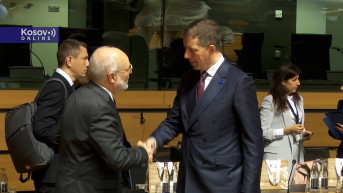
Serbian Foreign Minister Marko Djuric attended today’s meeting of the Committee of Ministers of the Council of Europe, from where he stated that the most important news is that Kosovo has not become and will not become a member of the Council of Europe.
Kosovo was not on the agenda of today’s meeting of the Committee of Ministers, and Djuric emphasized that he had warned about how Serbia had been admitted to that international organization.
“The most important news for the citizens of Serbia is that Kosovo and Metohija, our southern province, has not become and will not become a member of the Council of Europe today. In my address before the Committee of Ministers, I pointed out that, as we mark important anniversaries of both the UN Charter and the Council of Europe, we must not forget that Serbia was admitted 22 years ago as a democratic state that embraced the principles of democracy and international law, and was accepted into the Council of Europe within its UN-recognized borders,” Djuric said.
He stressed that Serbia is a country that firmly upholds the principles of international law.
“We stand for democratic principles, not ethnocratic or ethno-nationalist ones. In that sense, being fully honest with our citizens, it is significant that the Quint countries were the ones who did not support having Kosovo’s membership included on the agenda. Citizens should also know that Kosovo’s membership was blocked last year thanks to Serbia’s diplomatic efforts, primarily through President Vucic’s high-level diplomatic engagements with European leaders during that period,” the Serbian Foreign Minister said.
As he added, Prime Minister Kurti’s regime, unfortunately, continued over the past year to violate the collective rights of Serbs, which was clearly taken into account by member states.
“Unfortunately, more than two-thirds of Council of Europe member states recognized the independence of Kosovo and Metohija shortly after its declaration. This is one of the organizations where we generally do not have majority support for our positions. However, it was important that again this year Serbia’s position prevailed here. Also crucial is the continuous engagement of our parliamentarians with their colleagues in the Parliamentary Assembly of the Council of Europe. But I repeat, last year’s top-level diplomatic activity by President Vucic, our efforts, and those of our parliamentarians have once again produced results,” Djuric stated.
He also addressed the fact that the meeting in Luxembourg included significant discussion about the situation in Ukraine.
“Serbia has, of course, supported the principle of Ukraine’s territorial integrity and sovereignty, just as we support the sovereignty and territorial integrity of all states. At the same time, we distanced ourselves from certain other decisions concerning the establishment of tribunals and courts in that area, following our national interest. I also want to emphasize that the meeting included remarks from the representative of Bosnia and Herzegovina, who tried to portray a black-and-white picture that, I would say, likely does not reflect the unanimous views of all actors within Bosnia and Herzegovina. I wanted and was able to state that Serbia strongly supports the Dayton Peace Agreement, supports internal and democratic dialogue with all democratically elected leaders within Bosnia and Herzegovina, and that we reject the black-and-white narrative being insinuated, one that harms Republika Srpska and its democratically elected representatives,” the Minister said.
He emphasized that Serbia’s delegation had presented a comprehensive view on many topics.
“I have now spoken about the topics that are politically most important for us, but when it comes to global issues, we have supported the strategic goals of the Council of Europe, and we can say with our heads held high that we truly stand behind the values on which the Council of Europe was established immediately after World War II. Therefore, we seriously adhere to the principles of territorial integrity and the UN Charter and hold democratic values dear. We do not interfere in the internal affairs of other states. This has been supported and appreciated by some, and not by others, but I believe that this most aligns with our national interests,” Djuric said.
When asked whether he expects pressures for Kosovo's entry into the Council of Europe to continue, as well as what the topics of his discussions with the foreign ministers of Hungary, Georgia, and other countries were, Djuric reminded that Serbia had become a part of the Council of Europe with Kosovo.
“In my view, loyalty to Serbia means loyalty to the truth. And the truth is that 22 years ago, Serbia became a member of this organization within its borders, which you can see on this pin, including Kosovo and Metohija, and that we became a member as a democratic state. It is unacceptable for the borders of a democratic state, or any state, to be arbitrarily redrawn in violation of the UN Charter. This is the principle we stand behind, even though two-thirds, and more than two-thirds, of member states support the independence of Kosovo and Metohija. This is the principle that prevailed. Therefore, Pristina will not become a member of the Council of Europe today. This is the result, as I mentioned, of President Vucic's diplomatic activities at the highest level last year, our activities, and our parliamentarians in the Parliamentary Assembly of the Council of Europe,” Djuric emphasized.
Regarding talks with representatives of other countries, he reflected on meetings with representatives of Georgia and Hungary, which were friendly.
“We also spoke with representatives of our friendly country, Georgia, with the new foreign minister. Good news for the citizens of Serbia is that, starting from June 25, if I’m not mistaken, direct flights between Belgrade and Tbilisi will start, and I hope that in the next few months we will open our diplomatic-consular mission in Tbilisi. Georgia today has an economic growth rate of over 6 percent, it is completely friendly to us, supports us on Kosovo, and we have similar challenges. I look forward to advancing cooperation with Georgia. Today, I am meeting here with Mr. Szijjarto. Our friends, neighbors, and brothers, the Hungarians, are a country with whom we are working on the development of new energy capacities, new gas pipelines, and expanding border crossings, to ensure faster and easier movement of people. At the same time, we are very grateful to Hungary for its support here in the Council of Europe and everywhere else, and it is always a pleasure to talk with Mr. Szijjarto,” the Serbian Foreign Minister concluded.
0 comments