
Djuric: Kurti does not want Serbs to regain control over institutions in northern Kosovo
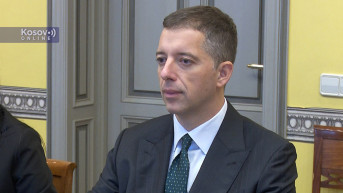
Albin Kurti does not want Serbs in the local elections to regain control over institutions in northern Kosovo, nor to maintain control in six Serb-majority municipalities south of the Ibar River, Serbian Foreign Minister Marko Djuric warned today, in reference to the CEC’s decisions on the allocation of seats in polling boards for the October 12 local elections and on the number of voters in Serb-majority municipalities, as highlighted by the Serb List. He therefore reiterated the importance of Serbs turning out for the local elections and remaining united around the Serb List.
Djuric told TV Prva that Kurti and his regime have, for three years now, attempted in the worst manner of apartheid—unbecoming of the 21st century—to marginalize and suppress Serbs politically and in terms of security. This is evident, he said, from the dozens of political prisoners in Kosovo, who lack access to valid and transparent judicial proceedings, as well as from the unilateral shutdown of 125–130 Serbian institutions in Kosovo.
“In the context of elections, it is clear that Albin Kurti does not want Serbs to regain control over institutions in northern Kosovo, nor to maintain control in the six Serb-majority municipalities south of the Ibar. He does not want Serbs to be part of the government in the way envisaged by the so-called Constitution of Kosovo, which provides that the largest Serb party nominates ministers and other officials. Kurti wants to prevent all this and to deter Serbs from going to the polls. That is why Serbs must turn out and remain united around the Serb List, because that political organization—precisely due to its ties with Serbia in terms of political dialogue and coordination—is a thorn in Kurti’s side. For that reason, they seek to brand it as a terrorist and aggressor organization,” Djuric said.
He also recalled the statement of Kosovo’s Justice Minister Albulena Haxhiu, who said that banning the Serb List from the elections was a “triumph of democracy,” asking rhetorically whether anyone could imagine an official in 21st-century Europe publicly celebrating the fact that a political organization representing an entire national community had been barred from elections as a “triumph.”
“We have fully exploited that statement in our talks with various interlocutors, especially in Europe. Their response has not been favorable toward Kurti. That is why I said that the decision to ban the Serb List will not stand,” Djuric said.
Commenting on reports that the EU is suspending contact with Kurti until a new government is formed in Pristina, the minister said such a position can only be welcomed, because Kurti’s regime has shown nothing that would align it with 21st-century Europe.
“This is a regime that focuses partly on ethno-nationalism, partly on social demagoguery, and it certainly does not contribute to stabilizing the situation in the region. Through constant provocations and the devising of new hostilities against one national community, as well as against nearly all non-majority communities in Kosovo, it actually blocks normalization of relations in the region,” Djuric said.
Military Alliances in the Region Do Not Contribute to Building Trust or Cooperation
Djuric also pointed out that recent military alliances in the region do not foster trust or cooperation, but instead aim to exert pressure on Serbia. He stressed that, in the absence of transparency, agreements, and adherence to regional arms-control principles, Serbia is obliged to sound the alarm.
“When agreements on such serious matters are made without consultation, and when certain countries are excluded—not only ours—it is a cause for concern,” he emphasized. He reminded that there are numerous mechanisms for security consultations in the region, raising the essential question of why some are resorting to such measures.
“No one is naive. This is a not-so-subtle form of political pressure. My message is that such steps do not help build trust or cooperation,” he underlined.
Djuric said that the true purpose of these military alliances is to pressure Serbia.
“The answer to this is a strong Serbia, stable, pursuing a mature, responsible, and peaceful policy, and capable of defending itself,” he stated.
He recalled that on September 20 a clear demonstration will be given that Serbia is capable of ensuring the security of its own territory and deterring anyone who might act to destabilize the region.
“Serbia is committed to cooperation and maintains extensive partnerships with many states. We have never said that we will not cooperate with neighboring countries, but we expect others to engage in consultations in a spirit of good neighborliness. Anything else creates room for insecurity,” Djuric said, noting that because of the region’s past, all actors must be especially careful with such matters.
The minister added that by “sounding the alarm” he does not wish to stir up tensions, but as foreign minister it is his duty to ensure a safe, peaceful, and friendly environment for Serbia, where open issues are resolved through dialogue and misunderstandings are smoothed over, if they exist.
“But there is a need to alert the public to what is happening. We will continue our diplomatic activities and efforts to make such actions transparent,” Djuric said, recalling that Serbian President Aleksandar Vucic had also announced he would discuss all these developments with world leaders and the NATO Secretary-General—not to cast the region in a negative light, but to send a message that Serbia expects a more open environment for cooperation.
Speaking about the recent visit of the Serbian President to China, Djuric said the trip had been very positive, which was no surprise, given that China is one of Serbia’s most important strategic partners.
He added that Serbia’s particular comparative advantage lies in being the only country on the European continent to have an active Free Trade Agreement with China.
Reflecting on his recent visits to the United States, Japan, and Africa, Djuric said he strives to strengthen Serbia’s position wherever possible.
He repeated that in the U.S. he had an excellent meeting with U.S. Secretary of State Mark Rubio.
“This is an important step in our relations, one we had waited for many years and worked long and hard to prepare. It strengthens Serbia’s position in the U.S. for all citizens, regardless of political orientation, because through strategic dialogue with the U.S. we have been classified in a different way in their nomenclature,” Djuric said.
He added that at the same time Serbia’s foreign policy is achieving extensive cooperation in other parts of the world as well, noting his visits to Japan, African countries, his attendance at the Bled Forum, and his visit to Spain.
“The visit to Spain was exceptionally important, since Spain is one of Serbia’s key partners in the EU, a country that does not recognize Kosovo’s unilaterally declared independence. We have excellent economic relations, but there is potential for much more,” Minister Djuric concluded.


0 comments