
Djuric: Pristina's activity in the international arena has been almost completely halted
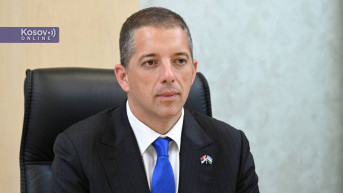
Serbian Foreign Minister Marko Djuric stated today that the "battle for Kosovo and Metohija is constant" and stressed that Pristina's activity in the international arena has been almost completely halted, RTV reported.
Djuric said that Pristina's activity in the international arena has been "almost completely halted, although the prime minister of the provisional institutions in Pristina, Albin Kurti, is achieving certain gains on the ground through force."
"We can see that, when it comes to the European Union, he (Albin Kurti) has effectively been under some form of measures for years, that the United States suspended its strategic dialogue with Pristina, and that regarding the wave of recognitions, which at one time brought dozens of new recognitions annually, their record over the past 10 years has not been favorable at all," Djuric said, as reported by RTV.
The head of Serbian diplomacy said that the greatest achievement of Serbian diplomacy is that it has maintained excellent relations with all key actors in the international community, both in the West and in the East, adding that in this field President of Serbia Aleksandar Vucic has stood out compared with other heads of state.
"That is something many people will not tell you publicly, but behind closed doors, despite all the challenges we face, it is a subject of respect and, if you will, even a bit of envy," Djuric said on TV Prva.
He pointed out that Serbia is a militarily neutral country, but not a value-neutral one, stressing that Serbian policy is based on clearly defined values contained in the Charter of the United Nations.
"Let us not forget that we inherit the tradition of the founders of the United Nations, although unfortunately our continuity was interrupted in the 1990s by certain wrong decisions. But those values remain at the core of our policy: the inviolability of borders, respect for sovereignty and territorial integrity, respect for freedom of decision-making, an independent, free, and sovereign foreign policy course, and cooperation based on equality and mutual respect," Djuric stated.
According to him, this does not mean that Serbia's policy is devoid of respect for certain principles related to the protection of human rights and other universal values.
He also stressed that, alongside these principles, Serbia has national interests that it must protect, emphasizing that the "battle for Kosovo and Metohija is constant."
"We have Pristina and its allies, who for decades have been lobbying to become full members of the United Nations, full members of various other international organizations, and to have Serbia completely pushed out," Djuric said.
Asked whether it is more difficult today to advocate for the Serbian cause, the Serbian foreign minister noted that the country has a strong story to present to the world through Expo.
"In other words, an international event that will bring together 137 countries for now, and we expect even more, in Belgrade, where we expect it to be used as a kind of global summit, not only political, but also focused on sports, culture, and connecting this region with the world," the minister said.
He added that Serbia also presented itself to the world through the Serbia-Africa Summit held in December last year in the field of security.
"The leading role was played by our Security Information Agency, where 45 ministers and national security advisers from African countries gathered in Belgrade to discuss cooperation with the continent. In this way, Serbia is positioning itself as a country with a comparative advantage over some other similar medium-sized or smaller countries on the European continent," Djuric stressed.
According to him, Serbia must position itself as one of the bridges of cooperation between civilizations and continents.
"That is part of our historical role dating back to the time of Saint Sava, and during the era of the former Yugoslavia that policy was wisely continued," Minister Djuric concluded.
0 comments