
Djuric: Serbia approaches dialogue with Pristina responsibly, Kurti does not respect the dialogue
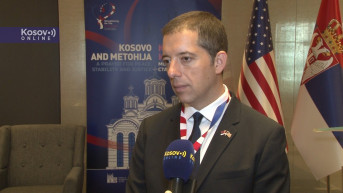
The Serbian Ambassador to the United States, Marko Djuric, stated that Serbia approached the dialogue with Pristina responsibly and constructively and that the international community knew who did not respect what had been agreed upon back in 2013, as reported by "24sedam."
Djuric mentioned that Kurti had demonstrated himself as a "kind of master of provocations" in Brussels and that other participants in the meeting could attest to this.
"For the citizens of Serbia, it is important that the state delegation led by President Vucic acted with the aim of protecting the collective, political, economic, cultural, and every other right of Serbs in Kosovo and Metohija. We are not arbitrarily inventing something new, but we are relying on what was agreed upon in 2013 and 2015. We are not asking for anything less or more than that," Djuric said in a statement to Tanjug during the celebration of the Serbian Progressive Party patron saint, Saint Petka.
Regarding the format in which the talks were held in Brussels, Djuric said that after 20 months of Kurti's unilateral moves and 20 escalations in high political circles and the international community, there was a growing awareness that they should address this issue.
He also questioned how one could expect dialogue and trust with people who had removed Judge Nikola Kabasic, the president of the court in North Mitrovica, just because he had dared to oppose the desecration of the Serbian cemetery in North Mitrovica.
"Two days after Nikola filed a criminal complaint, Vjosa Osmani signed a decree to dismiss him, even though he had submitted his resignation more than nine months ago when the Serbs withdrew from the institutions. She waited for this moment, which speaks only of their attitude towards the Serbs. They were irritated by the fact that he spoke about the position of the Serbs in Kosovo and Metohija," Djuric noted.
If it were up to Kurti, Kosovo would not have had a European path at all
Djuric emphasized that one of the early commitments of the constructive approach of Belgrade, which was often forgotten, was in the fact that, in exchange for the CSM, it had been agreed that the sides would not block each other on the EU path, and that had been immediately adhered to by the Serb List.
He reminds that the Serb List voted for the ratification of the Kosovo Stabilization and Accession to the EU Agreement, which Kurti's Self-Determination Movement did not do.
"Without the support of the Serb List, the vote would have been unsuccessful. So, if it were up to Kurti, Kosovo would not have had a European path," Djuric emphasized.
"All of this is a consequence of Kurti's unilateral moves"
The attention paid by some European leaders to this issue is a consequence of Kurti's unilateral moves, the Serbian Ambassador pointed out.
"It is important that they show in their behavior that there are consequences for Kurti's malicious activity that began with the removal of the commander of the North Kosovo Police Region, Nenad Djuric, followed by the expulsion of Serbs from the government in Pristina, practically violating the so-called Constitution of Kosovo that guarantees the representation of the majority, the majority Serbian party. Kurti ignored that, then, over 60 times, he sent special forces to the north of Kosovo and Metohija, creating one crisis after another," Djuric said.
As he noted, all of this contributed to creating a political climate in which regular dialogue, as it was conducted over the past decade, could not take place, and in which some European leaders felt the need to get involved.
"What we would like to see is an objective assessment, a picture in which it is clear that the Serbs are victims of Kurti's efforts to ethnically cleanse them from Kosovo and Metohija, expel Serbs from our southern province, and that, besides being good propagandists, they have no other policy than to pressure the Serbs, make unilateral changes on the ground, and have no orientation toward compromises, agreements, and building a different future for everyone in Kosovo and Metohija," Djuric said.
On the other hand, as Djuric noted, Serbia is focused on protecting the rights of its people, but it is open to creating a new paradigm in Serbian-Albanian relations, which, he said, has been continuously demonstrated in recent years.
Djuric stresses that those who want to see can clearly see who the victim is, who is constructive and oriented toward normal relations between national communities, and who wants to achieve political goals through violence, various pressures, and behavior inappropriate for the Europe of the 21st century.
"Serbia's negotiating position is difficult"
"We know that a large number of them come from countries that supported Kosovo's independence, and we have illusions about their positions. Serbia's negotiating position has been difficult for over two decades when it comes to Kosovo and Metohija," Djuric said.
In that regard, Djuric emphasized that Banjska was a tragic event that had primarily affected the families of people who had lost their loved ones, "by the will of a destructive policy that, over the past 20 months, wanted to change the ethnic picture in the north of our province while trampling on the collective rights of the Serbs."
"The difficult negotiation position has not been easy even before Banjska, and it certainly is not easier after it. Our job is to continue to gain friends, explain our position, and create public opinion that will be more receptive and open to Serbia's interests, and that is what we are doing systematically," Djuric said.
Any transformation of the "Kosovo Security Force into a so-called army and a heavily armed military formation goes against UNSC Resolution 1244 and the Military-Technical Agreement from Kumanovo," Djuric said, commenting on the statement of the US Ambassador to Pristina, Jeffrey Hovenier, who called for support for the transformation of the Kosovo Security Forces.
"It is also dangerous that such a move would support the policies of Kurti's government, which, over the past 20 months, has demonstrated actions contrary to normalization, dialogue, and respect for the collective and individual rights of Serbs. This government is responsible for the departure of 11 percent of the Serbian population from Kosovo and Metohija during its mandate. There is no reason to support any further armament. Instead, the entire region needs more dialogue and the building of trust," Djuric stated.
When asked to comment on the recent announcement by Serbian President Aleksandar Vucic that Djuric will return to Serbia soon and on which position we can expect him, the ambassador said that he does not engage in calculations.
"I try to do my job to the best of my ability"
"If you follow my political activities, you can notice that, unlike many colleagues, I don't focus much on myself, so now, I don't deal with any calculations. I try to do my job to the best of my ability. I am very proud of the fact that in the past three years in Washington, we bought a phenomenal new building of the Serbian embassy, which is less than a mile from the White House, on the most beautiful street in Washington, something that makes Serbia proud," Djuric said.
He added that last week, they had opened a new residence in Washington, which would be a home for cultural, political, and other events.
"I am proud of the fact that we have gathered and mobilized the Serbian diaspora, one million Serbs in America, for political engagement. Last week, we held a conference on Kosovo, marking the first time in history that the Serbian state organized such an event in Washington. Three months ago, we founded the Serbian-American Business Council in Washington, made up of the largest American companies operating in Serbia, which is already working as a lobbyist and addressing American officials with the request to more energetically support Serbia," Djuric emphasized.
The ambassador emphasized that he did not have much time to engage in speculation or to assume what he would be involved in in the future.
"Believe me, I usually don't have time to even write about what has been done, even on social media, let alone to deal with what I will do in the future. But what I know is that I work with the best team for Serbia, Aleksandar Vucic's team and the Serbian Progressive Party, and I will continue to carry out my political activities in coordination and agreement with President Vucic and my Serbian Progressive Party," Djuric concluded.


0 comments