
Djuric: Serbia wants to join the EU as soon as possible; Wadephul: Progress in the dialogue with Kosovo is crucial
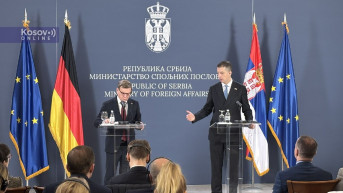
Serbian Foreign Minister Marko Djuric said today, after meeting with his German counterpart Johann Wadephul, that Serbia wants to become a member of the European Union as soon as possible, which is the state’s strategic goal. He added that he informed his counterpart about the situation of the Serbian people in Kosovo, as well as Serbia’s commitment to preserving stability.
Wadephul emphasized that progress in the dialogue with Kosovo is crucial on Serbia’s path toward EU membership, and that the Ohrid Agreement is binding for both sides.
“For Serbia, the EU is a strategic goal because we see it as an opportunity to change the paradigm of relations in the region, an opportunity to create a new, different future in which that greatest peace project in the history of the continent will transform interstate and interethnic relations on the continent,” Djuric said.
To reach that goal, he stated, reform progress must be doubled, even tripled.
“What we have achieved in cooperation with Germany in the economy contributes to the overall reforms. We jointly noted that our relations are highly developed, along with a readiness for their further improvement,” Djuric said.
He emphasized that he informed his German colleague about the position of the Serbian people in Kosovo, but also about Serbia’s commitment to preserving stability in the region and the aspiration to change the paradigm of interethnic relations and create a different, European perspective for all people living here.
“This is especially important in the context of a difficult and polarizing year, particularly considering the need to create a perspective for younger generations in the region. Partnership with Germany is of key importance in this regard, because with support we can make the European perspective very close, tangible, and attainable,” the Serbian foreign minister underlined.
He stated that Serbia wants to join the EU as soon as possible.
“We can achieve this, given our human capacity and the fact that Serbia accounts for 52 percent of the regional economy, as well as our overall societal potential. We believe that Serbia’s place and future are in the EU,” Djuric said.
He also noted that German Minister Johann Wadephul is an excellent connoisseur of Balkan affairs and a strong advocate of deepening cooperation with the region and creating new relations.
Djuric expressed gratitude to Germany for all the assistance it has provided to Serbia, recalling that the two countries are marking 25 years of cooperation in the field of development aid.
He reminded that a large Serbian community lives in Germany, serving as a bridge between the two countries and capable of contributing to the overall strengthening of relations.
Djuric also said that he asked Wadephul for support in opening Cluster 3, in line with the European Commission’s recommendation.
He pointed out that the Berlin Process is one of the most important instruments for regional cooperation.
“We have offered Germany for Serbia to play a more active role in regional cooperation within the Berlin Process. We are determined to do much more in the coming years, to continue improving political, economic, and overall relations in the region, to strengthen and deepen ties with Germany, which we respect and thank for the fact that Serbia has doubled its GDP, to a significant extent thanks to German companies. Our connection is not only economic but also based on values, and cooperation will continue to grow,” Minister Djuric stated.
No ambiguity – our path is the EU, but we take our national interests into account
Reiterating that Serbia is committed to EU accession, Djuric pointed out that this implies accepting the EU’s Common Foreign and Security Policy and actively participating in its formulation.
He emphasized that Serbia, even today as a non member, contributes significantly to the EU’s Common Foreign and Security Policy, considering the size of the country and number of inhabitants.
“Today, the alignment percentage is at a record high. Last year it was around 50 percent, now it is close to 70 percent. I want to assure both the Serbian and German public that this percentage will continue to rise,” Djuric said.
However, he noted that Serbia is not joining an algorithm but a system of values in the EU, because it wants to be a society similar to Western democracies.
“This requires reforms, but we must keep in mind that Serbia has certain national interests in the region and issues related to previous decades, which we are trying to resolve in a constructive manner, with EU mediation and cooperation with EU partners, so that Serbia’s full potential for participation in the Common Foreign and Security Policy can be realized. There is no ambiguity, our path is the EU,” Djuric concluded.
Wadephul: On the path to EU membership, progress in the dialogue with Kosovo is crucial
German Foreign Minister Johann Wadephul said that progress in the dialogue with Kosovo is essential for Serbia’s path toward EU membership.
He stressed that the Ohrid Agreement is binding and that both sides must implement it.
Wadephul conveyed that he had open and constructive talks in Belgrade and emphasized that Serbia and Germany are connected economically and through people, recalling that Germany is Serbia’s largest trading partner and that a large number of Serbs have found a home there.
“Serbia is part of the European family and should participate in the family of European values. The promise the EU made in Thessaloniki in 2002 still stands,” Wadephul emphasized.
He pointed out that he discussed with Minister Djuric the joint defense of European values.
“I explained that Serbia, as the economically strongest country in the region with the largest population, has the greatest significance in the Western Balkans and must decide to commit to its European course and alignment with foreign and security policy, because otherwise it sends mixed signals that are incompatible with the core EU values,” Wadephul said.
He stated that they agreed there are many areas for further improvement of cooperation, especially in the energy sector, primarily renewable sources, with the aim of strengthening independence from Russia.
He added that they also discussed security in Europe, stressing that Ukraine faces another difficult winter.
“Russia has increased its attacks on Ukraine. The strongest guarantee against Putin’s aggression is Ukraine’s ability to defend itself. We must continue exerting pressure on Russia to end this war of aggression. The war Putin is waging comes at a high cost. It is important that we in the EU remain persistent and implement the 19th package of sanctions. Assistance to Ukraine is not only financial but also political,” Wadephul noted.
He said that the war in Ukraine has given Western Balkan countries new momentum on the European path.
He stressed that membership requires progress in rule-of-law reforms and the fight against corruption, and that he expects the Serbian government to speed up reform efforts.
“A clear commitment to European policies is also necessary. Rule of law and freedom of assembly are non negotiable, and without them democratic development is impossible,” Wadephul said.
He noted that violence occurred against demonstrators in Serbia and that it is the government’s obligation to ensure the right to peaceful protest.
Wadephul emphasized that the Berlin Process is an important catalyst on the path to the EU and promised that Germany will continue to play a leading role.
“It is essential that we achieve concrete progress. The mobility agreement must be fully implemented in the region. These are concrete benefits for citizens. They matter because real rapprochement will occur only if trust grows. Our goal is clear: more Western Balkan countries should become part of the EU,” he stressed.
Wadephul also conveyed that Serbian President Aleksandar Vucic clearly stated that Serbia is on the European path.
“I consider that statement convincing and fully support it. For this, it is essential that Serbia align its foreign and security policy, especially regarding Ukraine. We discussed this intensively and I once again appealed for Serbia to demonstrate its support for Ukraine in practice and clearly state that Russia initiated the war of aggression,” Wadephul said, adding that Ukraine is fighting the war for all of Europe and that clear support and taking its side are necessary.
He welcomed the Gaza resolution
Wadephul also commented on the adoption of the UN Security Council resolution on Gaza, which, as he explained, will enable the implementation of the 20 point plan and thereby create conditions for peacekeeping forces to help ensure humanitarian aid to the population.
“This is good news and shows that the UN system is functioning. Germany has always been clear that this resolution is key for us for a peaceful future and peace between Israel and Palestine,” the German minister underlined.
He emphasized that the German government will continue to assist in the reconstruction of Gaza and is waiting for Egypt to invite all actors.
“We are ready to go to Cairo and take steps to improve the situation in Gaza and enable the start of constructive talks for peaceful coexistence,” Wadephul said.
0 comments