
Hoti: Wadephul in the region in the name of the European idea
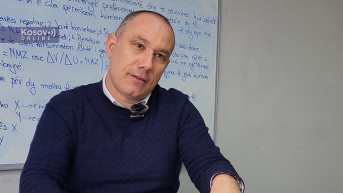
The visit of German Foreign Minister Johann Wadephul to the Western Balkans is important because it combines two motives – the idea of accelerated integration of the region into the EU, as well as the motive of Berlin as a main actor with growing military power that is involved in interstate relations in Southeastern Europe, in the Western Balkans, and also in the north of the continent, said Dritan Hoti, professor of international relations and geopolitics at the Mediterranean University in Tirana.
German Foreign Minister Johann Wadephul is currently on a tour of the region. He began his visit in Sarajevo, continued to Podgorica and Tirana, from where he sent the message that Berlin remains a strong partner in supporting the region on its path to the EU. He is currently in Belgrade, from where he will travel to Pristina and then to Skopje.
Hoti points out that Wadephul is coming in the name of the European idea in what he describes as an extraordinary situation regarding the integration of the Western Balkans into the European Union.
“The main thing is that the minister of foreign affairs of a power that has historically been involved in defining the ‘physiognomy’ of nation states in Southeastern Europe is coming to the region. Germany was involved in defining borders not like other European powers at the end of the 19th century, but during the 20th century, and it was the power that influenced the borders of Eastern Europe in the context of the wars that were fought. I am speaking in a geopolitical sense of war. The presence of German armies defined several borders different from those that existed before the war, and we must say that this influence was favorable for Albanian national goals. However, it should be emphasized that this minister is coming in the name of the European idea. We are talking about an extraordinary situation that is often highlighted, regarding the integration of the six Western Balkan countries into the European Union,” Hoti told Kosovo Online.
He notes that in a brief statement given on the plane, Wadephul emphasized that the countries of the Western Balkans are an integral part of Europe not only geographically, but also culturally, historically and geopolitically, referring above all to the successes achieved by Albania and Montenegro.
“He highlighted these two countries and spoke about the rapid perspective of their membership and Germany’s support for that perspective, meaning their integration into the EU. He also stressed the main condition – the implementation of reforms, and reforms include not only those contained in the clusters, but more than that, so that our countries are prepared for integration into the EU,” Hoti said.
He believes, however, that Wadephul’s visit has another “dimension”, because he is the foreign minister of a country that has set the goal of creating a consolidated army, perhaps the strongest army on the continent according to the words of Chancellor Friedrich Merz, which, Hoti explains, under current circumstances will function in defense of the European idea and what is considered European democracy.
“Germany is a country involved in Southeastern Europe and the Western Balkans, in the name of the European idea but also as an individual actor. Germany is also involved in Northern Europe, referring to the impact of the war between Russia and Ukraine and the geopolitical consequences in that part of the continent. So, we are talking about an important visit in which two motives are combined, the idea of accelerated integration of the six Western Balkan countries into the EU, and the motive of Germany as a main actor with growing military power that is involved in interstate relations in Southeastern Europe, in the Western Balkans, as well as in Northern Europe. We can see that there is a symmetrical link between the war between Russia and Ukraine and the emotional and ideological developments in certain Southeastern European countries, and this is a motive that is not directly mentioned,” said Hoti, who completed his studies at the University of Graz and in Vienna.
Regarding the war between Russia and Ukraine, Hoti assesses that if Russia emerges as the winner, it will turn into a pillar of power that will not be ideologically friendly toward the West, but will be a power based on the idea of the greatness of Russia.
He is convinced that the first consequences of such an outcome of the war would reflect on the system of international relations in Europe, since Russia is a Eurasian but primarily a European power.
This would also, he adds, have direct repercussions in certain Western Balkan countries where Russia has always had traditional platforms for its influence and continues to have them, though in altered forms.
“So, the visit of the German foreign minister contains this complexity – both the European perspective of the Western Balkan countries and what is called the geopolitical aspect. The minister of a country like Germany is coming here with messages for our countries. We are not talking about Albania, which in the ideological sense has no issues regarding the West, but about countries like Serbia, Montenegro and North Macedonia. Germany, given the nature of its diplomacy and the functioning of its state, will at some point demand the final determination of the ideological orientation of these countries. Here I am referring primarily to the case of Serbia, and to some extent Montenegro, which is easier to manage and is a NATO member,” Hoti said.
In his view, the economic aspect is not crucial in the visit of the German official.
“Germany is a major country with consolidated economic power, one of the countries with the largest foreign trade in the world, but I think that although the economic aspect plays a role, it is not decisive in this visit,” Hoti said.


0 comments