
Djuric: The US administration is clear in condemning Albin Kurti's policies
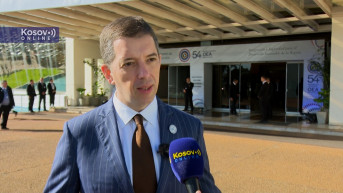
Serbia's Minister of Foreign Affairs, Marko Djuric, stated that the US administration was clear in its condemnation of Albin Kurti's policies, emphasizing that Belgrade would like to see more energetic action from representatives of international organizations in Kosovo.
"It is nice to say they are against unilateral measures, but if Kurti continues, it is necessary for KFOR, EULEX, and others to use their powers," Djuric said on TV Pink.
Two Serbian embassies in Europe received threats
As he says, Kurti's extreme actions have broader consequences. He mentioned that Serbian embassies in two capitals had received threats of being targets of terrorist attacks and that those threats came from extremist circles within our diaspora, specifically from citizens of Serbia of Albanian nationality.
"I'm mentioning this because someone from Pristina has been systematically working for years to create a climate where attacking anything Serbian is allowed. Security measures at our consular offices have been heightened this morning, and one perpetrator of these threats has already been identified. However, this is a pattern we have seen before – choosing a person with a history of mental issues, while organized groups often lurk in the background," Djuric explained.
As he added, he does not want to disclose details without consulting security agencies because he does not want to worsen the situation, but he can say that security measures were increased this morning at some of Serbia's diplomatic and consular offices in Europe.
Speaking about the situation regarding the opening of the Ibar Bridge, Djuric emphasizes that since the autumn of 2021, Kurti's regime has been doing everything to change the situation in Kosovo to the detriment of the Serbian people.
"He is working to completely eliminate Serbian institutions, and he is doing this for his political reasons as he tries to profile himself as a national politician for all Albanians in the region, with his influence extending to North Macedonia and Montenegro. His party is not just an ordinary one, it is a radical extremist movement skilled in propaganda and presenting itself to the international community while carrying out a dark ethnonationalist policy. Our people in Kosovo and Metohija feel this the most. A regime can be described as apartheid for Serbs," he noted.
In this context, he reminds that for 14 months, Serbs have been unable to trade with Serbia, unable to buy even a bag of chips or a bottle of Coca-Cola just because it was produced in Zemun.
"What is even worse is that for seven and a half months, we have been banned from paying pensions, salaries, and social assistance. Meanwhile, there is an ongoing, intense effort to change the ethnic structure in the north, it is not just about the threats to open the bridge," he said.
Djuric mentioned that he had addressed the National Democratic Institute (NDI) on another matter yesterday.
"I believe it is very bad to allow an extremist like Kurti to use the Democratic Convention in the US as a platform to promote false information and lies about events in our region," Djuric said, adding that yesterday we had also seen Kurti's statement about opening the bridge.
He points out that Kurti's government is under restrictive measures, and US officials have not received its representatives for some time.
"His participation indicates that someone who opposes Washington's policies is given a platform to spread inaccurate information. That is why I reached out to NDI and pointed out that his regime systematically oppresses human rights in Kosovo and Metohija, and this has already had an impact," he said.
When asked to comment on statements by Daniel Serwer, a professor at Johns Hopkins University, who said that the government in Kosovo can either accept or reject coordination with allies but that they need to improve relations with the US and Europe, Djuric says that if Serwer says this, then it is clear that Kurti has gone too far.
"If this is coming from someone known for not being sympathetic to Serbia's state policy, then it is clear how far Kurti has gone, considering this is a man who has strong sympathies for the independent Kosovo project. If he has come to criticize Kurti's policies, then everything is clear," Djuric said.
Speaking about relations with America, Djuric says that Serbia and the United States have been developing relations for 143 years and that he is confident that these relations can return to their former glory in the future.
"Our interest is to improve these relations. The fact that the US has become our number one partner in terms of service exchange strengthens our position. However, our position is further bolstered by the influence we have exerted and the encouragement we have given to the Serbian community in the US to become more active," he said.
He notes that Serbia seeks clear relations between Serbs and Albanians and aims to deepen cooperation with regional states.
"We are in the business of making friends. We are working to advance Serbian diplomacy and expand our presence in different parts of the world," Djuric said.
In this context, he mentions that today he has the honor of hosting the Minister of Foreign Affairs of Dominica.
He says that Dominica is a small country in the Caribbean Sea, but that Serbia makes no distinction.
"We want to help and nurture that friendship, and it is important to us to have friends we can rely on," Djuric said.
He also announced that at the end of the week, he will travel to Tonga, where he will participate in the Pacific Islands Summit.
"It takes 38 hours to fly there from Belgrade with layovers, and that is the shortest connection, but it is a great honor for me to represent Serbia there because we want to establish relations with a number of those countries," he said.
When asked about the situation in Gaza and relations with Israel, Djuric says that Serbs and Jews share much in common throughout history and that Serbia should use this to influence the Jewish community.
As he explained, as an ambassador to the US, he worked on connecting with the Jewish community in the US and deepening their understanding of the situation of Serbs in Kosovo and Serbia's independent policy.
"We continued to work on that and will continue in the future. We want a peaceful resolution as soon as possible after the Hamas attacked on October 7. We want the release of all hostages who have been held for over 100 days, and we also want the suffering of civilians and the killing of innocent people to stop. In this sense, we support the efforts of parts of the international community to reach a peace agreement," Djuric said.
Commenting on Serbia's foreign policy, Djuric reminded that he had taken on the role of Minister of Foreign Affairs at a time when there had been an initiative to vote on the Srebrenica Resolution at the UN and the fight on this issue led by Serbian President Aleksandar Vucic.
He emphasized that the process of Kosovo's membership in the Council of Europe had also been unfolding simultaneously.
"We are pursuing a balanced foreign policy that allows Serbia to be a bridge in many places," Djuric said.


0 comments