
Vucic: The truth is not one-sided, the resolution will put a mark on the foreheads of the victims
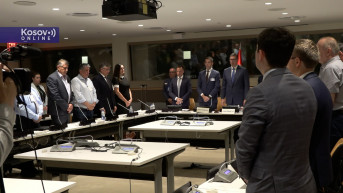
The panel "We speak because they cannot - voices that need to be heard" was held at the United Nations, the testimony of witnesses and victims of the war in Bosnia and Herzegovina, where Serbs who experienced or witnessed crimes spoke.
The meeting was also attended by the President of Serbia, Aleksandar Vucic, and the Minister of Foreign Affairs, Marko Djuric.
Vucic said today that Serbia will never be silenced and that all those responsible for the terrible crime in Srebrenica have been arrested and extradited.
He pointed out that these are individuals who were sent to prison. He expressed his gratitude to all the people who spoke today about their experiences and sufferings during the war in the former Yugoslavia.
"I was touched by the testimony of American citizens of Serbian origin who came to testify about their suffering. This is only a group of people living in the USA, we did not bring hundreds of thousands of them from Bosnia and Serbia. We wanted to show that the truth is not one-sided and these victims are just said," Vucic pointed out at today's briefing at the UN.
Vucic pointed out that "only ordinary people" spoke at this briefing, for whom it will be very difficult if the resolution is adopted, because they were victims, and suddenly they will be marked as part of the genocidal nation.
"I know you will say that this is not true, that amendments have been adopted that deny it. Then I ask the question - why is this resolution adopted. If it is about individual responsibility and who is responsible for crimes - that has already been established by verdicts. To everyone was sentenced, they are also in prison. What are we going to do tomorrow? The resolution does not mention individuals", noted the president of Serbia.
Vucic also asked why they started with Srebrenica, and not with something that was done against the Serbs in the First World War, in which, he underlined, the Serbs proportionally suffered the most.
"We lost 28 percent of the population. After us, the French lost 25 percent of the population in the First World War... In the Second World War, 85 percent of the people killed by the Nazis in Yugoslavia were Serbs," added Vucic.
He pointed out that, when it comes to Srebrenica, Serbia never hid the fact that Serbs committed terrible crimes and condemned it.
He also reminded that two presidents of Serbia went to Srebrenica.
"I went in 2015 to pay my respects and I was almost lynched. The people who attacked me were not even found. For a prime minister to be violently attacked by a large number of people, and no one responded...", stated Vucic and added that only a few days after that, he invited leaders from Bosnia and Herzegovina to Belgrade.
The President of Serbia warned that if the resolution is adopted - on one side there will be celebration, but on the other side there will be indignation, sadness and anger.
"Is that the goal? Will the resolution unite people in Bosnia and Herzegovina? No. Will it unite people in the region? No, not at all. Why are we doing it then? Will it ensure peace? You all know the answer is negative," Vucic said.
He also asked if the purpose of the document was to punish a nation that loves freedom.
That is why he once again asked everyone not to vote for the proposed Resolution on Srebrenica.
"Once again, I beg you, I do not threaten and blackmail like other countries, including some of the co-sponsors of the resolution... I invite you not to vote for the resolution and to create conditions for inclusiveness and dialogue," emphasized the President of Serbia.
Vucic said that he wanted to discuss the Resolution in Srebrenica with a permanent representative in the UN, but that he received the answer "you will face the resolution as we will give it to you".
Vucic says that Serbia is too small, but that he is convinced that democratic values should matter to everyone and that all parties should be involved in the process of passing such important resolutions.
"Dear friends from Europe, Africa, Asia, Latin America from all continents what will you do when you open that Pandora’s box. What will you do with it. You want to say that there was no genocide against the Soviet people in World War II, will you say that there was not genocide by Croatian Nazis and others. What will you say about different issues from around the world? Will you turn your head, or will you say we don't deny anything," said Vucic.
Vucic pointed out that he is proud of his country and people who have always strived for freedom.
"Coming from a small country, I am proud of the fact that we have always loved freedom and paid a high price for it. Once again, I ask you to think about your decisions because it can affect not only the region where I come from, but also the whole world. We will not be silenced, we will fight for the truth," said Vucic.
At the beginning of the panel discussion, a minute of silence was held for the victims of war.
The Consul General of Serbia in Chicago, Damjan Jovic, said opening the panel discussion that the sufferings of the Serbs, the victims of the war in Bosnia and Herzegovina, were ignored and that the Resolution on Srebrenica, which will be discussed 29 years after the war, divided not only the people of the Balkans but also the members of the international organization.
"These people are people, American citizens, representatives of the victims of the war in Bosnia whose suffering was either ignored or ignored by the authors and sponsors of the draft resolution that suddenly became an additional reason to strengthen all the animosities between the different ethnic groups in Bosnia and the wider region. They will share first-hand experiences with us," said Jovic.
He pointed out that all victims, on all sides, have the same rights.
Duska Stanic, I was eight years old when the war broke out in Yugoslavia, and before the conflict it didn't matter who was of which nationality.
"Unfortunately, one cold April morning, my mother told me that school was canceled. But my mother told me that I had to stay at home and play with my sisters. I didn't realize that we were the minority. And we were confined to the house, eating we only ate what we had at home. At the age of eight, I tried to understand what was happening. A group of soldiers came in front of our house and one of them pointed a gun at me and forced us to get into the van. We didn't know where we were going," Stanic pointed out.
He remembers that the soldiers locked them in the school, without food or water. Stanic says that she was broken, hungry and exhausted.
"I heard that they were going to throw us into a pit like they did in World War II. I heard from my grandmother how they tortured Serbs and threw them into pits, and now we were going through the same," she stated.
Stanic says that the Serbs were later taken to a concentration camp.
"The soldiers came to torture us. They would line us up for the firing squad and ask the mothers if they wanted them and the children to be the first. I found out later. They carved crosses on their bodies," she said.
Stanic pointed out that on one occasion she was almost attacked and raped by two Bosniaks.
"We lived in Sanski Most so I thought I could start a new life, even though it was a territory held by Serbs, shells were my lullaby. Bosniaks went to school with us. One of the Bosniaks when I went to school said ‘Let's rape her’," Stanic said.
When the city was attacked again, Stanic managed to escape.
"In October 1995, our town was attacked again. We managed to escape with the carriages - women, children and elderly. It was October, we lived outside. I was homeless and scared again. Only later did I realize what I went through in my childhood. Greek families took us in and placed us in their homes. Only then did I realize that this is how childhood should feel. I realized that there are still good people and there is hope," she concluded.
Dijana Ivanovic said that she was born in Livno, where in 1991, before the war, there were 5,000 Serbs. Today, according to her, there are about 20 of them there
As she says, in May 1991, the soldiers took her father away, who never returned home.
"The school was converted into a concentration camp for Serbs, it was run by Croats and Bosniaks. He was placed in a small room of 12 square meters with other captured Serbs. My father said that these people were tortured for days and later executed. My father was tortured every day for 5 months, mostly by Croats who were friends with him before the war," said Ivanovic.
Her father is in the camp, she points out, because he was beaten to death and begged to be killed.
"They put a gun in his mouth and threatened to kill him. He begged to be killed. When one of the torturers got tired, another would replace him. One night, they blindfolded him and told him that they were taking him to be shot. They put a gun to his forehead, but the gun was empty. They tied him to an electric chair, they burned his body on his back. He was put in solitary confinement for several days, without food or water. 5 5 months. My mother shared his fate. She lived in constant fear," Ivanovic said.
One morning, she recalls, a Serbian neighbor was found dead, she had been raped, and her arms and legs were broken.
"My mother was taken to a concentration camp on August 10, 1992. They constantly threatened her that they would bring four children and kill them in front of her," said Ivanovic.
Her parents were released from the camp thanks to a prisoner exchange.
She left the city and has not found the strength or courage to return since then.
"Until today, no one has been held accountable for the Serbs who died in my city," she said.

0 comments