
Drecun: The key question is what position Sorensen will take on Pristina's unilateral moves
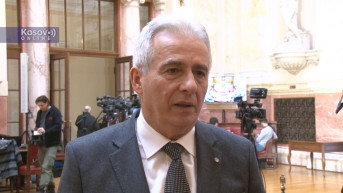
Starting February 1, Peter Sorensen will succeed Miroslav Lajcak as the EU's special envoy in the dialogue between Belgrade and Pristina. The key question is what his stance will be on Pristina’s unilateral actions and everything that hinders the continuation of the dialogue, says Milovan Drecun, chairman of the parliamentary Committee for Defense and Internal Affairs, as reported by RTS.
“Miroslav Lajcak leaves unresolved issues, with the key matter being the formation of the Community of Serb Municipalities. Now, we face a situation where this issue has become peripheral, while Pristina prioritizes two points in the Agreement on the Path to Normalization that are unacceptable to us,” Drecun said.
He described the agreement as having essentially become "dead on paper."
“I believe this is due to the agreement's inherent flaw. That flaw lies in treating Kosovo as a state. If such a situation occurs, no agreement can be implemented, as this is unacceptable for Belgrade. Moreover, there has been no de-escalation of the crisis in the north, and all other issues that were supposed to be resolved through dialogue were left by Lajcak to Pristina to impose unilaterally, to the detriment of the Serbian people,” Drecun added.
Regarding expectations from Sorensen, Drecun said the critical question is who is backing him.
“You see, the autonomy and independence of mediators like Lajcak, and now Sorensen, is questionable. They don’t have much room to maneuver,” the chairman of the parliamentary committee stated.
Concerning the Belgrade-Pristina dialogue, Drecun noted that Sorensen could technically try to revive it and be more proactive.
“But to me, the crucial question is what his position will be on Pristina’s unilateral actions and everything that obstructs the continuation of the dialogue,” Drecun emphasized.
He expects Sorensen to act in accordance with the EU’s defined policies.
“If the EU’s position is that the realization of this so-called basic agreement and its accompanying annex is key, including the implementation of two points – namely, that we don’t oppose Kosovo’s membership in international organizations and treat it as a state – this will remain an insurmountable problem, and no matter how experienced a mediator is, they won’t be able to overcome this,” Drecun explained.
The influence of Trump’s administration
However, Drecun believes the most important question now is how Trump’s administration will approach the Washington Agreement.
“Trump is, I would say, an unconventional politician. He takes a much more pragmatic approach to problem-solving. Trump won’t be willing to let the EU handle key processes in this region. He will maintain a leadership position, formally perhaps allowing the EU to take the reins. However, the question is whether he will again pursue a dual-track approach, working bilaterally with Belgrade and Pristina as he did in his first term, achieving the Washington Agreement without the EU. Or, will he truly hand over the reins to the EU? Though it is clear that without decisive US involvement, nothing can be resolved in Kosovo and Metohija,” Drecun said.
According to Drecun, Trump is a shrewd politician.
“You see, he raises the bar of his demands to the maximum, then anything below that appears as a concession on his part. He is an excellent negotiator. Naturally, he won’t abandon the stance that Kosovo is a state and will expect Belgrade to agree to it. But the question is what methods he will use to achieve that goal. Judging by his first term and the Washington Agreement, he seems more inclined toward economic measures rather than strong pressure,” Drecun noted.
He suggested waiting to see Trump’s approach to the basic agreement.
“If he opts to pressure Belgrade into recognizing the fake state of Kosovo, we will be no closer to resolving the Kosovo issue or succeeding in dialogue. On the contrary, we will be further away. If he chooses softer approaches, we’ll have room to maneuver and find a solution – not entirely meeting Pristina’s expectations but aligning with some of Belgrade’s interests and those of the Serbian people. A strong political clash is likely to occur between Washington and Brussels over how to address certain issues on the European continent, including those in the region,” Drecun concluded.

0 comments