
Escobar: By ignoring dialogue, Kosovo is ignoring partners
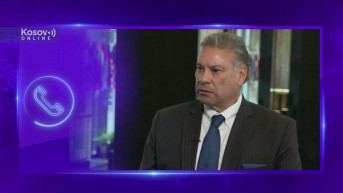
Deputy Assistant Secretary of State for Western Balkans Gabriel Escobar stated today during an online conference that by ignoring dialogue, Kosovo was disregarding European partners and thus preventing the US from persuading partners to support Pristina on the international stage.
Escobar referred to the statement made by the US Ambassador to Pristina, Jeffrey Hovenier, that it was currently difficult for the United States to advocate for Kosovo in the international arena.
"The path to the EU and NATO leads through countries that have not recognized Kosovo. These countries would like to see progress on dialogue-related issues. By ignoring dialogue, Kosovo is disregarding European partners and preventing the US from convincing partners to support Kosovo," he said, adding that he was concerned about Kosovo's disregard for US concerns.
Escobar told reporters that he was in Brussels, where he had meetings with the EU Special Representative for the Kosovo-Serbia Dialogue, Miroslav Lajcak, as well as NATO representatives, and then he would go to Pristina, "where he will focus on the consequences and possible solutions for uncoordinated measures to abolish the dinar."
He announced that he would then travel to Vienna, where he would have talks with the OSCE, from where he would travel to Montenegro to support the new government and its European path. In Washington, upon his return from the Balkans, he announced that he would have discussions next week with the Quint on all these topics.
He emphasized that he was traveling to Kosovo at a critical moment and wanted to try to persuade Pristina to return to the implementation of the Brussels and Ohrid agreements.
"The US believes that there is no alternative to dialogue. Dialogue has been a mechanism through which many problems have been solved, and it remains the main mechanism for addressing challenges. I call on both sides to respect and implement everything that has been agreed upon and to implement the Brussels and Ohrid agreements, as well as to show goodwill by avoiding measures that would lead to tensions and non-fulfillment of these obligations," Escobar stressed.
He emphasized that the US was concerned about the implementation of the decision of the Central Bank of Kosovo for five reasons.
"We hear about many problems faced by the citizens of Kosovo who depend on payments from Serbia, and we urge the Kosovo Government to take the concerns of the international community seriously. The first reason for concern is the speed of implementation of the decision. We are not talking about the legitimacy of the measure, but its implementation. It took France a year to introduce the euro, while Kosovo is implementing the CBK measure in three weeks in the north. Another reason for concern is that the Kosovo Government has not offered any alternative for providing funds to those who depend on these means. Thirdly, there has been no discussion with the affected population. Fourthly, two weeks before the announcement of the decision, Kosovo, along with other Western Balkan countries, agreed in Skopje that mechanisms for payments would be adopted by the end of the year. And fifthly, the Kosovo Government does not allow the international community to assist in solving this problem, which has caused chaos in Kosovo's economy," he said.
He reiterated that on the European path, dialogue had no alternative, especially for Kosovo, which was most interested in gaining more recognition from European states.
"Dialogue is very important for Kosovo, whether accepted or not. We support a dialogue in which the EU has even offered direct solutions, such as a draft statute for the Community of Serb-majority Municipalities," Escobar explained.
He emphasized that the EU had offered many options to make the dialogue successful for both sides.
When asked what the Kosovo Government told the US regarding the proposal for the draft statute for the CSM, he responded that they had never received a clear answer on whether they had accepted it.
"We find it difficult to understand why it needs to undergo constitutional review. Let's be clear, the CSM will not be another Republika Srpska, a state within a state. There is nothing in the statute that would grant executive powers. The CSM is merely an opportunity for municipalities with Serb majority to coordinate local services in Serbian language for the citizens of Kosovo," he pointed out.
Escobar stressed that the formation of the CSM was a legally binding commitment.
"We believe that the issue of the dinar would be resolved with the CSM. In the proposed draft statute of the CSM submitted by the EU, there are measures that foresee transparent money transfers from Serbia according to Kosovo law. The CSM would solve the issue of the dinar. We want Kosovo to progress on this matter as quickly as possible," he stated.
When asked about the consequences for Kosovo and Serbia if they failed to implement the agreed-upon agreements from Brussels and Ohrid, Escobar said that the primary responsibility laid with Kosovo to progress with the commitments made regarding the formation of the CSM.
"We have seen steps towards enabling the right to petition. We are waiting for both sides to do more in the dialogue. From Serbia, we expect the commitments made to become legally binding and irreversible. We want to see more from both sides," he pointed out, reminding that the implementation of agreements also determined the European path.
Regarding the relationship between the US and the Kosovo Government, he said that the partnership between the US and Kosovo was based on the relationship between citizens and did not depend on one individual or party.
"But I would say that currently, we have a problem in communication with the Prime Minister, and it's not just the US; the EU, NATO, Great Britain, and other countries like Albania, and North Macedonia are facing the same issue. We had a close partnership with Kosovo, and we would like to see it restored," he added.
He emphasized that the US policy towards the Western Balkans had not changed due to the war in Ukraine, but there was an increased urgency to address outstanding issues.
Escobar stated that the US was advocating for the urgent resolution of open issues in the Western Balkans, and no policy involved sacrificing allies. Kosovo was an important partner for this, as it could help Serbia become more integrated into European structures.
"We want Serbia and Kosovo to be productive partners in the Euro-Atlantic community and to have predictable relations. This can only be achieved through dialogue," he emphasized.
When asked if there was concern that Russia was working through Serbia to destabilize the region, Escobar said that what was happening in the Balkans was not something caused by Russia.
"The problems in the Balkans have existed among the countries in the region for a long time. By addressing these open issues, we hope to eliminate the possibility of Russian influence, which could exploit the region to cause instability," he emphasized.
Regarding North Macedonia, he said that the US expected the new government, after the elections, to continue the policy of its predecessor, the policy of being a solid partner committed to NATO membership and EU accession, as well as fighting against corruption.
Regarding Montenegro, when asked about the Democratic Front, he said that it was not up to the US to decide who formed the coalition government.
"We have expressed our concern because there cannot be a partner in the government who questions everything we hope Montenegro will achieve, such as Euro-Atlantic integrations. These are the forces that have disputed many things in the past, including recognition of Kosovo's independence, as well as reform packages crucial for the European path. They have not changed, and we have not seen a commitment to Euro-Atlantic values. We are concerned that there is a partner in the government who does not share the values of others in the coalition," Escobar concluded.


0 comments