
Gogic: It's unlikely that the EU and the Quint representatives will unlock the dialogue; pressures haven't yielded results so far
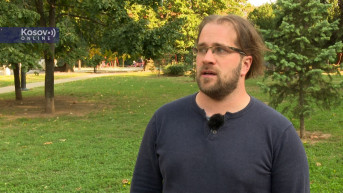
Political analyst Ognjen Gogic believes it's highly unlikely that the EU envoys and representatives of the Quint countries, who are coming to Belgrade and Pristina tomorrow, will be able to unlock the dialogue and encourage the parties to fulfill their commitments. He points out that their previous visits and pressures have not yielded results either.
Gogic, speaking to Kosovo Online, recalls that the "big five" visited the region, including Belgrade and Pristina, at the beginning of the year, and there was talk of an agreement then. There were threats of sanctions and strong measures against both Serbia and Kosovo if that document wasn't accepted and implemented.
In Belgrade and Pristina, the Special Representative of the EU for dialogue, Miroslav Lajcak, the US Envoy for the Western Balkans, Gabriel Escobar, as well as envoys of the leaders of France, Germany, and Italy, Emanuel Bonne, Jens Plotner, and Francesco Talo, are coming. Gogic says that the arrival of other representatives alongside Lajcak is a sign that the Quint countries support his work.
"However, they already came with Lajcak, and it didn't yield results. In these global circumstances, with the outbreak of the war in Israel, there are much greater security threats to Europe than the situation in Kosovo, so if their support or their presence as Lajcak's supporting voices in January didn't produce results, it certainly won't in October," Gogic concludes.
"This sounds like a replay, like a movie we've already seen, but the problem is that it seems like we all forget about it. In the meantime, after the 'big five' visit, there was the Franco-German proposal, which was later renamed the European proposal, accepted in some form, but nothing came of it," Gogic points out.
As he adds, after their visit earlier this year, not only was the agreement they sought to be accepted not implemented but the previous agreement, the Brussels Agreement from 2013, was also undermined, as well as previous agreements.
"This shows their real diplomatic limits. If they had the real power and strength to compel, force, or encourage the parties to fulfill their commitments, they would have done it by now. This shows that they have neither the 'carrot' nor the 'stick' for both Belgrade and Pristina. The new initiative demonstrates weakness, meaning they don't know how to manage this situation because they are doing the same thing and expecting a different outcome," our interlocutor emphasizes.
Gogic believes that if there were indeed an insistence on a new agreement, it would only create more confusion because, as he says, no one would know what is relevant, which agreements matter - whether it's UN Security Council Resolution 1244, the Brussels Agreement, or the agreements from Brussels and Ohrid this year.
It would only add another level of commitment, Gogic says, indicating that no one would be clear on what is relevant, and everyone could choose what suits them.
"It is precisely the insistence on agreements when the time is not right that has led to this situation," Gogic says, who believes that the moment for any agreements has not yet arrived.
Specifically, as he notes, Pristina does not want any agreement regarding the Community of Serb-majority Municipalities, and Belgrade does not want to enter into any agreement that would lead to non-recognizers from the EU and NATO recognizing Kosovo's independence, which was the intention of the Ohrid Agreement - to enable Kosovo to gain recognition from five EU countries that do not recognize them and maybe become a part of NATO, which is unacceptable to Serbia.
"The parties responded to the insistence on agreements with a crisis. Forcing agreements that are more needed by the EU than the parties involved leads to a radicalization of the situation on the ground. The best thing they could do is to give up insisting on any agreements for a while and pause this matter," Gogic says.
When asked whether additional pressure could be expected on Serbia and Kosovo, Gogic says that talks of pressure have been ongoing since the beginning of the year, from January when the "big five" came, but that this pressure did not yield results.
"One can question whether that pressure was real or perhaps a bluff and whether they are serious now. I think the talk of pressure is an outdated method that does not yield results and rather leads to counter-effects. I think Belgrade is expected to show cooperation when it comes to uncovering facts related to the events in Banjska, and above all, that the proceedings against Milan Radoicic, who is suspected of various crimes, are conducted. As long as Serbia remains constructive in this regard, it will be spared from additional pressure," he notes.
He adds that this crisis in Kosovo arose after the elections held in April, which the Serbs boycotted.
"If they had the ability to pressure anyone, they would have foreseen that these elections should be a part of the Ohrid Agreement. I have never understood how it was possible to accept the roadmap in Ohrid without elections being its point. At that time, both Lajcak and Josep Borrell actually admitted that they had no way to secure them. This shows that pressure is more of a rhetorical figure than a real one, and if it exists, it produces counter-effects to what those pressures aimed to achieve," Gogic emphasizes.



0 comments