
In Gracanica, the anniversary of the beginning of the NATO bombing was commemorated: For the Serbs, time is divided into before and after the war
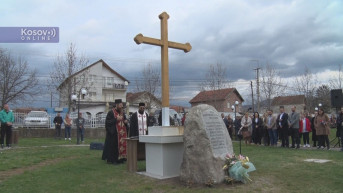
With a memorial service and laying of wreaths in front of the cross erected in honor of the fallen Serbs in the courtyard of the Cultural Center in Gracanica, the 25th anniversary of the beginning of the NATO bombing of the Federal Republic of Yugoslavia was commemorated.
The memorial service in front of the cross erected in honor of those who perished in the NATO bombing was officiated by priests of the Eparchy of Raska and Prizren. Subsequently, representatives of the Kosovo Government Office, the Office for Kosovo and Metohija, the Interim Government of the city of Priština, and the Municipality of Gracanica laid wreaths in front of the memorial.
Malinka Mitrovic, representing the Office for Kosovo and Metohija, emphasized that March 17th and March 24th were the two most tragic dates in modern Serbian history.
"For heartless merchants of death, we were a good opportunity for enrichment. We became numbers and collateral damage. Miraculously, they are the 'merciful angels,' while we are 'collateral damage,' and even God wept that first night when the ominous sirens announced that our skies were no longer free. They were not free; they were occupied by 1,100 combat aircraft, which carried out nearly 20,000 combat flights in 78 days. They delivered 20,000 tons of destructive explosives, and 36,000 tons of cluster bombs, choosing no target or aim. They targeted children, women, elderly, sick, and pregnant women, which means it didn't matter to them where they would strike. Serbia became the Serbian Hiroshima," Mitrovic said.
The director of the National Library in Gracanica, Brankica Kostic, emphasized that powerful Europe, a great democracy, a strong historical victor, died on the territory of Serbia and Montenegro at the very beginning of the bombing, when, as she stated, international law and justice also died.
"At that time, the 19 strongest powers violently and fiercely attacked a small nation, and almost the entire world remained silent. There were few even who verbally supported us, and never in the history of our existence were we so alone as in 1999. Those dreadful iron birds dropped tons and tons of cargo, radioactive bombs, cluster bombs, tomahawks, and everything we heard of for the first time, but we can never forget it. We wondered then, and it still isn't clear to us, where so much hatred came from, why, we perhaps deserved that hatred with that inscription in Geneva at the Red Cross headquarters reminding the world to be humane, at least as much as Serbia showed humanity even towards its enemies in the Great War," Kostic emphasized.
As she said, for Serbs, time was divided into - before and after the war.
Majda Popovic from the Cultural and Educational Community of Kosovo and Metohija stated that in 1999, a small, peace-loving country had been bombed 'in a cruel, cowardly, and bloodthirsty manner.'
“You destroyed everything for us, but you did not extinguish our spirit, our love for freedom, you did not crush us. Here we testify about your evil, and you have put on your wicked clothes again and continue your mission of death and hell. On that 24th of March, we saw you with bloody eyes, and that evening you set fire to Goles, and then to the Gracanica Zelenika with infernal fires, demonstrating the power peculiar to you to extinguish our ordinary joy,“ Popovic said.
The participants from the Music School performed the national anthem 'Boze pravde' in front of the gathered crowd, while Helena Popovic recited the verses of Ratko Popovic's poem 'Punoletstvo smrti' (Coming of Age of Death).
The event was organized by the Eparchy of Raska and Prizren, the Interim Municipal Assembly of Pristina, the Cultural and Educational Community of Kosovo and Metohija, and the Cultural Center Gracanica.



comments