
Great Britain and the USA for re-evaluating the role of UNMIK, while for Russia, the role of UNMIK is irreplaceable
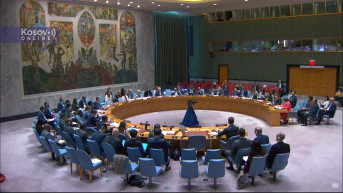
The representative of Great Britain at the United Nations, during the discussion on UNMIK's report over the past six months, called for a redefinition of UNMIK's role, a sentiment echoed by representatives of the USA and Japan. The Permanent Representative of Russia pointed out that UNMIK's role is irreplaceable, while the diplomatic representative of France stated that UNMIK should remain in Kosovo for as long as necessary.
The British representative urged both sides to show courage in fulfilling previously reached agreements, primarily in establishing the Community of Serb Municipalities and bringing to justice those responsible for the events in Banjska.
He called for a redefinition of UNMIK's role, noting that 16 years after the declaration of Kosovo's independence, the situation on the ground is "unrecognizable."
The same call for redefining UNMIK's role was made by Japan's ambassador to the UN, Yamazaki Kazauki.
The Deputy American Ambassador to the UN, Robert Wood, reiterated the demand to reassess UNMIK's role and suggested that discussions in the Security Council be limited to closed consultations once a year.
"After a quarter of a century, UNMIK has largely outlived its original mandate, and the USA urges the Security Council to review this mission and begin the process of its closure," Wood said, warning UNMIK to adopt a more neutral stance in future reports on the situation in Kosovo.
"The goal of the USA is mutual recognition," Wood stated, criticizing the Serbian authorities for the fact that, as he said, "the perpetrators of last year's events in Banjska are at large."
"We are concerned about the uncoordinated actions taken by the Kosovo government, which are not in line with the commitment of the Kosovo authorities to participate in the EU-mediated dialogue," Wood said, noting that such actions impact vulnerable and minority communities.
The Permanent Representative of Russia to the UN, Vassily Nebenzia, stated that ethnic tensions in Kosovo are at their highest level in the last 15 years and that the responsibility for this lies with the Pristina authorities, who want complete control over northern Kosovo.
He pointed out that Serbs in Kosovo are "barely surviving," and that Kosovo Prime Minister Albin Kurti has declared war against Serbs, cynically calling it "a fight against fascism both at home and abroad."
He warned that since the arrival of Self-Determination in power, the number of ethnically motivated violence has dramatically increased.
"If pressure is not exerted on Kurti, he will continue to expel the Serbian population from the enclaves. Belgrade is under constant pressure to recognize the independence of Kosovo, while the provisions of the Brussels Agreement, especially Pristina's obligations to form the Community of Serb Municipalities, are deliberately overlooked," the Russian ambassador said.
Therefore, he called for pressure to be exerted on Pristina.
"We demand pressure on Pristina to fulfill this provision immediately and unconditionally," Nebenzia said, noting that the announcement by the authorities in Pristina about forming a helicopter unit is in direct contradiction to UN Security Council Resolution 1244 from June 1999.
The Russian ambassador stated that UNMIK's role in the stability of Kosovo is irreplaceable, accusing the Kosovo and international authorities of deliberately neglecting investigations into attacks on two Russian diplomats a few years ago.
France believes that normalizing relations between Belgrade and Pristina is key to ensuring broader European security, condemning the successive actions of the Kosovo authorities in the north that have disturbed the local population, said the deputy ambassador of that country to the UN, Jai Darmadhikari.
The French diplomat also stated that it is unacceptable that the perpetrators of the events in Banjska are still at large.
"We will continue to support the EU-mediated dialogue, which has been mandated by the Security Council to achieve a lasting and binding agreement," said Jai Darmadhikari.
The representative of China emphasized that Serbia's territorial integrity must be fully respected.
"The Chinese position is clear - we support a mutually acceptable solution with full respect for Resolution 1244 and Serbia's territorial integrity," said the Chinese ambassador to the UN, Fu Cong.
He emphasized that the situation in northern Kosovo has escalated, and the responsibility lies with the authorities in Pristina, as unilateral actions—such as the banning of the dinar, closing Serbian institutions, violence against Serbs, and the announcement of the opening of the bridge on the Ibar—have had consequences for the safety of Serbs.
He added that China shares the concern regarding the situation in Kosovo.
He called on Pristina not to make unilateral decisions and to return to dialogue.
The Slovenian ambassador to the UN, Samuel Zbogar, stated that unilateral and sudden actions in Kosovo destroy trust and lead to an escalation of tensions.
"They do not help and should be avoided," Zbogar urged.
He highlighted that Slovenia seeks the establishment of the Community of Serb Municipalities (ZSO) and noted that stronger commitment from the leaders of Belgrade and Pristina to the Brussels Agreement of 2013, as well as the agreement from Ohrid, is needed.
"The path to peaceful coexistence is not paved with short-term victories; it requires commitment and compromise. The sooner the parties recognize this, the more progress and stability there will be," Zbogar said.
The representative of Algeria at the UN expressed concern about the situation in northern Kosovo and called for a de-escalation of tensions.
According to him, the source of great concern is Pristina's unilateral decisions without consultation, such as the abolishment of the dinar, the closure of the Postal Savings Bank, and other Serbian institutions, as well as the intention to open the bridge on the Ibar.
He pointed out the importance of ensuring that Serbs and other minorities are represented in local institutions.
The representative of Algeria supported the work of UNMIK.



0 comments