
Is the West preparing new sanctions against Pristina: Rhetoric getting sharper; situation increasingly difficult for the Serbs
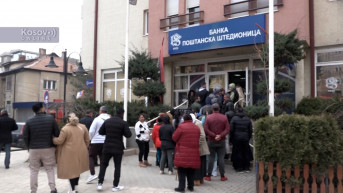
The European Union imposed punitive measures on Kosovo last summer for not making enough effort to calm the situation in the north. Since then, Kosovo officials have not stopped lamenting the 'unfairly imposed sanctions', although their significance and effect are primarily political and symbolic. This is evidenced by experts for Kosovo Online, but also by the situation on the ground, which is getting harder for the Serbs day by day.
The CBK regulation banning the dinar in Kosovo, which prevented residents in Serbian communities from withdrawing social assistance and other financial benefits yesterday, has drawn criticism from numerous US and European officials, with even the US Ambassador to Kosovo, Jeffrey Hovenier, stating that relations between the US and Kosovo have been strained.
However, one cannot live off of messages, as anyone could see watching the citizens of North Mitrovica, Gracanica, and Leposavic... waiting in lines (in vain). This was reiterated today by disgruntled educational workers in North Mitrovica and Silovo, protesting the impossibility of withdrawing their salaries. The only 'message' they understood, they say, is that they should leave Kosovo.
Could new sanctions against Pristina become a reality, and what would they achieve, considering the pessimistic or simply realistic maxim that it is madness to do the same thing over and over again, expecting different results?
Experts argue that the existing measures are not without effect and that Pristina could face new restrictions, while others remind that the EU's idea is not to punish anyone. Most people would probably agree with both claims, except perhaps the 31,586 social assistance beneficiaries from Serbia, according to the latest data, who might not.
Milica Andric Rakic, Program Manager at the NGO Social Initiative, assesses for Kosovo Online that if Kosovo wants the current EU measures to be lifted, it must comply with the given conditions. She notes that a new package of sanctions "is not unrealistic" because, as she says, there is already too much talk about it, adding that "where there's smoke, there's fire". She points out that many sources in Pristina are talking about the possibility of new sanctions, and they have probably been informed that something similar could happen.
"As for effectiveness, they can be effective, depending on the type of sanctions. We can see from the behavior of Minister Xhelal Svecla, who suddenly stopped his activities in the north after the announcement from the US Embassy in Pristina condemning the closure of interim bodies. So, criticism definitely has some effect, not necessarily on all government officials, but on some of them. Therefore, if they are individual sanctions, which is what is most talked about in Pristina, i.e., the possibility of sanctioning individuals, it can be effective because it creates pressure on the government to remove such individuals from executive positions," Andric Rakic says.
According to her, new sanctions are still under serious consideration.
"We recently had a congratulatory message on the declaration of independence by Macron, he spoke about the coming weeks as crucial, that effectively President of Kosovo Vjosa Osmani sends the CSM statute to the Constitutional Court. Based on that, we can say that, at least, if nothing else, there is some deadline; if Kosovo wants the current EU measures to be lifted, it must respect those things that are given, such as local elections and sending the statute by that deadline, which I assume is related to some EU Council meeting where a decision on lifting measures could be made," our interlocutor states.
As she emphasizes, if the desired results are not achieved by then, it can be argued that the measures will not be suspended, and there could potentially be a formal expansion of those measures to the CSM.
"Because the measures currently imposed were introduced on June 3 and were primarily due to the mayors, so quick local elections were requested, mayors were asked to work from alternative locations, the CSM was not included in that, and if, in the coming weeks, as they requested, it is not resolved, perhaps the CSM may be on that list of conditions for lifting measures, at least as far as the EU is concerned," Andric Rakic believes.
Milos Pavkovic from the Center for European Policy also assesses for Kosovo Online that the US and EU are actively considering how to penalize the unilateral actions of Kosovo Prime Minister Albin Kurti regarding the decision of the CBK to discontinue payments in dinars.
"The EU, the Quint countries, and the US are not satisfied with how Kurti and his government are behaving due to all the escalations they are causing, so we can expect a response from both Brussels and Washington. We followed the statements of James O'Brien last week, where he even questioned the partnership between the US and Kosovo. So, the situation is currently alarming, both in the context of the dialogue and the relations between Belgrade and Pristina, as well as the Kosovo Government's relations with the Serbs in the north. It requires a clear political response from the EU and the US, which I expect we will see in the coming period. What will it be like? For now, we don't have specific indications; we saw that the EU introduced a package of restrictive measures to the Government in Pristina as early as June last year, which did not have a positive effect on the course of events. Now, we can expect perhaps stricter and more concrete sanctions directly against individuals in the Kosovo Government. It depends on the mood of the member states, and of course, the US," our interlocutor said.
He emphasizes that one part of the first package of EU restrictive measures was the suspension of certain funds from pre-accession funds for Kosovo, indirectly affecting citizens.
"I think the EU will take care not to introduce restrictive measures that will affect the entire population, so the European Commission will seek to introduce another package of measures targeting specific individuals. It is important to mention that the EU recently announced the Growth Plan for the Western Balkans. This involves around six billion euros in direct financial assistance intended for Kosovo as part of the Western Balkans. The entire fund can be blocked for Kosovo if it fails to meet clear criteria that take into account good neighborly relations and dialogue with Belgrade. This is a form of indirect measures, so the growth plan can be blocked for Kosovo as long as it does not show willingness for dialogue. Another aspect is that the path to EU membership for Pristina can also be conditioned on progress in the dialogue, similar to Serbia's path conditioned by Chapter 35. These are some mechanisms that the EU can utilize, and there are always additional sanctions that can be much stricter and are already part of the dialogue in Brussels and Washington," Pavkovic noted.
He emphasizes that although there are mechanisms in place, the problem for the EU is the lack of unity in implementing these measures.
"There have been instances with the first package of measures, which included a ban on high-level political meetings, where some member states directly violated those measures. This occurred with Croatia, Estonia, and even Albania, which directly violated those measures and called for meetings with the highest Kosovo officials, including the Prime Minister and President. Such actions further diminished the EU's credibility. The essence is that the European Union cannot act alone in such measures; it must be supported by the US. Only then could they yield results," Pavkovic concluded.
Analyst Afrim Hoti assesses for Kosovo Online that the EU's idea is not to punish anyone but to exert pressure on Serbia and Kosovo to implement what has been agreed upon. Hoti recalls that Kosovo is already facing some political measures from the EU, and there are already some consequences of those measures.
"From my point of view, there will be no other sanctions because the EU's idea is not to somehow punish countries, especially young countries like Kosovo. Nor the other side. We do not see EU sanctions against the Republic of Serbia or the political leadership in Serbia. The idea is how to exert pressure on both sides to implement what has already been agreed upon: I am talking about the Ohrid Agreement and other agreements reached so far between the Kosovo Prime Minister and the Serbian President," Hoti said.
If new measures are indeed implemented, our interlocutor believes that there will certainly be consequences for the citizens of Kosovo.
"Whatever the EU decides, it will certainly affect the citizens and the political leaders of both countries. But the most sensitive effects will be felt by the citizens of both countries. Let me give you an example: some projects started before the EU's political measures. They are still suspended due to the political obstacles and disagreements that the Kosovo Government shows towards EU authorities. In this regard, we do not see any implementation of projects, I am talking about major projects that the EU intended to implement," he explains.
According to him, the EU does not have a mechanism to impose decisions on any country.
"Not only the EU but also countries bilaterally, cannot impose decisions. All they can do is exert some kind of pressure or utilize bilateral relations, especially with countries with which you have allied relations. I'm talking about Germany and Kosovo, or France and Kosovo, or the UK and Kosovo. But that is not a real mechanism for taking action or stopping certain decisions," Hoti concludes.
Program Director of the ACDC organization in North Mitrovica, Aleksandar Rapajic, says for Kosovo Online that there has been talk for some time about additional punitive measures towards Pristina, but in his opinion, even the existing sanctions - which were imposed over half a year ago - have not yielded any results.
Rapajic emphasizes that the punitive measures currently in place are very mild.
"There was talk that Kosovo officials would not be allowed to participate in events organized by the EU, that they would not be invited to meetings, but as far as we can see, this is not happening. Often in conversations with international representatives, they mention that they want to impose sanctions, but in a way that will not harm Kosovo citizens, but will only be directed towards certain individuals. Unfortunately, I think that such sanctions cannot yield results because those individuals in power are prepared to endure any sanctions to achieve their goals," our interlocutor states.
When asked what kind of sanctions could be effective, Rapajic points out that the greatest support for the Kosovo Government comes from the US.
"There is a huge so-called Millennium Fund in Kosovo that serves to support institution-building and economic transition. That fund is still functioning. If the US were to threaten even slightly to cut off that fund, I think it would have a very significant impact on the government in Pristina," Rapajic states.

0 comments