
Hill: Disappointing how far we have come in Kosovo, I am optimistic that the CSM will be formed
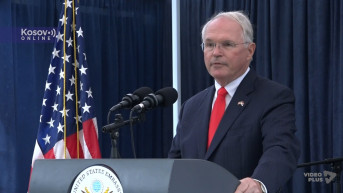
The U.S. Ambassador to Serbia, Christopher Hill, told RTS that it is very disappointing to see how far things have come in Kosovo and that there are many reasons for the lack of progress in the Brussels dialogue, primarily due to the Kosovo government. He expressed optimism that the Community of Serb Municipalities, agreed upon 12 years ago, will need to be established.
Asked whether the U.S. failed to provide a dignified life for Serbs in Kosovo, Hill responded that it was a real challenge, and Kosovo was supposed to protect various peoples, including the Serbian people.
“And I must say, as a personal matter, I find it very disappointing how far we have come in Kosovo. I hope there will be more effort in the dialogue. At this moment, I am thinking about the Brussels dialogue. And I think many of us are very disappointed with the lack of progress there. And a lot of the reasons for that failure, in my opinion, are on the side of the Kosovo government,” Hill stated.
He says he can understand the concern and frustration of many in Serbia, who are disappointed with the lack of U.S. action.
“And I would like to see an approach that the EU supports. I think the EU is trying very hard. They face a considerable challenge. It is up to us to support Europe and see if some progress can be made. But I can tell you that I am not satisfied with what has been achieved,” admitted Hill.
Asked if he is an optimist, he answered that he is always an optimist, otherwise nothing would ever get done.
“I am optimistic that the Community of Serb Municipalities, which was previously agreed upon about 12 years ago, will have to be established. So yes, I will be optimistic about that, but I think everyone needs to pull together and finish this thing because this is now not satisfactory,” said Hill.
Asked whether the next administration might be more persistent in getting things done in Kosovo around the CSM, he responded that the current administration has also tried to support the EU in getting things done, especially in implementing what has been agreed.
“I assume any future administration would take the same stance. Why it hasn't happened is something people need to analyze, carefully look at, and see what can be done. It is very clear that this is an unsatisfactory situation, and I can add that if I were from Kosovo, I would find it very unsatisfactory. In the end, many people in Kosovo deserve a better situation and know that it can be achieved through greater cooperation within the dialogue organized by the European Union,” said Hill.
Regarding the change of power in the U.S., and the remark that each time there is a change of administration in Washington, local analysts conclude that U.S. policy towards the region, especially towards Serbia, will not change at all, Hill indicated that it is hard to say and will only be seen, but certainly thinks that the incoming, Trump administration, especially part of its staff, has experience working with Serbia, so he would not rule out a change.
“The question for Serbia and for the United States is to try to improve this relationship, to continue in the right direction. I think that will happen,” said Hill and added that there is inertia in everything, certainly in the State Department, but there is also an understanding that we need to move forward with Serbia.
“There have been some changes. Serbia is much more in a position where we agree on many more things together. We'll see how it goes, but I am optimistic about the future of U.S.-Serbia relations,” Hill was clear.
On the topic of strategic dialogue, he noted that there is much to discuss with Serbia, not just about bilateral relations, but also about issues in Europe, European security, the economy.
“The U.S. is quite an important factor in the Serbian economy, especially in the field of technology. So, we have more and more people, not just basketball players, but we have a lot of people going back and forth, we have additional flights between the two countries. So, I think we will see more, and I think this dialogue will be embraced by the next administration,” Hill expects.
Speaking on the sanctions against NIS, he expressed assurance that the issue was "very carefully studied and very carefully implemented."
“From the perspective of the Serbian economy and Serbian consumers, I can say with great assurance that this will not affect the Serbian economy, nor will it affect the availability or price of gasoline in Serbia. So I think we'll be fine there. But, I'm not saying it won't be important for NIS because I think that has been our stance for a while. We've been looking at this issue ever since this big refinery was sold to Russia and it was very generous from the Serbian side and now we see that Russia has benefited much more from the Serbian economy. We do not like what Russia did with it especially for the purpose of aggression against Ukraine, but I think this is also something that the Serbian people and the Government of Serbia need to look at because it makes no sense to lose sovereignty in the area of gasoline, and I think we'll see some changes there,” said the American ambassador.
On the observation that he personally witnessed the worst relations between Belgrade and Washington, and whether he is a witness to the best ever, he answered:
“Not yet. I think we are going in the right direction.”
Asked if Belgrade or Serbia would be a good place for a meeting between American President Donald Trump and Russian President Vladimir Putin, considering the pro-Russian and pro-Trump sentiment among the citizens of Serbia, he said he cannot speak on the issue of where any potential summits that have not yet been planned and discussed might be held.
“What I can say is that we all want this war to end. We all want this war to end. And I think a great effort needs to be made to do that. But as to where the meeting would be held or whether there will be a meeting, that is not up to me. And I think at this moment, it really cannot be answered,” Hill noted and added that a great effort is needed to see if this war can be concluded because it is a very harmful war.
“What Russia has done not only to Ukraine, what it has done to European energy supplies, what it has done to global food supplies... This war needs to end,” emphasized Hill.
Asked how he explains current events in Serbia when asked about it by his superiors in the State Department, he responded that at the strategic level he sees a country that has largely made its strategic choice to go West.
“I see Serbia, there are certainly a lot of different opinions here, as in many countries, but strategically I definitely think there is a tendency to go West. Tactically, this is a tough process and, you know, everyone has their opinion here. This is a country where people feel very free to express very different opinions, so I think it will be a tough process. My job as a diplomat is not to interfere, not to tell people what to do, not to meddle in that process, but to encourage it. And that's what I've tried to do,” said Ambassador Hill.
0 comments