
Ivanov: Trump wants a quick solution for Ukraine, but he would not necessarily apply it to Kosovo
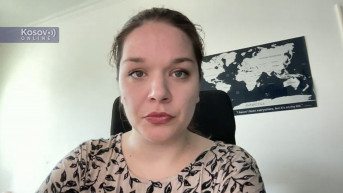
Helena Ivanov told Kosovo Online that US President Donald Trump seeks a "quick diplomatic victory" through the division of Ukraine but that this does not automatically mean the same approach would be applied to the Kosovo issue.
"The new US administration has only one goal: to reach an agreement that would be a major diplomatic victory for President Trump. In this sense, I believe they will push for some form of division of Ukraine to end the war as soon as possible. However, there will be significant resistance from both Ukrainian officials and European representatives," Ivanov stated.
She explains that the goal of Ukrainian and EU officials is to restore the situation to pre-2022, or even to 2014, when Russia annexed Crimea.
Trump's idea of dividing Ukraine does not necessarily mean that the same scenario would be applied to Kosovo, Ivanov is convinced.
"When it comes to Kosovo, I don't think President Trump is someone who is overly concerned with consistency, meaning that just because one scenario plays out in Ukraine, it doesn’t necessarily mean he will apply the same principles and standards to Kosovo. Trump is much more focused on achieving major diplomatic gains and making deals, with a very transactional approach to foreign policy," Ivanov emphasized.
However, she does not rule out the possibility that the US administration could propose a solution for Kosovo.
"Just as I believe they are looking for the most practical and quickest achievable scenario for Ukraine, I think they will attempt the same for Kosovo. However, that does not necessarily mean that dividing Kosovo would be the most efficient solution in this case," Ivanov clarified.
She says that although territorial division might seem like a quick and easy solution, in practice, it never is.
"On paper, dividing territories always seems like something that can be implemented quickly and easily. However, when it comes to actual implementation, it is very difficult to determine where the borders will be drawn, how they will function, and what will happen to those who belong to 'the other side,'" Ivanov noted.
In the case of Kosovo, as she says, the dilemma is not just how such a division would be implemented but also whether Belgrade and Pristina would even agree to such a scenario.
"On one hand, we know that Kosovo's authorities insist on full sovereignty and control over the entire territory of Kosovo, while on the other hand, Serbian representatives consider Kosovo an integral part of Serbia. So, besides European officials, I'm not sure how such an idea would be received by those living in Kosovo," she pointed out.
Ivanov explains that comparisons between Ukraine and Kosovo "only appear similar on paper."
"To an outside observer, Ukraine and Kosovo may seem like two similar cases in the sense that both involve questions of territorial sovereignty and integrity. However, there are many factors that differentiate Kosovo from Ukraine, which is why I don’t believe that a solution that might work for Ukraine would necessarily be successful for Kosovo," Ivanov said.
She adds that the application of the principles of territorial integrity and the right to self-determination raises numerous controversies and is often implemented differently in practice.
"These cases may seem similar on paper, but when examined closely, significant differences emerge in each specific situation. That’s why I believe the same solution cannot be uniformly applied to different cases, not just for Kosovo and Ukraine, but for other situations where these issues have arisen in the past or are emerging now," she emphasized.
Asked how the European Union might respond to a potential "American solution" involving the division of Ukraine, Ivanov said the EU is in a "very difficult position" because no one expected it to be entirely sidelined from a conflict unfolding on European soil.
"The European Union is truly in a very difficult situation. They may have expected geopolitical shifts if Trump won the US election, but I don’t think anyone anticipated that their position would be undermined so quickly. The complete exclusion of the EU from a conflict occurring on the European continent is something few could have foreseen before January 20 of this year, when Trump officially took office," Ivanov stressed.
Because of this, she says, the EU has two possible paths to regain relevance.
The first is aligning more closely with the US administration.
"That would be quite difficult. In this case, it would mean reversing everything the EU has been advocating since 2022 and adapting to a completely different, contradictory stance taken by the current US administration," Ivanov said.
As a second option, she sees the possibility of the EU pursuing an independent course and continuing to support the policies it has backed since 2022.
"That will also be very difficult because the EU is not independent in that sense. It lacks the military capacity to be a strong, autonomous player at this moment, whether in NATO, financial aid, or military support for Ukraine. They are likely leaning toward the second option, but the big question is whether, and to what extent, they will be able to establish themselves as such an actor," Ivanov concluded.



0 comments