
Jakaj: Once Haxhiu's term as acting president expires, without an agreement it will be unclear who will announce the election date
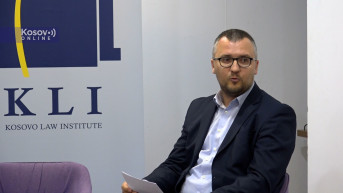
Senior researcher at the Kosovo Law Institute Naim Jakaj said that, after Albulena Haxhiu's term as acting president expires, Kosovo could face an unprecedented constitutional situation if a new president has not been elected by then. As he noted, it will be unclear who will announce the election date, who will invite political parties for consultations and who will dissolve the Assembly by signing a decree on its dissolution.
Jakaj said in an interview for Ekonomia Online that, after Haxhiu's six-month term expires, Kosovo will be left without an acting president, assessing that this is an unfavorable situation for society.
“Once Ms Haxhiu's six-month term expires, the country will be left without a president, in the sense that it will not have an acting president, and we will thus enter constitutional anarchy, a situation we have not experienced before, but which is not favorable for the Republic of Kosovo. During those six months, as well as from the time the election results were certified and from the constitution of the Assembly, political parties had the opportunity, particularly the Self-Determination Movement, to hold talks and reach an agreement on a consensual president. However, they did not do so,” Jakaj said.
According to him, the way political negotiations have been conducted so far has contributed to the creation of the current situation and could lead Kosovo to elections if the parties continue at the same pace.
“What has been done so far has looked more like political window dressing, which has led to this situation and which, by all appearances, will result in us going to elections if the negotiations continue at the same pace and with the same way of using citizens' trust in order to reach a political agreement,” he said.
Jakaj stressed that the Self-Determination Movement, as the political entity currently running the institutions, should invite all political parties to talks in order to find a solution.
“What should be done, particularly by the Self-Determination Movement, is to invite all political parties, whether it is a political agreement that would also include the law on the Specialist Chambers. If there is willingness regarding the draft law on the Bureau, the six draft laws related to the declaration on undertaken commitments, the two additional draft laws concerning the Growth Plan, as well as the draft law on budget allocations, then how is it possible for the Government of Kosovo not to find the appropriate time to analyze this draft law and sit down with PDK to reach an agreement on the president? This should be done so that the country does not go to elections,” Jakaj said.
He warned that, if no agreement is reached on the election of the president, a series of institutional uncertainties could arise after Haxhiu's term expires, including the question of who will take the steps necessary to call elections.
“If political parties are unwilling to elect a consensual president, as has been said, in order to warm the hearts of the citizens of the Republic of Kosovo, then, unfortunately, we are in a situation in which, after October 4, we will be left without a president. It will not be known who will announce the election date, who will invite political parties for consultations, who will dissolve the Assembly by signing a decree on its dissolution, or who will then convene the constitutive session, even if elections are held. Political parties could consider allowing the presidential function to continue to be exercised, in this case by Ms Haxhiu as acting president, but that would be unconstitutional,” he said.
Jakaj said that replacing the acting president would be contrary to the law.
“The Constitutional Court can change the standard, it can change a constitutional provision, as it has done two or three times before. However, such a thing would be outside constitutionality and legality, it would be contrary to international standards, as well as to the principles of the rule of law. Why, then, would the Constitution prescribe a period of six months? Why would a specific period be established during which a certain person, in this case the president of the Assembly, performs the function for six months? Because in six months, in Western countries, countries with consolidated democracy, the rule of law and a legal order, agreements are reached on very important issues, let alone on the election of a president whom Kosovo should have by the deadline specified by the Constitutional Court, which stated that if a president is not elected, the country goes to elections,” Jakaj said.
On September 23, the Constitutional Court ruled that the 60-day deadline for electing the president of Kosovo began on August 8, 2026, and expires on October 6, 2026.



0 comments