
Joireman: A sense of security is essential for forcibly displaced people to return to their homes
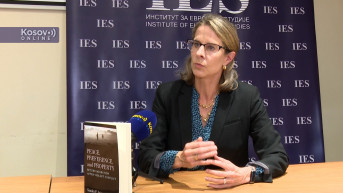
Sandra Joireman, a political science professor at the University of Richmond, explained that a sense of security is crucial for forcibly displaced people to return to their former homes, a pattern observed worldwide. At the same time, she noted that people generally prefer living in communities where they are surrounded by those they trust and share common ties. In the case of displaced Serbs from Kosovo, Joireman pointed out that they tend to return to areas where there are already Serbian communities.
Joireman highlighted that the experience of forced displacement is deeply traumatic, and as more time passes, like in the case of displaced Serbs from Kosovo, the likelihood of people wanting to return diminishes.
Post-conflict migration is one of the areas Joireman has researched. She has conducted fieldwork in Serbia, Kosovo, Ethiopia, Eritrea, Ghana, Liberia, and Oman. She was also a Fulbright Scholar at the American University in Pristina and recently gave a lecture at the Institute for European Studies in Belgrade on the topic "The Legacy and Lessons of Forced Displacement in Serbia."
After the conflict in 1999 and the following years, around 220,000 Serbs were displaced from Kosovo. According to UN data, the sustainable return rate to Kosovo is below 2%, the lowest compared to other post-conflict regions worldwide. Who is responsible for the failure to bring back more displaced Serbs?
"I don't think it's about who didn't do their job," Joireman stated. "There was significant investment in efforts to return Serbs to Kosovo, including several phases of housing reconstruction. The reason people are unwilling to return is not due to failed policies but rather personal preferences. Many of those who do not return prefer living in central Serbia or other places where they feel like part of the majority and more comfortable in their community."
When asked if fear of what returnees might face, such as provocations or attacks on their property or themselves, plays a role in their reluctance to return, Joireman responded:
"There have been some incidents, but according to OSCE data, these are often situations like graffiti or people addressing them in a hostile manner. While it's true that there are cases of intimidation in some areas, I think we cannot underestimate the trauma experienced by those displaced. This is not only true for Serbs from Kosovo. Bosnia, for example, shows us that people displaced by ethnic conflict are often reluctant to return to places where they would live as a minority."
Sandra Joireman explained that the pattern of Serbs returning to rural areas of Kosovo, rather than urban centers like Pristina, reflects a shift from typical return migration seen in other contexts. In countries like Liberia, Uganda, and Colombia, people tend to return to urban areas because of better job opportunities, access to education, and more entertainment options. However, this doesn't necessarily apply to Serbs returning to Kosovo.
"What we’ve seen with Serbs returning to Kosovo is that they’ve gone back to rural areas where they have their community and perhaps a strong connection to the land through many generations. This is something they simply do not want to give up," Joireman said. She acknowledged that she does not have specific demographic data to confirm this, but she assumes that older people are the ones most likely to return to their farms, orchards, vineyards, and the areas where there is a strong attachment to the land.
Sandra Joireman explained that efforts to restore property, like those seen in Kosovo, often occur long after the conflict—sometimes five, ten, or even fifteen years later. By that point, people may no longer care as much about returning. "The longer the time that has passed, the less likely people are to want to return because the community has changed, and so have their lives," Joireman noted. However, she pointed out that even decades after displacement, some people still challenge property confiscations, as seen in Europe with cases dating back to World War II. She highlighted a unique initiative in Ukraine, where efforts to identify lost property during the conflict are already underway, allowing people to report property losses online. This could be a useful model for future conflicts, as it would allow for a quicker restitution process once the war ends.
During her research, Joireman observed differences in attitudes toward returning to Kosovo based on generational divides among displaced Serbs. "I conducted many interviews with displaced Serbs in central Serbia, asking if they wanted to return, if they felt at home in central Serbia, or if they felt their home was somewhere else. I found a significant difference between generations. Children who were displaced with their families in 1999 and have since grown up in central Serbia feel that it is home. They strongly feel that Belgrade or other parts of Serbia are their home, but their parents often say that their home is elsewhere or that they are unsure where it is. So, the sense of losing home is much more pronounced in the older generation compared to the younger one, which has grown up here," she explained.
Regarding the importance of economic stability for those wishing to return to Kosovo, Joireman emphasized its significance. "Economic stability is extremely important because if you want to stay, you need to be able to make a living. I think that's another challenge with Kosovo, where the economy is relatively depressed compared to central Serbia, which discourages people from returning. UNHCR and the International Organization for Migration are very aware of this and have tried to include income-generating programs along with house reconstruction efforts," she said.
Joireman noted that while security is essential for people to return, it's also important for returnees to live with people they trust and feel comfortable with. "We've seen globally that safety is a prerequisite for people to return, but they also prefer to live with their own community, where they know and trust their neighbors. In the case of returns to Kosovo, people tend to go back to municipalities where their fellow Serbs live. I recently read a study on Syria, which found that refugees are more likely to return if they know that they will be returning with a group of people they trust and feel comfortable with. The same idea applies elsewhere in the world," Joireman concluded.
Sandra Joireman explained that the feasibility of Serbs returning to Kosovo depends on the area. "In some places, it's possible, in others, not so much. Serbs return to areas where their children can attend schools in the Serbian language, where there is a significant Serbian community nearby, and where there are enough young men and women for their children to marry within their ethnic group. These factors are important," she said.
What is particularly interesting in Kosovo's case, according to Joireman, is that the largest return of Serbs hasn't necessarily been to municipalities with a Serbian majority. "One might think that everyone would return to the north or to Gracanica, but that’s not the case. Some have returned to places like Istok and Klina, where they have established Serbian communities. What I don't know about Kosovo is how many people have stayed in these places after returning. It would become a problem if people began moving back to central Serbia for economic or educational reasons. This would make it harder for those who remain to stay," she added.



0 comments