
Konrad: We don't support just one side; we are in favor of respecting the Brussels Agreement
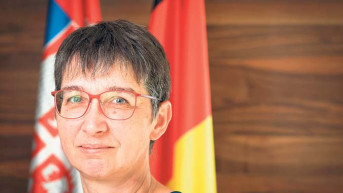
Germany and France support the process initiated by the Brussels Agreement, considering that it is particularly important that in this situation both Belgrade and Pristina be ready for a compromise, so that there is no escalation, says German Ambassador to Serbia Anke Konrad, adding that she does not see the basis for doubts that Berlin supports only one side or that it no longer wants the Brussels Agreement, RTV reports.
In an interview for Tanjug, Konrad points out that Germany advocates for the respect of the Brussels Agreement and its implementation, including the establishment of the Community of Serb-majority Municipalities, because it is part of that agreement, but at the same time she states that there are other points in that agreement, and that both parties should work on its implementation.
When asked if this means that Berlin is in favor of establishing the Community of Serb-majority Municipalities, she answers in the affirmative.
"This is provided for in the 2013 agreement and it clearly states that it should be implemented. There is nothing that would contradict that or indicate that the agreement is no longer valid. It must be implemented and that applies to both parties," ambassador said.
She adds, however, that there are other points in the agreement, and that it is not only about CSM, and that there is still a lot that needs to be resolved regarding customs, property issues, and transportation.
"Everything contained in the Brussels Agreement must be implemented," she pointed out.
She points out that the goal of the Franco-German proposal, the alleged text that was leaked to the public, for the solution of the Kosovo issue is aimed at the normalization of relations between Belgrade and Pristina and a future in which, according to her, all the countries of the region are members of the EU.
"At the end of the final solution, and there is a lot that needs to be solved until then, we start from the fact that there will be recognition of Kosovo. But we don't say - first recognition, and then the rest. First, trust needs to be established," she said.
Germany and France support, she points out, first, the process initiated by the Brussels Agreement and emphasizes that Miroslav Lajcak is an excellent EU envoy, who in the role of mediator tries to find a solution with Belgrade and Pristina, as far as the two sides allow.
"We support that process, and we want to point out the perspective of normalization, that the focus should be on the future. We would like to see the countries of the region as members of the EU. Such a perspective should be persistently highlighted, not to dwell on technical issues, but to look ahead, where that path leads, what is possible in the future. Our proposal, and I know all the speculations, has exactly that idea at its core," she said.
On the statement that, since Germany clearly stated that Serbia should recognize the so-called Kosovo, and that one gets the impression that Berlin is putting pressure on Belgrade to make it happen, she replies that one must go step by step, and the goal of normalization, she says, is to get out of the situation of constant conflicts, raising emotions when a certain deadline approaches.
"We need to enter into a regular dialogue, but not to have only high-level meetings when an issue remains without an agreement and an escalation is looming due to the expiration of a deadline, as now, but to have it be a process in which such issues would be resolved in a timely manner. No escalation is in our interest, and certainly not in interest of Belgrade, nor Pristina", believes Konrad, who recently assumed the post of German ambassador to Serbia, succeeding Thomas Schieb.
When reminded of the statement of the President of Serbia during his stay in Paris, that Pristina has the absolute support of Berlin, as well as London, for everything it does, Konrad replies that it is not her task to comment on anyone's statements.
"We want the implementation of the Brussels Agreement, the continuation of the dialogue on the normalization of relations. That's why I see no reason to suspect that Germany supports only one side, or that it no longer wants the Brussels Agreement," Konrad said.
Asked how she evaluates the cooperation between Germany and Serbia, at a time when the interests of our country do not coincide with Germany's political views, especially when it comes to the so-called Kosovo and the sanctions against Russia, she replies that the cooperation between the two countries is "close and with a lot of trust".
In the foreground is the economy, but cooperation encompasses much more than that, e.g., these days, the German government handed over new equipment for border control to the Serbian border guards, there is intensive cooperation in the field of culture and many more joint projects, she added.
Good cooperation, she says, is characterized by conversation, even on topics where there is no common opinion, but over which we have to fight to find a common position.
"Regarding the issue of Kosovo, our position is clear. We want a dialogue on normalization, for Belgrade and Pristina to find the possibility to normalize their relations. This would be very important for Serbia and Kosovo, but also for the entire region. On the issue of sanctions against Russia, the position is, also, known. We hope that Serbia, after already condemning Russia's attack on Ukraine, will do the same in the next step. We are talking about it, and we hope that Serbia, like the other countries in the region have done it, will be able to go that way," Konrad said.
When asked whether Serbia should still be afraid of Berlin's increased involvement, in a political sense, given the events in Kosovo and Metohija, and regarding Republic of Srpska, Konrad replied that she saw no reason for such fear and that Serbia should not be afraid, because Berlin's involvement is fruitful, she says.
In this sense, she stated that since 2000, through development cooperation, Germany has invested 2.3 billion euros in the development of Serbia.
"It's all part of engagement. We have trust, and I see no reason to be afraid," Konrad concluded.


comments