
Kurti: The Community of Serb-majority Municipalities is apartheid
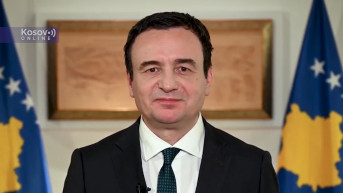
The Prime Minister of Kosovo, Albin Kurti, assessed that the Franco-German proposal was a good basis for talks, but reiterates that he is against the formation of the Community of Serb-majority Municipalities because he sees it as apartheid, Deutsche Welle reports.
Kurti said that the latest proposal for an agreement on the normalization of relations between Serbia and Kosovo, backed by the European Union and the US, was a solid platform for a step forward. He added that for now there were no plans for a meeting with the President of Serbia, Aleksandar Vucic, but he expressed hope that high-level negotiations would continue.
"The EU proposal, which has been accepted in principle, needs to be further elaborated, because many concepts in the proposal are generic, and we need to further discuss the implementation mechanism, the time sequence of implementation, and especially the international guarantees for this future agreement," Kurti said.
Asking for the CSM before recognition is like asking for a cup of coffee without a mug
He, however, reiterated that the full normalization of relations had to have mutual recognition as a central part.
"We cannot let the cart go before the horse. Looking for any kind of community before mutual recognition is like asking for a cup of coffee without a mug. It is not possible," Kurti said.
He says that the part of the Brussels agreement that foresees the formation of the Community of Serb-majority Municipalities contains racist elements and reiterates that it has already been rejected as such by the Constitutional Court of Kosovo.
"It's apartheid. I'm against it. When we declared independence 15 years ago, there was 93 percent of Albanians and we were told by the international community that Kosovo could not be declared an independent Albanian state, but a multi-ethnic one. Insisting now on an ethnic Community of municipalities is strange and unacceptable," Kurti adds.
He called on Serbia to be the first to form "communities in the Presevo Valley or Sandzak and show by example how that model should work".
"But I think it's not an idea for the people, for increasing rights for citizens, but for territorial expansion. In Bosnia and Herzegovina, Montenegro, and Kosovo, Serbia gives hundreds of millions of euros to prevent the Serbs from integrating. Therefore, the concept of the Serbian world as a new name for Greater Serbia lives on instrumentalizing the Serbs wherever they are," Kurti says.
When asked how he planned to return the Serbs to Kosovo's institutions, Kurti said that those mayors who had resigned could not return, but new elections would have to be organized.
"On the other hand, we are very interested in as many Serbs as possible applying to become police officers in Kosovo. So far not enough have signed up, but the number is increasing, so we are hopeful. I don't want to replace the Serbs with Albanians in the north, but we will not stop enforcing the rule of law in the entire territory," Kurti said.
He once again called on the Serbs to trust the Government of Kosovo and apply for a job, promising that they "will not need membership cards of the Serb List" for that, as he says was the case before.
Serbia is not a normal country
Speaking about 15 years since the declaration of independence, Kurti assessed that Kosovo was a double success story - about the "struggle for the liberation of a nation" and the building of democracy accompanied by economic development.
The relations between Serbia and Kosovo, however, are not normal, says Kurti, but he believes that this is a consequence of the fact that Serbia is not a normal country.
"Kosovo is a normal democratic country. Serbia is not. Even according to Freedom House, Kosovo has a democratic regime, and Serbia is a hybrid regime, which is a euphemism for autocracy," he says.
He repeated the accusations against official Belgrade that they had instructed the Serbs to leave the institutions and "criminals in the north" to hide behind the people and the national identity.
"Because of fear of the rule of law, they erected barricades, and also because of fear of the rule of law, they decided just before the New Year to remove them. Our police do not chase anyone based on ethnicity or national identity, but only based on their actions and behavior, whether it is an individual or a group," he adds.
We do not rule out the possibility of aggressive attacks by Serbia
Kurti believes that if the agreements fail, a new war can occur.
"I'm not saying they're going to attack us this week or next week. But we are also strengthening our security and defense capacities," the Kosovo Prime Minister said.
He recalled the close ties between Serbia and Russia, especially in the military domain, and said that after the Russian invasion of Ukraine, they were also on guard - especially after Serbia had already deployed 48 offensive operational bases on the administrative line with Kosovo.
"There are 28 military bases, 20 gendarmerie bases, with 50 to 150 armed men in each of these offensive operating bases, where many Wagner Group and Night Wolves mercenaries have been seen circulating and organizing. Some of them also came to the barricades in the north with slogans dominated by the message 'pray to God and stick to Russia'. That's why we have to be careful. We do not rule out the possibility of aggressive attacks from Serbia," the Prime Minister of Kosovo claims.

0 comments