
Lajcak: Without the CSM, based on the agreements reached, there is no agreement - wait and see
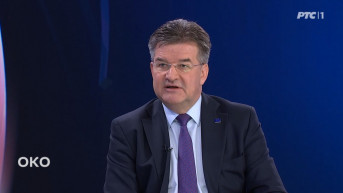
The Special Envoy of the European Union for the dialogue between Serbia and Kosovo, Miroslav Lajcak, pointed out today that the Community of Serb-majority Municipalities had to be established, based on the agreements from 2013 and 2015, and the models he had proposed in Pristina, he says, aim to show that there is no need to fear the Community.
Lajcak, in the RTS "Oko" show, indicated that the goal of his mandate was to help normalize relations between Kosovo and Serbia and to work on that.
"The very name of my position says that relations are not normal, and I want to establish relations in which people can move freely, study, and do business, and that is in the interest of everyone," he explained.
Lajcak recalled that a high-level meeting had been held on February 27 in Brussels, and it had been agreed that there had no longer been a need to discuss the text of the proposal that had become public.
"However, in order to implement that text, we need to agree on the sequence of steps, who should do what, and when. The level of trust on both sides is very low and both sides are looking for guarantees. And the goal of my visit to Belgrade and Pristina is exactly that," he added.
He said that he had been in Pristina to get an opinion regarding the annex for the implementation of the agreement.
He stated that an important part of the agreement was the establishment of the CSM.
"It was agreed in 2013 and 2015, since then nothing has happened, and it must happen, based on what was agreed. We proposed the analysis of 15 existing models as an inspiration, not as an alternative because the two agreements from 2013 and 2015 may not answer all the questions," he explained.
He said that the CSM had to be established based on the agreed model in 2013 and 2015.
The models he transferred to Pristina, he explains, should show that no one should be afraid of the Community.
"In Europe, there are models of self-government of minority groups or people. It is nothing dangerous, no one should be afraid of it. It is normal in Europe that we have a legal guarantee, rules, that the minority community feels safe," Lajcak added.
When asked whether the CSM would have executive powers, he said that the CSM did not exist on that day, and what it would have should be agreed upon by Belgrade and Pristina within the dialogue, but based on what had already been accepted and signed.
He pointed out that the Statute should be proposed and there should be an agreement on it.
"For us, it is important that everything that was agreed is fulfilled. It has not been fulfilled for ten years, but it will be this time. We will not have an agreement without the CSM and the guarantee that it will be established. Inspiration is needed because many in Kosovo are afraid of the CSM, that it will cause damage to the functioning of the system. But many models in Europe show that this is not the case," he explained.
Lajcak reminded that in February, the European Council, as the highest body of the EU, had adopted conclusions in which three members were committed to dialogue, and one of them was precise that the CSM had to be established.
"The EU and the US clearly and explicitly state that the CSM must be established. The Article 7 of the proposal states that it must be established. It must and will be," Lajcak said, and when asked how it would be established now when it hadn't been for 10 years, he replied, "Wait, you'll see."
He added that the position of the EU and the US had never been so clear, and the EU had never been so united with Great Britain and America, that the CSM had to be formed and that everyone had to respect it.
When asked about the upcoming talks in Ohrid, Serbian President Aleksandar Vucic said that he should go to Ohrid, that it was in Serbia's interest, and that it was important to continue the talks.
"The goal of my mission in Belgrade and Pristina is to prepare the positions and bring the positions of the two sides closer together, to prepare a proposal that should serve as the basis of the talks in Ohrid," Lajcak said.
When asked whether each side could choose what they wanted to discuss, he reminds that the proposal has been accepted as a whole, but that the implementation needs to be negotiated.
"Our goal is to agree on the full implementation of the proposal. The CSM has become a key issue and the time has come that, if there is no CSM, there is no agreement, no normalization. But I don't believe that it could be fixed. The expectation of the EU is so clearly and explicitly stated that for me the question is not whether it will be formed but how," Lajcak said.
In response to the statement that he seems to be putting unequal pressure on one side and the other, he says that for three years he has been listening in Serbia that he supports Kosovo, and in Kosovo that he supports Serbia, which for him is an indication that he is neutral because he just wants to help solve the problem.
When asked if he had brought an ultimatum to Belgrade in January, he replied that the EU did not use the language of an ultimatum, but that they had discussed what alternatives there had been, and that Vucic clearly said that the alternative to rejecting the proposal would not be good for Serbia.
Asked whether for him, as a Slovak diplomat, Kosovo was an integral part of Serbia or if he considered it independent, he replied that he had been dealing with this region for more than 20 years, he knew it well, and he saw how much potential and desire the Balkans had to become part of the EU.
"The past hinders progress towards the future. It is mine to help solve the problem, but not in the sense that someone wins and someone loses, but to make it a 'win-win' situation, to help and open European doors," Lajcak said.
Commenting on the low support for the EU in the region, he says that there are several reasons and that citizens in the region have lost confidence in the EU regarding the region's membership.
He says that since the outbreak of the war in Ukraine, the EU has changed its attitude and is serious, and now the EU doors are open again, and the only question is whether the countries of the region can take advantage of this opportunity.
"The Balkans will be safe only when the countries of the region become full members of the EU," Lajcak said.
When asked how to trust Brussels, considering the example of North Macedonia, which changed its name and did not progress far in the accession process, Lajcak said that the atmosphere in Brussels had changed and that everyone knew that the goal of the process should be the membership of these countries and that it was not a political decision, but related to the fulfillment of technical conditions.
"That is why it is important to mobilize all pro-European forces in Serbia and the region because the door will not be open forever," Lajcak noted.
He pointed out that the European proposal was about normalization, not about capitulation.
"We should be aware of that and I believe that the proposal is fair and beneficial for Serbia and the region," Lajcak said.
He added that he was not here to change history, but to help make the future better, a European one, because he knew from the perspective of his country how much good it would bring to the citizens.
"I have the mandate of 27 member countries, and my mandate is to help normalization and I am doing that. This is not capitulation," Lajcak said.
When asked if it was a recognition, he replied that Serbia and Kosovo should agree on that and that the EU would not decide on it.
Asked whether a satisfactory plan could be reached in Ohrid, or at a subsequent meeting, as well as whether it was possible to resolve the Kosovo issue in a year, as the US said, Lajcak replied that one day the issue had to be resolved because one could not live in the past.
"We need to look for a solution. I advocate that we look for a fair solution for both sides. The past cannot stop us on the way to the future. We are looking for a solution that would open the European way so that the citizens of Serbia can believe that their European future is not a matter of decades, but the near future. The meeting in Ohrid aims to reach an agreement on the implementation of the agreement, which has such support in the EU that I do not remember in the past. We all want this area not to become a ground for destabilization," he explained.
Asked about his position on the Republika Srpska in Bosnia and Herzegovina, he said that the Republika Srpska was the architecture that had been decided in Dayton, where the main goal had been to stop the war.
"That should be respected. We succeeded in that, but we are not at war today. We should not look for war solutions, but functional solutions. Bosnia and Herzegovina is not a model of state functionality. Today we are looking for solutions that will speed up the European path of this region. That is the main difference. That's why we shouldn't look for inspiration in war models," Lajcak pointed out.
He said that the Republika Srpska solution had been adopted in 1995 and that today a European solution was being sought, which would speed up the European path.
He pointed out that he was proud of his service in Sarajevo because Bosnia and Herzegovina had then signed the Stabilization and Association Agreement with the EU, which, he believes, is the most important document, even more, important than receiving candidate status.
However, he says that in Bosnia and Herzegovina, there is a constant discussion about competencies and that a solution must be found that is European, who gives competencies to whom - entities to the state, or the state to the entities.
"That is the main dilemma of Bosnia and Herzegovina, about which there is one opinion in Sarajevo and another in Banja Luka," he said.
He pointed out that now, when he was not in Sarajevo, he was watching from a distance, and that he did not take sides with either of them, but only wanted to encourage finding a solution because it was crucial for Bosnia and Herzegovina.
As far as Montenegro is concerned, he said that the country had made the most progress on the European path, but the fact was that after the 2020 elections, there had been a standstill, that is, the state had been more concerned with itself than with democratic reforms.
"There was very little progress on the European path. There was an institutional crisis. We did not have a functional constitutional court. I believe that we are now on the way to returning to normality. We have presidential elections and after that, I expect a solution regarding the mandate of the government," he said.
In the end, when asked if after the dialogue he expected that Belgrade and Pristina would have something to reward him for, he said that he was here to help a fair process and offer his knowledge from the region and knowledge from the EU to help Serbia and the entire region on the European path.
"I am here to help a fair process; I offer my experiences and the experiences of the EU in order to help Serbia and the entire region on the way to the EU. I believe in the European way and European solutions. And history will judge whether my way of acting is fair or not," he emphasized.

0 comments