
Le Figaro on the Popovic case: A new anti-Serb provocation – 30 days in prison for a verbal offense
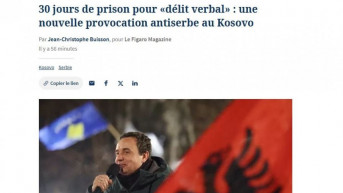
The renowned French daily Le Figaro published an article about the arrest of Igor Popovic, assistant director of the Office for Kosovo and Metohija, stating that France has called for his immediate release. The article raises the question of what exactly Popovic's "crime" is, given that he merely stated facts about crimes committed against Serbs—facts that have been internationally acknowledged as such.
The article opens with the question: “What are the Albanian authorities in Kosovo aiming for?” followed by a summary of the events leading up to Popovic’s arrest.
“For two weeks now, one of the Serbian negotiators involved in the EU-mediated dialogue between Belgrade and Pristina has been rotting in a prison in Gnjilane, a small town in what was once a Serbian province that declared independence in 2008. Igor Popovic was arrested by Kosovo police forces on July 20 in Brnjak, in the northwest of the country, where several thousand Serbs still reside. Shortly after his detention, the investigating judge ordered 30 days of custody. His crime? ‘Incitement to discord and intolerance,’” Figaro writes.
The article then questions the exact nature of the “verbal offense” Popovic is being accused of.
“Invited to pay tribute to the memory of 47 murdered Serbs and Roma and dozens of residents from the area around Orahovac who were abducted by the KLA in July 1998, Popovic gave a speech on July 18 in Velika Hoca, in which he called this movement—the armed wing of the Albanian separatists—a ‘terrorist organization’ (a term used at the time by the Yugoslav authorities and even by the United States until 1997), responsible for ‘the killing of Serbs.’ These are all truths, facts that have been acknowledged, including by the International Criminal Court in The Hague, through the Kosovo Specialist Chambers, which is currently trying four former KLA leaders, including former president (2016–2020) Hashim Thaçi, for crimes that may qualify as war crimes and crimes against humanity. Yet, nearly thirty years after these events, Kosovo continues to regard every action taken in the name of liberation from Serbian rule as an act of resistance—even the killing of civilians. ‘The KLA’s just struggle is the foundation of our state and cannot be questioned,’ said Smajl Latifi, mayor of Rahovec, in reaction to the Popovic case,” the article continues.
The Serbian government reacted immediately, denouncing the arrest as “a serious and unacceptable violation of fundamental rights and freedoms.”
“For her part, Ana Hrustanovic, Serbia’s ambassador to France, sees the arrest as ‘a new provocation aimed at destabilizing the situation on the ground and in the region, directly affecting the dialogue between Belgrade and Pristina. It is unacceptable that members of the negotiating team be arrested.’ At the same time, it is equally inconceivable that anyone should be prosecuted simply for mentioning crimes that are internationally recognized as such, committed against Serbs in Kosovo and Metohija,” Figaro emphasizes.
The article also recalls that the French Ministry of Foreign Affairs expressed its concern in a statement published on July 24:
“France reiterates its support for European mediation efforts toward normalizing relations between Serbia and Kosovo. This implies that negotiators and their teams must be able to move freely and safely in both countries. France calls for the immediate release of the Serbian deputy negotiator Mr. Igor Popovic.”
The European Commission adopted a more cautious tone, expressing the desire “for full respect of the rule of law and the right to a fair trial,” the paper notes.
It is also mentioned that Popovic’s family and lawyers—he has long been respected for his work with the missing persons commission (which investigates both Serbian and Albanian victims)—have been able to visit him in his cell.
“Petar Petkovic’s deputy reiterated to them that he does not believe he offended anyone by stating plain facts in his speech. Dejan A. Vasic, who leads his defense, stressed that Popovic’s statements in no way constitute a criminal offense. However, some of his close associates do not share that measured optimism. For them, as well as for many observers, this arrest is part of a broader campaign of intimidation, even persecution—legal, economic, if not physical—of the Serbian minority in Kosovo. Contrary to the official rhetoric of the Kosovo authorities—closely watched by EU representatives seeking regional peace—it seems everything is being done to push the Serbs to leave. Especially ahead of parliamentary elections: for fifteen years now, anti-Serb sentiment has been a guaranteed vote-winner in the Albanian-majority areas of Kosovo,” the article states.
The French daily also points out that Kosovo Prime Minister Albin Kurti “understands this well” and has spent the past two years provoking constantly.
“In 2022, by preventing the opening of polling stations in Kosovska Mitrovica—a city divided between Serbs in the north and Albanians in the south—he nearly sparked conflict by imposing a rule that vehicles in the Serbian part of Kosovo must carry Albanian license plates, which enraged Belgrade. Peace was eventually restored, but not for long. A few months later, Kurti allowed the deployment of Albanian special forces in the same predominantly Serbian region, leading to barricades and serious tensions. Then he imposed Albanian mayors in municipalities with Serb majorities. The result: violence and unrest in which dozens of people were injured—Serbs, Albanians, police officers, KFOR members, and even journalists reporting on the events,” Figaro writes.
The article concludes that Kurti is behaving as if he’s hoping Serbian President Aleksandar Vucic will react harshly, “so that he can cry wolf and point to the return of Serbian imperialist nationalism.”
“So far, Vucic hasn’t taken the bait. While calling for an end to Albanian terror, he reiterated that ‘there will be no conflict and that he will always fight to preserve peace and stability.’ But the question remains—do the Albanians in Kosovo truly want the same?” Le Figaro concludes.
comments