
Less: In the long term, border changes are a prerequisite for the stabilization of the Balkans
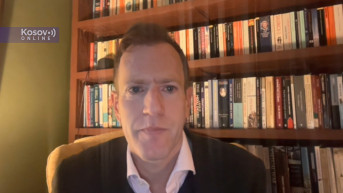
Timothy Less, a professor at the Centre for Geopolitics at the University of Cambridge, tells Kosovo Online that the administration of U.S. President Joseph Biden will certainly not support a solution to Kosovo's status based on territorial exchange, and that such a solution would not have the support of Kamala Harris's administration either, if she wins the elections in November. If Donald Trump wins the elections, his administration, as Less assesses, would support territorial exchange or the partition of Kosovo as a means to secure Serbia's recognition of Kosovo.
The option of territorial exchange was mentioned a few days ago by John Bolton, the former National Security Advisor in the administration of former U.S. President Donald Trump, when he stated that the American position has "for some time" been the hope that Serbia and Kosovo could reach something acceptable to both sides, including territorial exchange.
"Biden, Harris, and the Democratic Party, in general, are liberal idealists motivated by ideas of restorative justice, punishment for what they see as Serbia's barbarism in the 1990s, opposition to nationalism and nation-states. They place great value on what they call the international rules-based order, which excludes any kind of border changes, especially at a time when Russia is seeking to revise borders elsewhere in Eastern Europe," says Less.
On the other hand, as he adds, it is entirely likely that an American administration led by Donald Trump would support territorial exchange or the partition of Kosovo as a means to secure Serbia's recognition of Kosovo, with the clearest proof being that this was the solution the previous Trump administration pursued when Trump was in power at the end of the last decade. Less believes Trump might have even completed this solution if he hadn’t lost power in November 2020.
"Furthermore, territorial exchange or the partition of Kosovo would align with Trump's worldview if he returns to power in 2025. Unlike Kamala Harris and the Democrats, he is not interested in punishing the Serbs, he is a nationalist, sympathizes with nationalists around the world, and is not interested in maintaining the international rules-based order if it contradicts American interests—in this case, the American interest in resolving Kosovo's status and bringing American troops home. Through his statements, Trump has implied that he is willing to accept the partition of Ukraine as a means to end the war in that country, and he probably wouldn't be concerned about setting a precedent in Kosovo for redrawing borders elsewhere in Eastern Europe," says Less.
Regarding how the option of territorial exchange is viewed by official London and Berlin, our interlocutor says that, as things stand, he doubts they would be "in favor." Both countries, he notes, are led by liberal idealists who oppose border changes in the Balkans for largely the same reasons as the Biden administration.
"This is hostility toward nationalism, a desire to punish the Serbs, a kind of legalistic way of thinking that does not accept border changes, hostility toward Russia, opposition to the partition of Ukraine, and so on. All of which certainly represents an obstacle or at least a potential obstacle to any future Trump administration's attempt to resolve Kosovo's status through territorial exchange, just as it was in 2018 when London and Berlin opposed partition, encouraging the Albanians to resist it as a solution. But the government in Germany is weak and could fall, potentially being replaced by a right-wing government that has a more realistic and less idealistic view of the Balkans. In that case, it could force the United Kingdom to change its position to avoid isolation and allow others to determine a solution for Kosovo's status without it," Less believes.
When asked whether territorial exchange would be an option that contributes to stability in the Balkans or would have the opposite effect, as others in the Balkans might want to reopen border issues, Less says that although there are short-term risks of instability, they are limited. In the long term, however, border changes in the Balkans are a prerequisite for stabilizing the region.
"This would allow various peoples to live in their own states with full rights and opportunities, as opposed to the current multiethnic concept, which maintains a state of nervousness, tension, and ultimately instability," says Less.
He certainly does not exclude the possibility that territorial exchange, in the case of resolving Kosovo's status, would bring up other border issues, pointing to the stance of Milorad Dodik and the Serbs from Bosnia and Herzegovina during the 2018-2020 period, when they advocated for the inclusion of Republic of Srpska in the agreement regarding Kosovo's status.
"Moreover, I believe that the Bosnian Serbs would push even harder for this in 2025 if Donald Trump were to return and seek partition as a solution, given their increasing determination to separate from Bosnia and the pressure on Mr. Dodik, whom the Bosniaks and their international allies are trying to imprison because of his stance on the independence of Republic of Srpska. I don't doubt that moves to break up Bosnia would provoke a political reaction from the Bosniaks, who want to preserve the country within its current borders, but I wonder what they could really do to stop it unless the U.S., under Donald Trump, would be willing to support them. This means that while there are some short-term risks of instability due to territorial exchange as a solution, I believe those risks are limited," concludes Less.


comments