
Lucic: Accusations from Pristina about hybrid warfare are dangerous and false – Telekom Srbija to file lawsuits against those responsible
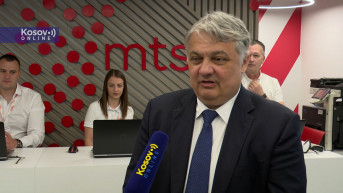
The CEO of Telekom Srbija, Vladimir Lucic, stated this evening that accusations claiming Belgrade is waging hybrid warfare against Kosovo through the company and that a bomb threat to the Kosovo parliament allegedly originated from an MTS number are “an absurd and shameful attack on a company that has been a thorn in Pristina’s side for two years.” He emphasized that such attacks will no longer be tolerated and that anyone accusing Telekom Srbija of such dangerous activities will face lawsuits and compensation claims.
“I believe there are two goals here. First, nervousness because they can’t form a new majority, and second, pressure on the Serbs – particularly now on our company,” Lucic told Euronews Serbia.
He recalled that Pristina’s authorities tried to shut down Telekom on Kosovo two years ago.
“They issued a decision for our shutdown, which we managed to prevent with the help of the international community. The attacks come almost daily, but Telekom will now respond more firmly. We will react more strongly than before, because this is no longer just political pressure, but a direct attack on our work and presence,” Lucic said.
He stated that it all started after a statement by Kosovo’s acting Minister of Internal Affairs, Xhelal Sveçla, followed by comments from Prime Minister Albin Kurti and one of their security analysts who "explained" how Telekom allegedly participates in hybrid warfare.
“This is a very dangerous level of attack on our company and we will not allow it. Whoever sent that message, it turned out to be a false alarm – there was no threat at the Assembly. I even doubt that any of our five million users reported anything at all,” Lucic added.
He stressed that Telekom Srbija operates strictly in accordance with the law and international agreements, including the Brussels Agreement, under which the company has 28 base stations in areas where Serbs live in Kosovo, while the headquarters and technical infrastructure are located in Belgrade.
“When they need information, they know it has to go through the Serbian Ministry of Justice, not by harassing our local company, which doesn’t even hold those data. Still, they continue to exert pressure locally and then present it as if we’re hiding something or not cooperating,” said Lucic.
He described the situation as a coordinated effort to once again subject Telekom Srbija to political pressure, similar to what occurred two years ago when there was an attempt to terminate their operations in Kosovo, halted thanks to international support.
“They’re misleading both the embassies and the public. If they granted us the third license, as we’ve requested, we would build a full network and be obliged to have all the necessary technical capacities and local control. They know this but don’t care about the truth – only about weakening or eliminating us,” Lucic warned.
He announced concrete legal steps:
“Anyone who accuses our company of such serious matters in the future will face lawsuits and compensation claims. We will no longer tolerate these attacks. Telekom Srbija is not a target, and we will not allow ourselves to be associated with any kind of hybrid warfare or terrorism,” Lucic stated.
Lucic accused Albin Kurti’s administration of knowingly and continuously violating its own laws in order to hinder Serbian businesses in Kosovo and further pressure the Serb population living there.
“What we’ve been saying for two years is now even more obvious – Kurti’s administration selectively applies the law. If the company is Serbian, like Telekom, then different rules apply – just to make our work more difficult and indirectly pressure the Serbs,” he said.
He also recalled a previous case involving the head of Kosovo’s Competition Protection Commission, who announced a €1.5 million fine for Telekom Srbija on television before a formal decision had even been made.
“This is unimaginable in European practice – for the head of a regulatory body to appear on TV and publicly state who will be fined before a decision has been made. That is a direct violation of legal procedure,” Lucic emphasized.
He particularly pointed out that Pristina has for years refused to grant Telekom the third license, although this is foreseen under the Brussels Agreement.
“They were obliged to announce tenders. And they know it. They’re aware we would win, because we have technical and financial capacities that others do not,” said Lucic.
He added that there was an attempt to allocate the entire 5G spectrum without Telekom’s participation, which, in turn, opened space for a new diplomatic initiative.
“We will intensify communication with the U.S. side. We expect the arrival of new ambassadors in Pristina and Belgrade, and we believe we can resolve the issue of the third license,” said Lucic.
He claimed that the existing operators in Kosovo, particularly the one that was, in his words, established by “seizing Telekom Srbija’s assets in 1999,” lack the capacity to build a modern network and are operating at a loss.
“If we obtain the third license, we will not only bring a higher-quality 5G network, but we will also have a large user base – among both Serbs and Albanians. Telekom has the support of the U.S. Export-Import Bank and the strength to cover the entire region. Sooner or later, they will have to let us develop the mobile network in that territory,” Lucic emphasized.
Telekom Srbija employs 250 people and has around 30,000 users in Kosovo, but the company’s significance for Serbs goes far beyond the numbers, Lucic said.
“That’s 30,000 households that get internet, TV, landline, and mobile telephony through us. People are trying to live a somewhat normal life under extremely difficult conditions. Telecommunications today are a fundamental part of everyday life,” Lucic said.
He pointed out that citizens in Kosovo want to watch Serbian channels, have high-quality internet, and maintain stable connections with relatives and friends across the country.
“We provide that. Cutting us off would make that much harder – and for many, it would be yet another signal to leave their homes. That’s why we’re a problem,” Lucic stressed.
Speaking about overall business operations, Lucic reminded that Telekom Srbija is currently the most successful operator in the region, as recently confirmed by telecommunications media in Croatia.
“A Croatian portal that has been following telecoms for years reported that we are €400 million ahead of the next-largest operator – Hrvatski Telekom. We’ve outgrown the region in terms of revenue, and I believe that by next year we won’t even be included in the same comparisons. Our growth indicates we are moving toward the European market,” said Lucic.
According to him, Telekom Srbija expects to be compared with the biggest players on the European market within two to three years.
“We are no longer just a regional company. We are becoming a European operator that brings real development and support to people – whether they are in Belgrade, rural Serbia, or Kosovo and Metohija,” Lucic concluded.
0 comments