
Monument unveiled to members of the 37th Motorized Brigade killed, missing, and wounded in Kosovo
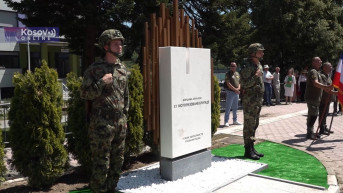
A monument commemorating the 60 members of the 37th Motorized Brigade who were killed, three who remain missing, and 186 who were wounded in Kosovo during the NATO air campaign against the Federal Republic of Yugoslavia was unveiled and consecrated today in Raska. Serbian Deputy Prime Minister and Minister of the Interior Ivica Dacic said the monument represents an expression of respect for those who honorably served their homeland and confirms that their sacrifice will not be forgotten.
Dacic emphasized that the monument carries special significance because it was erected at the initiative of the Association of Members of the 37th Motorized Brigade, with the support of the local government, demonstrating that preserving the culture of remembrance is not only the responsibility of the state but also of the community itself.
"When a community decides to erect a monument to its brigade, it preserves the memory of all its members—those who laid down their lives, those who endured the hardships of war while fulfilling their duty, and their families, who bore the greatest sacrifices alongside them," Dacic said, according to a statement issued by Serbia's Ministry of the Interior.
He noted that the members of the 37th Motorized Brigade carried out their duties honorably, professionally, and courageously during one of the most difficult periods in the country's recent history.
"Their loyalty to their oath, their sense of responsibility, and their willingness to sacrifice remain enduring values and an example for future generations," the minister said.
Dacic also pointed to the symbolic importance of the monument's location, on the square in front of the Raska Primary School, where it will serve as a daily reminder to younger generations of the values of freedom, responsibility, and love for one's homeland.
"Children, young people, and future generations will pass by this monument every day. It will be their silent teacher of history. It will remind them that freedom is a value preserved through responsibility, solidarity, and devotion to one's country," the minister said, expressing confidence that the monument would remain a lasting symbol of gratitude, unity, and respect, as well as a place where future generations would learn the value of peace, freedom, and national unity.
"Today, we do not speak about war in order to glorify it. On the contrary, we speak about people who, when their country called upon them, stood in its defense, fully aware of the burden they were undertaking. Their courage obliges us to preserve peace, foster understanding, and do everything possible to ensure that such suffering is never repeated. It is our shared responsibility to preserve the culture of remembrance. A nation that forgets its history risks losing part of its identity, while a nation that remembers its heroes with dignity and respect builds a more secure future," Dacic said.
He stressed that the Republic of Serbia, together with the Ministry of the Interior, remains committed to preserving the memory of all those who served their country and to upholding the values of honor, responsibility, and patriotism, which, he said, are embedded in the foundations of Serbia's security institutions.
Dacic also stated that Serbia today faces attempts to revise its history, both from abroad and within the country, with the aim of portraying "the Serbian people, who themselves suffered greatly, as a nation that committed genocide, ethnic cleansing, and war crimes."
"Unfortunately, some claim that it was Serbia's own policies that caused the NATO aggression against our country. On behalf of the police, the Ministry of the Interior, and I dare say the Government of Serbia—and I am confident that President Aleksandar Vucic shares this view—I want to say that we fought a defensive war, that all of our soldiers were fighters for freedom and war heroes, not war criminals. That should be clear to everyone," Dacic said.
He noted that nearly 1,000 Serbian police officers were killed during the conflict in Kosovo, as well as in attacks carried out by what he described as "Albanian separatists and terrorists."
Emphasizing that the courage and sacrifice of the members of the 37th Motorized Brigade secure them an everlasting place in Serbia's history, Dacic also advocated increased investment and economic development in those parts of Serbia that suffered the greatest losses during wartime, saying that they had helped preserve the country.
The brigade's wartime commander, later Chief of the General Staff of the Serbian Armed Forces, General Ljubisa Dikovic, said that through its service and its role in defending the country, the 37th Motorized Brigade had earned a place among the most distinguished military units in Serbian history, alongside the Iron Regiment and the First and Second Proletarian Brigades.
"May this monument stand as a symbol of our respect for the victims, and as a reminder and a warning that they must never be forgotten and that they deserve a permanent place in the history of Serbia," Dikovic said.

0 comments