
27 years since the start of the NATO bombing of the FRY: The day the first bombs and international law fell
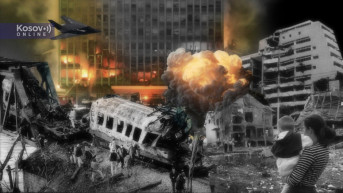
On this day 27 years ago – March 24, 1999 – the first NATO bombs fell on the Federal Republic of Yugoslavia, but international law also fell, as on that day, 19 countries gathered in the largest military alliance attacked a sovereign state without a mandate from the United Nations.
On March 24, 1999, at 19:41, the first projectiles, launched by NATO forces, hit targets in the vicinity of Pristina.
Everything was targeted – from bridges in Novi Sad, to the bridge in the Grdelica Gorge at the moment when a train was crossing it, where dozens of people were killed. Cluster bombs were dropped on Nis, and A-10 aircraft using radioactive ammunition operated in Kosovo.
At the same time, a war was being fought on the ground between members of the KLA, supported by members of the Albanian Army, as well as NATO special units, against the army and police of the FRY.
The battles of Kosare and Pastrik were the fiercest and largest during that period.
On March 24, at around 19:45, air raid sirens sounded across the FRY. The first casualty occurred in Prokuplje. The Ratko Pavlovic – Cicko barracks and its communications center were targeted, and soldier Boban Nedeljkovic was killed, while five of his comrades were wounded.
It is estimated that during the 78 days of bombing, around 2,500 civilians were killed, including 89 children, and about 6,000 people were wounded, including as many as 2,700 children. A total of 1,031 members of the army and police were killed, and 5,173 were wounded.
Bridges were destroyed, infrastructure was devastated, and schools, healthcare facilities, media outlets, embassies, cultural monuments, churches, and monasteries were targeted. There was hardly a city that was not hit by projectiles.
The term “collateral damage,” used by NATO representatives, was often heard during those 78 days of bombing, while civilians were dying. Albanians, Serbs, and others.
That a military operation was increasingly likely could be sensed earlier that year, after the failed negotiations in Rambouillet.
The order to begin the military operation was issued by then NATO Secretary General Javier Solana to the commander of allied forces, US General Wesley Clark, even though he did not have approval from the United Nations Security Council.
With the explanation that the goal of the operation was to stop a “humanitarian catastrophe in Kosovo,” the bombing lasted two and a half months and resulted in numerous human casualties and enormous material damage.
In Kosovo, targets included Gracanica, Leposavic, Kosovska Mitrovica, Kosovska Vitina, Pec, Podujevo, Gnjilane, Prizren, Urosevac, and others.
The last projectiles fell in the area of the village of Kololec near Kosovska Kamenica.
On May 1, 1999, NATO bombed a bridge in Luzane near Podujevo as a Nis Express bus was crossing it, killing 44 people. Two days later, a “Djakovica Prevoz” bus was targeted near Savine Vode on the Pec – Kula – Rozaje road – 20 people were killed and 43 were wounded.
Near the village of Korisa, not far from Prizren, a column of people was bombed on May 14, killing 87 and wounding 70. The Dubrava prison in Istok was hit on May 21, and at least 20 prisoners were killed.
During the bombing, 2,300 airstrikes were carried out on 995 facilities across the country, and 1,150 combat aircraft launched nearly 420,000 projectiles with a total weight of 22,000 tons. NATO launched 1,300 cruise missiles, dropped 37,000 cluster bombs, which killed around 200 people and injured several hundred, and used banned depleted uranium ammunition.
A third of the country’s electricity capacity was destroyed, and two oil refineries were bombed.
The bombing of the Chinese Embassy in Belgrade was a major diplomatic incident during the NATO bombing of the FRY. On May 7, 1999, at 23:45, three NATO missiles hit the building of the Embassy of the People’s Republic of China in New Belgrade.
Three Chinese nationals were killed in the attack, and several others were injured.
NATO expressed regret over the incident, explaining that it was caused by outdated maps provided by the CIA.
The bombing ended with the signing of the Military-Technical Agreement in Kumanovo on June 9, 1999. Three days later, the withdrawal of FRY forces from Kosovo began.
After the NATO Secretary General issued an order to stop the bombing on June 10, the last projectiles fell on the area of the village of Kololec, in the municipality of Kosovska Kamenica, at 13:30.
On that day, the UN Security Council adopted Resolution 1244, and 37,200 KFOR troops from 36 countries were deployed to Kosovo, tasked with maintaining peace and security and enabling the return of hundreds of thousands of Albanian refugees until the highest degree of its autonomy was defined.
Many international representatives pointed out that this was a clear violation of international law that led to the systematic ethnic cleansing of Serbs from Kosovo.
On the other hand, in Pristina, on the anniversary of the start of the NATO bombing of the FRY, gratitude is always expressed to the countries that decided on this intervention, which opened the door to the declaration of independence.

0 comments