
Muhadri: The peoples of the Western Balkans are united by a common history – the struggle for national freedom
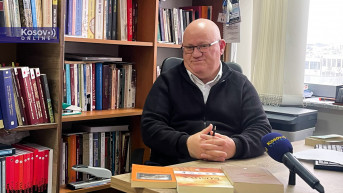
A researcher at the Historical Institute in Pristina, historian Bedri Muhadri, stated that the Western Balkans is characterized by a shared history reflected in the struggle of all its peoples to achieve national freedom. He added that the EU is attempting to minimize the significance of the nation as the foundation of statehood, which is most evident in the case of North Macedonia.
“A common characteristic of the national identities in the Western Balkans lies in the shared history of six peoples. Albanians, Serbs, Montenegrins, Macedonians, and Bosniaks were for a long time under the rule and administration of the Ottoman Empire. These peoples continuously fought for the attainment of national freedom,” Muhadri said to Kosovo Online.
Commenting on the dissatisfaction of the North Macedonian authorities regarding the omission of key national identity terms in the European Parliament’s progress report on the country’s EU accession, the historian believes this is an attempt to “minimize the significance of the nation as the basis of statehood.”
“By removing the terms ‘Macedonia’ and ‘Macedonian language’ from the progress report on Macedonia, the European Union is attempting to diminish the importance of the nation as the foundation of statehood. The Macedonian national consciousness, which emerged in the early 20th century, forms the basis for political and legal self-determination,” Muhadri asserted.
However, he also emphasized that the “state geography of North Macedonia” consists of indigenous peoples such as Albanians and Bulgarians, and that the country’s authorities should recognize them as “founders of the state.”
“The state framework of Macedonia should be built on the ethnic concepts of its peoples. The state of Macedonia needs to recognize the peoples who are the founders of that state,” Muhadri specified.
Ethnic identities
He believes that the EU should recognize ethnic identities but is uncertain whether the case of North Macedonia is an attempt to quietly introduce similar "rules of the game" for the national identities of other Western Balkan candidates.
“The European Union certainly needs to recognize ethnic identities, and based on the principle of ethnic cohesion, peoples should be treated equally in the constitutions of states. Specifically, this refers to Macedonia, whose history has been shaped by multiple ethnic groups. Now, whether this is an attempt to erase the identities of Balkan candidates, I cannot say for sure. The European Union, which is essentially built on the principle of equality among its member states regarding matters concerning their own countries, is trying to find solutions through a modus vivendi – that is, in line with the political circumstances of the moment. The ethno-concept of ‘Macedonia’ dates back to the early 20th century, while the history of Macedonia is well documented, with Albanians and Bulgarians playing a significant role in its historical processes,” the historian said.
He clarified that all the peoples of the Western Balkans formed their ethnic identities between the 13th and 15th centuries.
“Albanians, Serbs, and Bosniaks formed their ethnic identities between the 13th and 15th centuries, Montenegrins in the 15th century, while Macedonian ethnicity, or Macedonian national consciousness, began to form in the territory of present-day North Macedonia after the Ilinden Uprising in 1903. Although the uprising was a rebellion against Ottoman rule, it involved Albanians, Bulgarians, and those who identified with the Macedonian national consciousness,” the historian claimed.
Regarding nations, Muhadri stated that the Albanian, Serbian, Bosniak, and Montenegrin nations were formed in the Middle Ages, while the Macedonian nation, or national consciousness, is based on a geographical concept.
“The territory was called Macedonia. Montenegrins also represent a deep Albanian-Slavic symbiosis, stemming from Slavic tribes that arrived in the 12th century and formed the Montenegrin nation based on the geographical concept,” the historian said.



0 comments