
An increasingly bleak demographic picture in the Region: How is the Western Balkans combating the “white plague”?
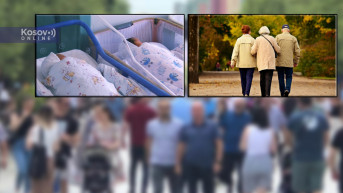
For decades, the Western Balkans has been witnessing increasingly alarming demographic statistics, particularly when it comes to natural population growth. This is the grim picture of the region on World Population Day, which this year is dedicated to the need to address demographic challenges. According to experts from Tirana to Belgrade, the approaches differ because large-scale migration is the key issue.
Written by: Djordje Barovic
The UN established World Population Day in 1987, when the global population reached five billion. The main goal of the campaign launched each year on July 11 is to draw attention to the pressing problems and challenges facing the global population.
Applied to the Western Balkans, the situation is alarming.
According to estimates by Serbia’s Statistical Office, the country’s population decreased by 437,205 between 2015 and 2024, due to natural population decline alone.
Census results in Albania from 2023 show that, due to negative natural growth and a high rate of emigration, it is among the countries in the world with the fastest shrinking population.
According to data from “Statista,” a German online platform specialized in data collection and visualization, Kosovo is among the top ten countries experiencing rapid population decline.
Kosovo’s Agency for Statistics (ASK) also reported after the census that Kosovo’s population is aging rapidly. The ratio of people over 65 to those aged 0 to 14 has doubled since 2011 and quadrupled since 1981, which they say represents an alarming increase.
In North Macedonia, there were more deaths than births last year.
As a possible solution, North Macedonia’s Prime Minister Hristijan Mickoski announced the introduction of a tax on singles and unmarried individuals.
However, this statement sparked widespread dissatisfaction in the country, prompting Mickoski to issue an apology.
“Of course, there will be no such tax. I apologize to those who may have misunderstood my initiative. But the fact is, I am extremely concerned about the demographic situation in Macedonia. And the fact is, as prime minister, it is my responsibility to be concerned about the demographic future of my homeland,” said Mickoski.
Taxing Singles and the “Polish Model”
Demographer Kristijan Fidanovski from Skopje told Kosovo Online that taxing singles is a bad move.
“I was immediately against such an idea. Punitive policies like that don’t solve the problem. On the contrary, we need to improve the living conditions of parents, not punish those who aren’t,” Fidanovski emphasized.
He added that it is wrong to draw a direct link between marriage and birth rates. “In modern societies, children are born outside of marriage, often in stable, mature relationships. Marriage is indeed an important institution, but it must not be a prerequisite for parenthood,” the demographer clarified.
He stated that the demographic problem is serious but not unsolvable.
“A combination of social, economic, and health policies is needed to help parents achieve the number of children they truly want. There are no quick solutions, but with carefully designed measures, we can slow the decline and mitigate the consequences,” said Fidanovski.
He warned that the entire region has long been facing the same demographic issues, particularly negative natural growth.
Until 2019, North Macedonia recorded a slight positive trend in natural population growth.
“The pandemic worsened the situation, and the negative trend continued after it,” said Fidanovski, adding that the key problem is not only low birth rates but also continuous emigration, which further reduces the population and accelerates population aging.
In an attempt to reverse these trends, many countries in the region have implemented various pro-natalist policies, but according to this demographer, the results are often modest.
He highlighted Poland as a good example of population policy.
His doctoral research focused precisely on this country.
“In Poland, for example, we have a case of progressive policy which, although initiated by a conservative government, was later accepted and improved with the change of power. The main value of this policy was not the direct increase in birth rates, but the significant reduction of child poverty,” said Fidanovski.
The essence of population policy in this country, he emphasized, is to provide “generous child benefits” to families regardless of their income.
In contrast, Hungary and Serbia are implementing pro-natalist policies with a strong emphasis on the third and fourth child.
“This can have regressive effects, as the benefits mostly go to wealthier families, especially through tax relief,” Fidanovski noted.
He stated that Hungary’s population policy is focused on the tax system and has some regressive implications.
“Parents do not pay tax until their third child reaches adulthood. And if you have four children, you are exempt from paying income tax for the rest of your working life as a parent,” Fidanovski said.
In practice, parents in that country are exempt from 15 percent of total tax.
“That means significantly more money for wealthier families. So for those reasons, I personally do not like that approach. Serbs have a somewhat less regressive policy,” the expert explained.
He pointed out that such population policies neglect the reality that most parents want only one or two children.
“Policies focused on large families will not significantly affect the overall birth rate,” Fidanovski is convinced.
Population Policy in the Region
Legal expert and demographer Miodrag Pantovic from Belgrade agrees that all countries in the Western Balkans are facing negative demographic processes, but that Serbia stands out in terms of the measures it has taken to halt and reverse that trend.
“All countries in the region are dealing with negative demographic processes. It’s just that in some places they started earlier and in others later. Serbia was among the first to enter into negative natural growth in 1991, along with Croatia, and afterward other countries in the region followed into depopulation,” Pantovic explained to Kosovo Online.
He said the only exception is Montenegro, which still records positive natural growth, but it is so low that it is expected to enter negative demographic territory this year, just like Albania.
“In essence, there will be no country in the region experiencing positive demographic processes,” Pantovic stated.
He emphasized that each of the Western Balkan states is trying to address this issue through various measures.
“If we look at the amount of money and financial resources used, it can be said that Serbia is the country that allocates the most. There are numerous measures that apply to supporting parents with children: from parental allowances for the first to the fourth child, support for assisted reproduction, assistance for buying the first home… Serbia is the country that allocates the highest share of its GDP in the world for population policy,” said Pantovic.
Regarding the situation in Kosovo, this demographer stressed that there has been “massive emigration” in recent decades.
“This is most evident from the results of the latest census conducted by the authorities in Pristina,” said Pantovic.
He added that this is also confirmed by German statistics, which show that in the past ten years the number of people from Kosovo has doubled.
“There is massive migration from Kosovo, but on the other hand, they still have positive natural population growth in that territory because even during former Yugoslavia, Kosovo had the highest natural growth rate—not just in the Balkans but in all of Europe. Until the 1960s, the average woman in Kosovo had five or six children, while in Serbia outside Kosovo the average was fewer than two. That was one of the reasons for the demographic explosion that occurred in Kosovo,” Pantovic explained.
He presented the data showing that according to the 1990 census, Serbs made up around 70 percent of Serbia’s population, including Kosovo, but accounted for less than half of all births.
“At the same time, Albanians made up about 16–17 percent of the population but accounted for nearly a third of all live births in Serbia. That shows just how much higher the birth rate among Albanians in Kosovo and Metohija was compared to the rest of the country,” Pantovic vividly explained.
He believes that many Western Balkan countries delayed implementing population policies, which is now reflected in their demographic trends.
“It could be said that those measures began later compared to Serbia, and that may be one of the reasons why the negative processes there are even more pronounced than here,” Pantovic noted.
Commenting on Prime Minister Mickoski’s idea that North Macedonia could combat the issue by introducing a tax on singles, Pantovic said it is an idea that dates back to Ancient Rome.
“There were the famous Augustan laws. When Rome, 2,000 years ago, began facing low birth rates, they introduced a tax on singles and also on families without children. But the system the Macedonian prime minister refers to is actually a German model inherited from Prussia, which Prussia used before unification. However, that model did not produce results,” said Pantovic.
He therefore does not believe that such taxes would be a good solution for population policy, but rather that the key lies in “balancing work and family life in households where both partners share domestic duties equally.”
“There is no universal solution. My personal view is that the issue of birth rates is more cultural than financial. The lowest birth rates are found in the richest countries in the world. It seems the better you live, the fewer children you have,” Pantovic concluded.
Migration and Economic Problems
Sociologist Artan Muhaxhiri from Pristina does not deny that Kosovo is experiencing a decline in birth rates, but he says natural growth is still positive.
He sees the causes in migration and economic problems.
“National population policy has changed in recent decades. There used to be around 30,000 births annually, but last year only 10,888 children were born. That is still a positive trend, but it’s clearly lower than before,” Muhaxhiri told Kosovo Online.
He emphasized that several factors contributed to the lower birth rate, with migration and economic problems being the most important.
“According to official data, around 32,000 people emigrated from Kosovo last year. There are also economic problems and a lack of clear prospects, which is true for almost the entire Balkans. All of these factors have contributed to the current level of birth rates in Kosovo. According to census data, Kosovo has 1.6 million inhabitants, although it was previously believed that number was higher. Nevertheless, this is the official figure,” the sociologist clarified.
He said the Government of Kosovo has several projects aimed at boosting population policy.
“Primarily to help young couples economically. There has also been an increase in support for children and new mothers. It was also said that housing blocks would be built for young couples with lower incomes so they could buy apartments at very low prices. But that has not happened,” said Muhaxhiri.
“Tradition of Large Families”
Arjana Muçaj, Head of the Department of Pedagogy and Psychology at the Faculty of Social Sciences at the University of Tirana, warned that unlike Albania, which is seeing a steady decline in natural growth, in the countries of the region where Albanians live there is a noticeable continuation of the “tradition of preserving large families.”
“If we go beyond the territory of Albania and analyze the situation in neighboring regions inhabited by Albanians, we see that Albanian society there continues with the mentality or tradition of what is called ‘preserving large families.’ This also explains why in those countries with Albanian populations the number of births is increasing—not decreasing,” Muçaj said in an interview with Kosovo Online.
She believes that Albania’s worsening demographic picture is the result of a trend where young people are more focused on professional careers rather than starting families and having children.
On the other hand, in the surrounding regions, Albanians place much more importance on tradition.
“That means the number of births in those regions is higher than in Albania. The numbers clearly show it. We have the case of North Macedonia, where the government is taking steps to provide more opportunities for young Macedonians to start families and have children, worrying that the ethnic balance may shift in this area,” Muçaj said.
She added that according to data from Albania’s Statistical Office, mothers in the country now give birth to only one child on average instead of two.
“This is influenced by many factors. The first is the postponement of marriage among young people. There used to be more traditional marriages, while now cohabitation is more common and couples in such relationships often do not want to have children, feeling freer to focus on their careers. So they prioritize professional development over what we call ‘the family nucleus,’” Muçaj explained.
As another important factor, she highlighted migration, calling it the biggest problem for the entire Western Balkans.
“The emigration of the population, especially the young, may positively affect birth rates in the countries they move to, but their departure from their home country will also reduce the number of births. Not only that, but it also affects the mentality of women. Girls now place much more value on education and careers than on having children,” said the expert.
Commenting on Albania’s demographic picture, Muçaj said that despite fewer births, the birth-to-death ratio in recent years has not fluctuated dramatically.
She attributes this to increasing life expectancy and living standards.
“Longer life expectancy definitely affects the birth–death ratio, although I’m not sure whether these are the official figures from Albania’s Statistical Office. Also, an important factor is the rising standard of living. Let’s not forget that we used to classify old age as beginning at 65. Today, that category is divided into two levels: from 65 to 80 and from 80 onward. This shows that life expectancy is increasing,” the expert concluded.



0 comments