
Murphy: Kurti knew that taking over municipal buildings would ruin the dialogue, and he did it anyway
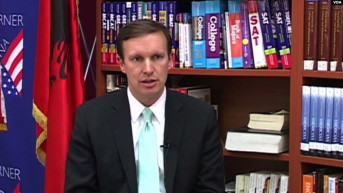
American Senator Chris Murphy told "National Journal" that the biggest obstacle to the normalization of relations between Serbia and Kosovo was the insistence of the Pristina authorities on unilateral action. He stated that the Prime Minister of Kosovo, Albin Kurti, had known exactly what would happen if he had sent the mayors to take over the municipal buildings in the north and that it would ruin the dialogue, but he had done it anyway.
Accompanied by Senator Gary Peters, a member of the Armed Forces Committee, the "National Journal" recalls, Murphy traveled to Kosovo and Serbia a few days before violence broke out in cities with a Serb majority. They met with leaders from across the region.
Murphy, who met with Kosovo Prime Minister Albin Kurti on May 22, agreed with Secretary of State Antony Blinken that the situation in the north could have been resolved through diplomacy rather than force.
"He didn't have to make a decision so quickly to take possession of municipal buildings," Murphy said, referring to Kurti's decision to enter Serb-majority cities and occupy municipal buildings.
"He could have tried to resolve it through a mediator like the US," Murphy said.
Murphy assesses that the process of normalization between Serbia and Kosovo often seems like "one step forward and two steps back".
“Right now, the biggest impediment is the Pristina government’s insistence on acting unilaterally. What happened over the weekend was unacceptable,” Murphy said. “Kurti knew exactly what was going to happen if he sent these mayors to take possession of these municipal buildings. He knew that it would throw a wrench in the dialogue, and he did it anyway.”
Murphy states that he hopes that, when the situation in the north of Kosovo calms down, attention will be focused again on the importance of implementing the Ohrid Agreement.
He said that the leadership of Pristina should establish self-governing Serbian municipalities, which the Serbian population in Kosovo is calling for.
"There is a precondition for lasting peace if we succeed in implementing the Ohrid Agreement," Murphy said.
Murphy also said that the US could begin to review its security assistance to Pristina if there was no progress.
"I don't think any of us can understand what Albin Kurti went through. He spent a long period of his life in prison. He obviously came to power as someone who took a pretty hard line throughout his political career and was elected on that basis," Murphy said and added that it was still different when you looked at things from the side and when you were the prime minister.
"It's different when you're an external organizer compared to when you're the prime minister. If the government in Pristina wants to fight, we as Congress have to make a decision about whether we're fully ready for that," Murphy pointed out.
He also stated that Russia was trying to encourage divisions and conflicts in the Balkans.
“Russia is playing games in the Balkans. They're trying to stoke division and conflict. Their hope is that a conflict, an actual kinetic conflict, arises in the Balkans that would distract the United States and Europe from the conflict in Ukraine,” Murphy, a member of the Foreign Relations Committee, told National Journal in an interview after his return to Washington.
He added that greater involvement of the US in the Balkans was needed.
"We have to engage aggressively in the Balkans to preserve the peace because right now we can't afford to put out fires in that region," Murphy added.

comments