
O'Brien: Support for Kosovo's membership in international organizations, but Pristina must fulfill its obligations
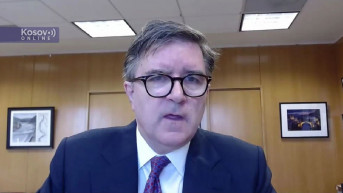
The United States strongly supports Kosovo's membership in international organizations, but Pristina must meet the high standards of these organizations, James O'Brien, Assistant Secretary of State for European and Eurasian Affairs emphasized today. He expressed hope that in the coming days, there would be activities from the Kosovo Government to implement agreements with the international community, which also included the formation of the Community of Serb-majority Municipalities.
O'Brien, in a video call with journalists, pointed out that regarding the dinar issue, the EU Special Representative for the Dialogue, Miroslav Lajcak, had put forward specific proposals.
"No government should undertake activities that impoverish citizens. In northern Kosovo, a large number of citizens are facing difficulties in procuring everyday necessities. The US envoy Gabriel Escobar was on the ground and saw firsthand that the way the Central Bank of Kosovo's regulation is being implemented is making life difficult for citizens," O'Brien explained.
He therefore emphasizes that this was not a good decision by the government.
O'Brien also emphasized that the US hoped for measures that enable citizens to purchase everyday necessities.
He assessed that the regulation had come at an inappropriate time because a series of agreements had been reached last fall, allowing citizens in northern Kosovo to pay for electricity, which was now prevented by the CBK regulation.
"We want to see practical progress to ensure that the community in the north can fulfill its obligations to Kosovo institutions," he added.
O'Brien said he understood that the Kosovo Government wanted to know "which currency is coming into the country," but he added that the decision increased tensions and encouraged nationalist rhetoric that needed to be reduced.
"Kosovo is facing important voting processes in the coming days. The rapporteur of the Council of Europe has outlined the conditions that must be met for accession to that organization. One of them was progress in resolving the property issues of the Visoki Decani Monastery. We welcomed the decision of the Kosovo Government in this regard, but it took a lot of time. It's only about protecting Kosovo's history and the community living there. We want the government to deal with such issues as if they were normal things," he added.
O'Brien pointed out that the CoE rapporteur also demanded progress in establishing the Community of Serb-majority Municipalities before the organization's ministers vote on membership.
He reminded that it had been agreed that progress must be made in implementing the agreement on the CSM, emphasizing that this was a key element in obtaining what Pristina wanted, which was membership in an international institution.
O'Brien said that there were still difficult decisions ahead for the government of Kosovo.
He stated that he knew Serbia and Kosovo both wanted to be a part of the EU and the global economy, and discussions were ongoing with both governments about this.
"In Serbia, President Aleksandar Vucic knows well that the use of force against Kosovo would be dangerous because we would consider it a threat to KFOR, which is there to protect citizens of all nationalities. He has said he will not use force. We monitor all military exercises. It is crucial for both sides to work on reducing tensions," O'Brien emphasized.
He also reminded that the US had clearly stated to Serbia that those responsible for the events since September last year must be held accountable.
"We expect this to be swift. The Serbian Government has already taken steps, including the dismissal of the head of the Security Intelligence Agency, and the withdrawal of troops. We want tensions to remain low," he emphasized.
O'Brien announced that the US and the EU would issue a joint statement on the occasion of the 25th anniversary of the "military operation," adding that it was important to be united on that day.
"I know that the decision to use force entails making many problematic decisions and consequences for citizens. But it was necessary at that time because the government in Belgrade opted for the use of force instead of negotiations," the US official explained.
O'Brien said it had been considered the only option to stop the humanitarian crisis.
He pointed out that in the process of resolving the humanitarian crisis, the President of the United States, EU ministers with the President of Serbia had been involved, and negotiations had not been abandoned, but, he repeated, a decision had to be made.
O'Brien pointed out that the decision to use weapons had been in the hands of other people, not those leading the negotiations.
"The positive side of the story is that we are now in a situation where six Western Balkan countries want to be a part of the EU, and the Union has accepted that. The United States strongly supports the region's integration into European and transatlantic structures, if they desire so," O’Brien said.
He also mentioned that President Aleksandar Vucic had been clear that Serbia's future lay in the European Union and the single market, which implied reforms in numerous areas.
"This is an example of strong relations we are building today, facing challenges together," O’Brien said.
On the other hand, Kosovo is, he says, an independent state, recognized by about 100 countries, reiterating that the operation against the FRY was a way to protect people in Kosovo from violence and expulsion, which was achieved, and it is now up to the countries to build relations with their neighbors.
Upon the journalist's observation that last year the Basic Agreement and the Annex in Ohrid were reached and asked whether the US would agree to a referendum in Kosovo on the CSM, O’Brien responded that he had not heard of such an idea and did not think it was necessary.
"It's good that Pristina has agreed with Brussels to take certain measures. It's up to the parties to fulfill what they agreed upon," O’Brien said, reiterating that for progress towards membership in the Council of Europe, Kosovo needed substantial progress in fulfilling obligations and implementing the agreement on the CSM.
"If someone wants to make a different decision, that is your right, but the consequence is deviating from the path Kosovo set for itself 15 years ago," O’Brien concluded.
He welcomed the decision of the European Council to open membership negotiations with Bosnia and Herzegovina, emphasizing that the future of the region is in the EU.
"We know there is a lot of work ahead, but the citizens of Bosnia and Herzegovina deserve to see changes. This is a very good step. We will continue to closely cooperate with the EU to help the region on its EU path," O’Brien said.


0 comments