
Odalovic: Since Kurti came to power, Pristina has avoided opening mass graves containing the remains of Serbs
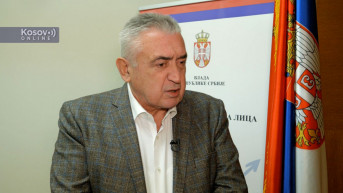
Veljko Odalovic, Head of the Serbian Government's Commission on Missing Persons, stated today, commenting on the arrest of two Serbs in Zubin Potok, that since Albin Kurti came to power in Pristina, there has been a continuous pattern of institutional and physical violence against Serbs, with no predictable rules as to when or where it will occur, RTV reported.
Speaking to TV Prva, Odalovic said that the recent arrests of Serbs across Kosovo, as well as cases in which lawyers have been denied access to detainees, are deeply concerning.
"These arrests, what is happening now, and the fact that even lawyers cannot reach detained persons, while no one knows who has been arrested or why, are deeply troubling because we have seen countless such cases recently. At the same time, an investigation that has existed in Pristina for more than 20 years is now being revived. The manner in which this is being handled shows that Kurti is further destabilizing northern Kosovo and Metohija through such actions," he said.
Odalovic explained that the detention of five Serbs and the subsequent arrest of two of them in Zubin Potok the day before yesterday is linked to a case dating back to 1999, when a group of intellectuals from Kosovska Mitrovica set out for Ulcinj but never arrived.
"It was a group of intellectuals who left Mitrovica for Ulcinj but never reached their destination. According to information that circulated at the time, they were executed and killed somewhere along the way. This case has existed and has been documented since 2003. The Kosovo Police have now entered that entire procedure," Odalovic said.
He pointed out that excavation work had already been carried out several times in the area where the remains of the missing intellectuals are believed to be located, but that those searches had produced no results.
"The area has already been excavated two or three times in search of those remains. From what I see in today's reports about an exhumation, this appears to be leading to yet another search. This is one of the cases that ranks very high on the list of priorities for the Pristina side. As the head of the Commission on Missing Persons, we exchanged certain information with them in the past. We provided everything we could to support the search for the missing persons," Odalovic explained.
According to him, for the first time the Pristina side failed to inform the Working Group on Missing and Kidnapped Persons in Kosovo and Metohija about the next steps in the investigation.
"In the past, we would be present with them at the search sites. For the first time, they have not invited us to be present at the location being searched, even though it is also in our interest to find the missing persons, regardless of our differences," he stressed.
Odalovic said that since Albin Kurti came to power, Pristina has avoided opening burial sites containing the remains of Serbs, despite the existence of information about locations where Serbs were allegedly killed and buried in mass graves.
"This sends the message that, at this moment, Pristina does not see the Serbs and does not recognize Serbian victims. We have not seen a single active effort to prosecute anyone for crimes committed against Serbs. If Serbs were treated as clay pigeons, was it open season on them? That is how Pristina behaves. The narrative is being changed. They are trying to transform a terrorist organization into a liberation army," he emphasized.
Odalovic added that the Racak case is one of the examples in which Pristina is attempting to pass judgment even though the International Criminal Tribunal for the former Yugoslavia (ICTY) never issued a verdict regarding the events in Racak.
According to him, Pristina's actions have not been met with any condemnation from the international institutions that maintain a presence in Kosovo and Metohija.
"At present, there are two umbrella international institutions responsible for Kosovo and Metohija. We have the United Nations, whose Special Representative of the Secretary-General is based in Pristina, and we have the EU mission. Yet what we see is silence, or an inactive role by both institutions in the face of the terror and persecution of Serbs and everything else that is happening," Odalovic said.
He added that such conduct by international institutions shows that Kurti has effectively been allowed to do whatever he wants without any meaningful oversight, while the Pristina authorities are most concerned by the reaction of the United States, which has suspended its strategic dialogue with Pristina.
"What worries them the most is the message coming from the United States. At the same time, Serbia is receiving positive signals in America, while they are moving in the opposite direction. That concerns their political parties and the people living there because America has always been their key partner. They have always said that as long as there was even one American soldier in Kosovo and Metohija, they had nothing to fear," Odalovic concluded.
Members of the Kosovo Police arrested two individuals in Zubin Potok on suspicion of allegedly committing the criminal offense of war crimes against the civilian population during the 1999 Kosovo conflict.
Yesterday, Dejan Vasic, the lawyer representing one of the detained Serbs from Zubin Potok, stated that neither he nor the defense attorneys representing the other detainees had been allowed to see their clients the previous night in Pristina, something he said had never happened in his 20 years of legal practice. Vasic added that the Basic Court in Pristina would decide today on the prosecution's request for pre-trial detention, at which point he would be able to see his client for the first time.

0 comments