
Odalovic: Pristina ignores Serbian victims and does not want cooperation on the issue of missing persons
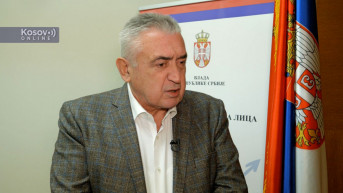
The President of the Commission on Missing Persons of the Government of Serbia, Veljko Odalovic, reacted in a statement to Kosovo Online to remarks made today by Kosovo Prime Minister Albin Kurti during a wreath-laying ceremony for war victims in Kosovo, stating that Kurti once again confirms that, for Pristina, Serbian victims do not exist and that the institutions there do not wish to cooperate on the issue of missing persons.
“The first piece of information shared with the media was that 1,565 persons are currently listed as missing. This is clearly a figure held by the provisional institutions in Pristina. It does not correspond to the official data we have, which are contained in the consolidated list of missing persons maintained by the International Committee of the Red Cross. At present, 1,581 persons are listed as missing,” Odalovic said.
In his view, this is further confirmation that Pristina does not wish to cooperate or address this issue.
“In accordance with the mandate entrusted through the Working Group mechanism established under the auspices of the Special Representative of the Secretary-General of the United Nations, which has been functioning for 20 years. Unfortunately, over the past five years, the provisional institutions in Pristina, primarily due to Albin Kurti, have done everything to undermine and halt the work of this Working Group. This is despite the fact that the group has achieved significant results, helping to clarify the fate of more than 1,800 persons who perished in the conflicts in Kosovo and Metohija between 1998 and 2000,” he stated.
He emphasized that the mandate of the Working Group dealing with missing persons is strictly humanitarian and civilizational.
“We had an agreed, consolidated list of missing persons and we addressed the issue without any discrimination. That is evidently what bothered some, and I believe that Albin Kurti has now, for the first time, stated this so openly, confirming that the resolution adopted a few days ago in the Assembly of the provisional institutions shows that they recognize no victims other than those of Albanian nationality, allegedly for which Serbian forces are responsible. However, the results we have achieved are substantial and refute this entire narrative advocated by Albin Kurti—we have resolved the fate of missing persons based on available information, for all individuals without distinction,” Odalovic said.
On the territory of central Serbia, according to information from various sources, including data from the Pristina side, Serbia has located and identified 914 bodies of Kosovo Albanians in relocated mass graves at sites in Batajnica, Petrovo Selo, Perucac, and Rudnica, all of which were handed over to families after identification.
“What is important today is to emphasize that, since an event and crime in Meja has been used as the basis for marking the Day of the Missing, I would like to point out that through searches conducted in central Serbia, out of 312 persons listed as missing, 296 were found in relocated graves, identified, and returned to their families, while 16 persons remain listed as missing. I say all this to underline that we approach our obligations and our mandate with the utmost responsibility,” he stated.
Odalovic stressed that Kurti’s statement further demonstrates that Serbian victims are of no interest to anyone.
“Out of the 1,581 missing persons recorded by the International Committee of the Red Cross as of today, 570 are persons of Serbian and other non-Albanian nationalities. These victims are not included in the resolution adopted a few days ago in Pristina, nor are they reflected in Albin Kurti’s statement, nor are they mentioned by anyone. It is as if Serbian victims and others whom we are searching for today, who are not of Albanian nationality, are of no interest to anyone. We are interested in all—persons of Albanian nationality, Serbian victims, and all other victims, without distinction. That is our mandate, and we act accordingly in response to all requests received from any source,” he said.
He also recalled the miners who disappeared at the Belacevac mine, abducted on 22 June 1998, as well as events in Zociste in July of the same year, when all persons of Serbian nationality present there were taken away, whose remains were only found in 2006 in the Volujak pit near Klina.
“That is what we do out of respect for all victims, and it is what the provisional institutions should also understand. For all persons, I repeat, for whom we receive any information, we will conduct searches. We have carried out approximately 16 additional searches at the request of the provisional institutions in Pristina, which yielded no results. However, we conducted them jointly, transparently, with representatives of the Pristina delegation, the International Committee of the Red Cross, the International Commission on Missing Persons, and the EULEX mission, and we often invited the families of Kosovo Albanians to visit these sites and verify them together with us. Unfortunately, this does not happen on the other side. For years, we have not been invited to any of the locations that we have shared with Pristina—through Brussels, Geneva, and direct meetings. Our requests, our locations, and our victims are currently of no interest to the institutions referred to by Albin Kurti, nor have we received any information about them,” Odalovic emphasized.
He recalled that a meeting of the Working Group scheduled for 11 March in Pristina had been postponed.
“We agreed to continue our work in Brussels through the mechanism, following the agreed declaration between President Vucic and Albin Kurti and the establishment of a joint commission, in order to achieve a new level of quality and support in this process, and we agreed to focus on archives. However, the meeting scheduled for 11 March in Pristina was not held, as the provisional institutions stated that the format of our delegation was unacceptable, and the session was postponed indefinitely,” he noted.
Odalovic expressed particular concern over the lack of reaction from the international community.
“This is what concerns me in this process—those who should react and send messages to Pristina to respect its obligations, to respect all victims, and to address this issue as a humanitarian one, as agreed in Brussels. The goal is to clarify the fate of the missing in order to help the families of Albanians, Serbs, and others learn the truth about their loved ones, and for this to be part of the normalization of relations. I am surprised that the ambassadors of the Quint were present today at the same location, but I will refrain from commenting—perhaps someone will draw Albin Kurti’s attention to the fact that he cannot speak selectively about victims,” he said.
He added that he expects a reaction from international actors.
“I hope their reaction will bring Albin Kurti back within a framework in which victims are addressed responsibly and without distinction. We have no issue fulfilling all obligations and continuing our work, but we expect the same from the other side, as there are also archives and responsible parties for missing persons there. The exchange of information has already existed, and that is the only correct path,” Odalovic stated.
In conclusion, he emphasized that Pristina must also change its narrative.
“Such behavior and actions, as well as the almost open hostility that Albin Kurti shows toward Serbia, Serbs, and Serbian victims, are unacceptable and do not contribute to resolving the issue, do not encourage dialogue, and do not lead to normalization of relations. European officials and the International Committee of the Red Cross must react and insist on the principles of humanity and equal treatment of all victims,” Odalovic concluded.
0 comments