
Odalovic on the talks in Brussels: Pristina will have to form the CSM; it is the only barrier against the terror of the Serbs
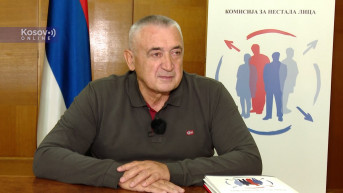
President of the Commission for Missing Persons of the Serbian Government, Veljko Odalovic, stated after yesterday's talks in Brussels, where the delegations of Belgrade and Pristina separately met with the European Union Special Representative for the dialogue, Miroslav Lajcak, that the CSM was the "topic of all topics". He emphasized that the future of the Serbs, all future relations, and stability in Kosovo depended on how the CSM would be structured and what powers it would have. Odalovic told Kosovo Online that Pristina would have to form the CSM, and there was no more dilemma about it.
"By establishing the CSM, we would interrupt the institutional terror that Kurti is conducting, and we would return to some normalcy, which would involve organizing new elections in the north for the Serbs to get their representatives, and the Assembly of the Community to be constituted", Odalovic pointed out, who was a part of the Serbian delegation at the talks in Brussels.
He emphasizes that it is not crucial whether the Community will be called the "Community of Serb-majority Municipalities" or the "Community of Municipalities with a Serb majority" but how it will function and what powers it will have.
Without the CSM, he warns, we are entering a more dangerous zone because, as he says, "Kurti has no intention of giving up everything he is doing and starting to return to normal but continues with the terror of the Serbs”.
"When you have local self-government in the north that was elected in containers, the presence of police with long guns, customs, police, judiciary without the Serbs, then it is a serious problem to protect the Serbian community. That was the essence of the first Brussels Agreement, to create a framework that would protect the rights of the Serbs", Odalovic says.
He believes that now is the time to decide whether the CSM will finally be formed or whether there will be a further escalation that brings many challenges and dangers and is not good for anyone.
"Now the most important thing is to create the right framework, to organize real elections in the north, and elect legitimate representatives of the Serbs because they are the ones who should choose representatives in the Assembly of the CSM. I think the best and fastest way is for the 'container mayors' to resign and shorten the path to new elections in the north", Odalovic emphasizes.
He emphasized that at yesterday's talks in Brussels, the Director of the Office for Kosovo and Metohija, Petar Petkovic, had presented all of this in a good way.
"Our side approached all proposals of the dialogue mediator constructively. I hope that Pristina will also start thinking constructively, not just obstructing and making moves that set us back, as has been the case so far. Everyone recognizes this, and why there are not stronger reactions from representatives of the international community to this is a question for them. It is certain that for many things Kurti has done so far, he had either direct or tacit support from a part of the European community, which is doing everything to finalize the statehood of their project. It is not good that they do it in a way that will not be applicable because it will open up many new problems. It is important not to get into a situation, as was the case, where many major agreements are made not to solve the problem but to promote a result, and beneath that, everything smolders and escalates", Odalovic says, who emphasizes the importance of respecting international law and principles to implement everything that has been agreed upon.
Regarding the messages from the head of the Pristina negotiating team, Besnik Bislimi, that the status of the CSM had not been discussed at the talks in Brussels and would not be until an agreement was signed that would imply obligations for the Serbian side, Odalovic says that these messages are aimed at calming the Albanian public in Kosovo.
"There would be no meeting in Brussels yesterday if the CSM was not a topic. One thing is what Bislimi and Kurti say for internal use because they are under great pressure from the public and the opposition, which claims that they are doing everything rather non-transparently, that some adventures they engage in, according to their standards and criteria, are a 'danger', as they say, to their 'statehood'. They must know that what they sometimes declare will not be the only relevant thing. They can have their opinion, but it certainly will not be decisive", Odalovic says.
He emphasizes that all messages from representatives of the international community since the escalation of the situation in the north due to Kurti's moves have been that the CSM must be formed.
"If the CSM were formed, things would function much better, it would be better for both Albanians and Serbs, and there would be no incidents. The CSM with the powers provided for in the agreements will not create any problems in the coexistence of the Serbs and the Albanians. The CSM doesn't bother anyone except in the minds of the most extreme who think that because some Western countries have recognized Kosovo, the story is over. Well, if it is, why are our officials getting their 'legs and arms broken' when negotiating to put their signatures on some agreements?" Odalovic points out.
When it comes to resolving the issue of missing persons, he says that the process has been "blocked in Brussels for three years due to Kurti's inexplicable stance".
He reminds that the working group had resolved more than 1,800 cases of missing persons by then, of which 90 percent were Kosovo Albanians. Another 1,615 people are still listed as missing.
"It seems to me that during yesterday's talks, for the first time, I sensed some 'positive wind' that this process could be unblocked. To hold a working group meeting where topics would be prepared to move in the direction of overcoming the problem. This would practically be a joint plan of Belgrade and Pristina for the next year so that operational work can be done", he says.
If that were achieved, Odalovic continues, next year we would have a fully operational process for resolving the issue of missing persons.
"Our side has made a huge contribution to harmonizing the text of the Declaration on Missing Persons, which was accepted in Ohrid by both Serbian President Aleksandar Vucic and Albin Kurti. It is a text of internal compromises; we even considered some objections from Pristina. The next step was supposed to establish the working rules under which the joint commission, formed on the basis of that Declaration, would support the work of the working group. It seems to me that there was a considerable amount of constructive approach from our side yesterday, and that was agreed upon as well. This creates the conditions for putting that joint commission into operation, which is particularly important when it comes to the archives of international organizations that were on the territory of Kosovo in the late '90s, where many pieces of information important for the search for missing persons are surely located", Odalovic says, emphasizing that Serbia approaches this issue not based on ethnic principles but as a matter of civilization and humanitarian concern, where discovering the fate of all victims is equally important.
He also emphasizes that there is great dissatisfaction among all families of the missing, both Albanians and Serbs, due to the blockade that arose in this process due to "unreasonable moves by Pristina".

0 comments