
Graovac: Kurti would rather go to elections than accept the CSM
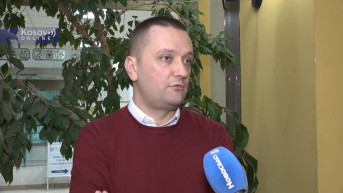
Srdjan Graovac from the Center for Social Stability assessed after another round of Belgrade-Pristina talks that it was currently difficult to expect any significant progress because it was clear that the Albanian side did not want the Community of Serb-majority Municipalities to be accepted as a solution. He added that Kosovo Prime Minister Albin Kurti would rather go to elections than accept the CSM.
"I think it is difficult to expect any significant progress when you look at the entire negotiation process, and we must consider it from two aspects. The first aspect is the idea that the Community of Serb-majority Municipalities be accepted as a solution. Then we understand that this can hardly be realized from the start because it seems that the Albanian side does not agree with it, i.e., it is clear that it does not suit the Albanian side at all", Graovac said.
He reminds that Albin Kurti gained popularity with a decisive stance that there would be no Community of Serb-majority Municipalities, and it is difficult to expect him to change his position when he has passed the halfway point of his mandate.
"He won the elections in February 2021, which means that the next elections in Kosovo are expected at the beginning of 2025. Taking that into account, it seems to me even more realistic that Albin Kurti would rather go to elections than accept the formation of the Community of Serb-majority Municipalities. This is only under the condition that the pressure from the West is so strong that he has to form the Community of Serb-majority Municipalities, which has not been the case so far. But if that were to happen, I think he would even prefer to go to early elections, and only then, with a new mandate, he would be ready for some compromise after materializing the support he now has in public", Graovac stated.
He adds that, apparently, there will be negotiations in the future regarding the draft of the CSM Statute, with the assessment that it will not go smoothly either, as there is no easy possibility of reaching a consensus between the Serbian and Albanian sides on that matter.
"And if there were to be some agreement on the draft of the CSM Statute, again, the implementation itself would not be easily agreed upon, or it would be impossible to find an agreement because, I repeat, Kurti does not want that implementation. On the other hand, if he were somehow forced to implement it, it would be conditioned, as Bislimi stated, exclusively by being a part of a comprehensive agreement in which Serbia would recognize Kosovo. When you take all that into account, I think things become more than clear, and there is little probability of any progress. The fact that you have two chief negotiators with completely different views on how these negotiation processes looked somewhere tells you the most, and that is due to the fact that Lajcak, as someone who moderates these negotiations, separately conducted talks with one and the other delegation, and the two delegations did not even meet. That tells you the most about how far we are from a successful continuation of the negotiations", Graovac said.
After the meetings with both sides in Brussels, the EU Special Representative for the Belgrade-Pristina Dialogue, Miroslav Lajcak, called the discussions "useful". However, Graovac believes that, for the Serbs and the Albanians, it cannot be reduced to just those words.
"If we think about his words a little, we will understand that he is looking for an expression that would provide additional encouragement to him and European officials to continue the negotiation process but without clear substance. That is the key problem because the essence is that you have to force the Albanian side to implement what has already been agreed upon, and signed, not just promised. This is the Brussels Agreement from 2013, a precondition for any further talks and for reaching subsequent agreements. And, in the end, the draft of the CSM Statute. All of this is a precondition for discussing other issues, and if you take that into account, then it becomes clear that this sentence also speaks of the impotence of Lajcak, the impotence of the Brussels administration. If, by any chance, they have the strength, if they have the ability to force Albin Kurti to implement what was promised if they have the desire to do so, they would certainly do it", Graovac said.
The key problem, our interlocutor emphasizes, is that the European Union has accepted the principle promoted by Kurti "to talk about the most difficult issue right at the beginning".
"You know that if you talk about the most difficult issue right at the beginning, then all other issues will remain on the sidelines. Serbia has advocated a stance from which the EU has gradually retreated, which is to reach agreements on what can be agreed upon, to relax the relationship between the Serbs and the Albanians, to make their lives better, and normal, and then leave the difficult questions for the end, making them less burdensome. If you have other issues resolved, and that crucial issue is less burdensome, then, of course, it becomes clear what the key problem is. The key problem is precisely in that, in connecting the status solution with the issue of the CSM, and in this way, you have blocked the entire process, not only because of Albin Kurti but also because the European Union has somehow accepted it as a model", Graovac emphasizes.
He reminds that mid-next year, European elections will take place, followed by the end of the year by the US elections, when pressure will increase.
"Do not forget that mid-next year there are European elections, and they want a certain success that they could present to the voters, that there will be pressure, but realistically, they do not have the instruments for that pressure. Decisive pressure needs to come from Washington, which has always been the mallet that helped European diplomacy to implement something. If that pressure comes, then achieving some result can be expected because that is the only thing Kurti can potentially react positively to. So, I would even expect more pressure after the new year, even more as the year progresses because at the end of the year, the US elections are coming. Also, the Biden administration will need some kind of foreign policy success before the elections, so I wouldn't be surprised if the Americans then intensify the pressure", he argues.
Graovac also added that he did not expect any progress regarding the calling of the extraordinary elections in northern Kosovo.
"Because Kurti gained his popularity by taking a clear stance, irreconcilable with the Serbian side, which aims to completely bring the northern part of Kosovo under Albanian control and keep it under Albanian control. If elections were held in northern Kosovo and Metohija, it would lead to the disempowerment of Kurti's fake mayors. We must call them that because they are indeed illegal and illegitimate mayors in the north, and that would weaken his position from the start. So, it seems to me, although Kurti will not deny that he wants those elections to happen, that he wants the authorities in northern Kosovo to have full legitimacy, he will sabotage it by saying, 'Sure, let's hold those elections, but as a precondition, we need to fulfill this and that, then as a precondition, we need to create some petition, how many signatures for that petition, will that petition be in line with the constitution of so-called Kosovo...' All of this will be an excuse to delay the process of going to elections in the north because, I repeat, this situation suits him as a response. He has his fake mayors in the north, has his Special Police Forces in the north, and he de facto controls the north, gaining popularity, especially among the radically inclined Albanian public in Kosovo and Metohija. This somehow convinces us that there is no chance of meeting the demands. Or, if he is willing to meet the desires of the international community, Albin Kurti will do so only after significant delays, depending on how much space he has and how strong the pressure from the West would be", Graovac concluded.


0 comments