
Orlic: Normalizing relations means talking about things important to people's lives
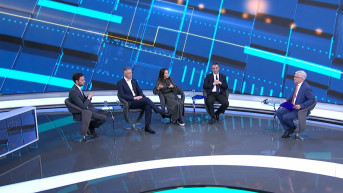
Serbian Progressive Party official, Vladimir Orlic, said in the "Takovska 10" show on RTS that the normalization of relations between Belgrade and Pristina implied a discussion about matters important to people's lives, while Snezana Paunovic from the Socialist Party of Serbia pointed out that normalization was the absolute right to security. On the other hand, the leader of Dveri Bosko Obradovic emphasizes that normalization cannot be achieved by violating the Constitution, and the president of the Movement of Free Citizens, Pavle Grbovic, says that it is time for political courage and important decisions.
Orlic, who is also the president of the parliament, said that the normalization of relations between Belgrade and Pristina implied what Serbian President Aleksandar Vucic had explained.
"This implies that we will talk with the people of Pristina, about all those things that are important for people's daily lives, about things that concern the facilitation of life and the relaxation of relations between the Serbs and Albanians," Orlic says.
He reminds that President Vucic also said what was out of the question for Serbia, what were the red lines, and what could not be discussed.
"Everything regarding recognition in any form is out of the question; everything regarding the membership of so-called Kosovo in the United Nations. He never hid anything from people, he spoke very openly about what we were facing, what we were doing, and in what way we would fight," Orlic says.
He emphasizes that the President of Serbia takes care of the vital state and national interests, as well as that he is always guided by the truth, unlike those who attack him.
Snezana Paunovic from the Socialist Party of Serbia says that the normalization of relations on a practical level means that the Devic monastery should not be locked 24 hours a day; that the sisterhood of the Patriarchate of Peja is not afraid of poisoning the fish in its own pond; that citizens can move freely from place to place without worrying whether someone will beat them; so that people can work freely on their properties.
"The absolute right to security, the property right, the basic human right to live where you were born. That is normalization," Paunovic said.
He says that everything else is the abuse of that term for daily political purposes, to which some in Belgrade and the Albanian majority in Pristina are prone.
The leader of the Serbian movement Dveri, Bosko Obradovic, emphasizes that "he represents the majority of Serbia which is against the implementation of the Franco-German agreement, the new Western ultimatum according to which Serbia must recognize the fake state of Kosovo".
"It is very important to see who is on which side. On the one hand, you have the government embodied in Aleksandar Vucic and Ivica Dacic in an informal coalition with Dragan Djilas and those gathered around him. You also have the support of Vesna Pesic, Vuk Draskovic, Nenad Canak, Cedomir Jovanovic, Sonja Biserko, and many others who are in favor of accepting the new Western ultimatum at any cost," Obradovic says.
He says that on the other side are 80 percent of Serbian citizens "who are against the recognition of the fake state of Kosovo", along with the state-building bloc and intellectual Serbia, which opposes the new Western ultimatum.
Obradovic believes that "the president of Serbia violated the Constitution and accepted the agreement which is the recognition of the fake state of Kosovo". He says that the normalization of relations cannot be achieved by violating the Constitution, recognizing Kosovo passports, other documents, territorial integrity, and sovereignty.
"These are all articles 1 and 2 of the Franco-German agreement. We cannot even accept article 4, paragraph 2, in which it is written that Serbia would not oppose the entry of the fake state of Kosovo into any international organization," Obradovic emphasizes.
He points out that we should not sign anything and accept what NATO imposes while the war in Ukraine continues. He believes that we should move towards a law on essential autonomy, treat the Albanian national minority as an integral part of the Republic of Serbia and move towards the reintegration of Kosovo into the full constitutional and legal order of Serbia.
To the remark that these are only "good wishes", Obradovic says that "the Franco-German agreement is then betrayal and capitulation".
He believes that negotiations should be returned to where they belong, from Brussels to the United Nations Security Council.
The leader of the Movement of Free Citizens, Pavle Grbovic, says that the fact is that the agreement was accepted verbally and that it became politically binding for Serbia.
"This was also confirmed by Mr. Borrell. That agreement and all obligations arising from that annex that was accepted in Ohrid become part of Serbia's negotiation process in case it wants to become a member of the European Union," Grbovic points out.
He believes that the political dilemma that needs to be answered is whether Serbia wants to continue its European path.
"If we want, we know what the conditions are. If we want, let's do it as soon as possible. Let's gather political courage and make important political decisions. I deeply believe that Serbia should be in the company of those countries and be like the countries to which our people go," Grbovic says.
He points out that it is completely legitimate for someone to think that Serbia has no place in that political space, but then he has an obligation to say how the country will compensate for the benefits it has from cooperation with the countries of the European Union.
"These are the countries with which we have the greatest economic cooperation; these are the countries from which the companies that employ hundreds of thousands of people in this country come. In the case of their departure, the people who propose a different policy do not need to explain to me how they will make it up, but to the people who work there,” Grbovic emphasizes.
He says that there are no more changes in the content of the agreement, but that it is time to choose whether Serbia will be part of the political space created by those who offered that content or whether it does not want to be.
"When it comes to the content of the agreement itself, it is not what we would like it to be and I am not happy about that, but it is the logical epilogue of the thirty-year process of expropriation and dissolution of Serbian statehood in the area of Kosovo and Metohija," Grbovic believes.
He says that it is historical justice that the hard pill facing Serbia should be swallowed by those who, as he points out, were the creators and implementers of the worst policy in the history of Serbia, the policy of the 1990s.


0 comments