
Osmani: I do not support Lajcak’s document on the Association of Serb-majority Municipalities; it violates the Constitution
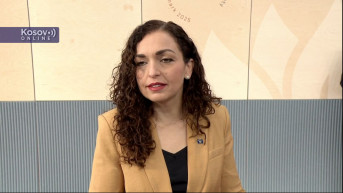
Kosovo President Vjosa Osmani has said that the document on the Association of Serb-majority Municipalities (ASM) proposed by former Belgrade–Pristina dialogue envoy Miroslav Lajcak violates the Constitution of Kosovo and that she does not support it. She stressed that dialogue with Serbia must continue and confirmed that she is seeking another term in office, noting that the final decision will be made by the future composition of the Assembly.
In an interview with Klan Kosova, Osmani said that the document presented by Lajcak concerning the ASM, in her view, violates the Constitution of Kosovo.
“I do not support such a thing,” Osmani said.
She added that dialogue with Serbia must continue and that the government must have the support of all political actors.
“The government needs the support of political parties in the dialogue process,” she added.
Another presidential term
Osmani confirmed that she is seeking another term as president of Kosovo, noting that the final decision lies with the future Assembly.
“At this point, I believe Kosovo needs continuity of good work. Accordingly, this issue will now be in the hands of the deputies of the Republic of Kosovo. We will see who will be elected,” she said.
According to her, the decision on electing the president requires the support of two-thirds of the deputies, who will have to decide whether they want to act in Kosovo’s interest and in line with the will of the citizens.
“I aspire to continue the good work for the citizens of the Republic of Kosovo and for our country. I believe that the many achievements and good things that await us and are within reach should continue, because that is in the best interest of our Republic. However, I am fully aware that this does not depend only on this assessment, but on two-thirds of the deputies of the Republic of Kosovo, who will have to decide, I would say, on two key points: first, whether they want to protect the best interests of the Republic, and second, whether they want to heed the will of the citizens,” Osmani said.
She emphasized that she would remain politically active even if she does not secure a second term.
New momentum in the recognition process with the Trump administration
Osmani also gave an interview to RFE/RL. Speaking about foreign policy activities, the Kosovo president said she and her team had worked intensively with countries that had previously announced a freeze in relations, and that Kosovo received four recognitions this year.
“Serbia claimed that it had persuaded more than 20 countries to withdraw recognition of Kosovo. Those countries did indeed make statements in Serbia’s presence. There were cases when they sent letters to the United Nations, cases when they sent letters to us and notified our allies that they were freezing the recognition process until the dialogue was completed. I worked to bring each of them back, except for one country. With each of them, I reconfirmed recognition in meetings with their leaders. It was as if they were new recognitions,” Osmani said.
She added that many other countries are close to making a decision and that cooperation with them is ongoing on a daily basis, and that with Donald Trump’s administration Kosovo has gained new momentum in the recognition process.
“I would like to thank all our allies for their support—of course the U.S. administration, as well as countries such as Turkey, Saudi Arabia, and others that have consistently supported us,” she said.
“Therefore, there is new momentum, and I am confident that very soon—at the beginning of the year, I would say—we will have more good news. I would not call it stagnation; it was simply a very difficult situation for us, when even our allies insisted that the entire focus be on the dialogue and emphasized that there should be no focus, on their side or ours, on the issue of recognition.”
She said that internationally, Kosovo has never been better represented, despite the challenges.
“Above all from Serbia, which escalated acts of aggression against Kosovo and destabilizing activities. In such circumstances, Kosovo’s institutions did everything possible to protect the interests of the Republic of Kosovo, its sovereignty and territorial integrity, and to present Kosovo with dignity to the world at all times. I now believe Kosovo needs continuity of good things. This decision is now in the hands of the deputies of the Republic of Kosovo,” she said.
A shared goal with Kurti
Commenting on differences with Kurti during their mandates, she assessed that they had always shared a common goal.
“I believe the most sincere cooperation is precisely the one that does not hide differences. What is most important, as I have noted in every public statement so far, is that we have never differed regarding the common goal we want to achieve—whether it is establishing sovereignty in every corner of our country or strengthening our state within the large Euro-Atlantic family. We had shared goals. We did not differ by a millimeter in our objectives. Sometimes we had differences in the way we pursued those goals,” she said.
EU measures unfair
Osmani criticized the EU measures against Kosovo as unjust and harmful to citizens, stressing that they were the result of Serbia’s criminal activities, not Kosovo’s. Asked about the application for EU membership, she said that some larger EU members insist that everyone unite, including states that do not recognize Kosovo.
“First of all, I want to say that these measures were absolutely unjust, unreasonable, and very harmful to all citizens of Kosovo, regardless of ethnicity. They were imposed on Kosovo at a time when, in fact, Serbia—through its gangs—attacked KFOR soldiers, resulting in injuries to 93 KFOR soldiers, as well as attacks on journalists and citizens in the north. Despite all these destabilizing and criminal actions by Serbia, instead of punishing Serbia, an extremely unjust decision was made, and in a very strange way, without any vote by the member states. Then two or three states used this situation to continuously block Kosovo, demanding things that should not even have been grounds, no matter how unjust their reasons were,” Osmani said.
Committed to dialogue
Osmani said that Kosovo is constructive in the dialogue, while Serbia often blocks implementation of agreements. She called on Brussels to pursue a consistent and balanced policy in implementing agreements.
“Continuing the dialogue is a process to which we are fully committed, as we have been throughout these years. Kosovo has never been absent from the discussion table; Kosovo has shown full constructiveness regarding the proposals presented by the EU. But, of course, Serbia blocked—even the very signing—of the Brussels Agreement and the Ohrid Annex.
However, there are many other agreements that Serbia agreed to and ultimately did not implement. For example, the Agreement on Missing Persons, where it still blocks implementation despite it being reached in Brussels, as well as many other agreements—from the recognition of diplomas for people graduating in Kosovo to the opening of all border crossings under the Brussels agreements. So we have a problem with the Serbian side, which never implements what it promises, and I believe we will face the same problems in the future. I hope, however, that Brussels will be much clearer in deeds, not just words, and will demand full implementation from Serbia of what it promises,” she stressed.
Speaking about the draft ASM, she said Kosovo insists on parallel implementation of agreements.
“Before Article 7, there are six other articles. It is very important to implement the basic principles of that agreement, which Serbia has not only failed to respect indirectly but has directly violated through the act of aggression in Banjska, the attack on our critical infrastructure at the Ibar–Lepenac canal, the abduction of Kosovo police officers on Kosovo’s territory, the recent abduction of a Kosovo citizen, continuous attacks on our territorial integrity, and even on NATO, by wounding 93 soldiers. Serbia violates this daily. Even when it voted against us in the Council of Europe, through constant lobbying against Kosovo’s membership and against recognition of Kosovo, Serbia flagrantly violates this agreement every day. I believe the EU’s priority should be precisely this first, and only then can we discuss other parts of the agreement,” she said.
Serbs have open doors for cooperation
She said that the Serbian community in Kosovo is treated as equal citizens and deserves greater representation, but that this is achieved primarily through respect for the law and the Constitution of Kosovo.
“I believe we must do more to communicate this better—we must find better, more open ways of communication. Their place is in our institutions; their place is equal to that of any other citizen. Therefore, my call to them is to seize every opportunity and every protection guaranteed by the Constitution of Kosovo, which is in fact the most advanced constitution regarding minority rights on the entire European continent. There is no European state that grants more rights to minorities than our Constitution.
So let them use them—they have open doors for cooperation, empowerment, and projects that benefit the community they represent. I sincerely hope they will use these constitutional and legal avenues, because that is the only way to strengthen their presence, their voice, and, I would say, their economic development. Because 26 years after the war, whether they live in the north or the more than two-thirds of Serbs who live in other parts of Kosovo, they deserve greater development and even stronger representation. But this is achieved primarily by respecting the laws and the Constitution of Kosovo and by using the rights offered to them, not by boycotts,” Osmani said.
Top of Form

comments