
Petkovic from Brussels: We insisted on the Community of Serb Municipalities and warned about Kurti's terror and ethnic cleansing of Serbs
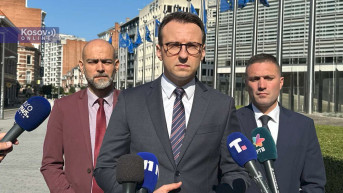
Director of the Office for Kosovo and Metohija, Petar Petkovic, addressed the press after a new round of dialogue between Belgrade and Pristina in Brussels, where he held a trilateral meeting with the EU Special Envoy for the Belgrade-Pristina Dialogue, Miroslav Lajcak, and Pristina's chief negotiator, Besnik Bislimi. Petkovic pointed out that they insisted on the formation of the Community of Serb Municipalities (CSM) and highlighted Albin Kurti's terror against Serbs.
"Our delegation had a meeting with Mr. Lajcak's team, followed by a trilateral meeting with Bislimi. Our side primarily insisted on the formation of the CSM, as we do every time, because it is of essential importance for the normalization process, primarily for the normal life of Serbs in Kosovo and Metohija. We spoke about the terror Albin Kurti is imposing on Serbs, especially in northern Kosovo. We pointed out all the difficulties faced by Serbs in Kosovo and Metohija, the ethnic cleansing being carried out against them, and the unilateral, escalatory actions, such as the shutdown of Serbian institutions, unlawful arrests of Serbs, and other actions that significantly worsen the position and life of the Serbian people in Kosovo and Metohija, which has also led to the departure of some Serbs from northern Kosovo,” said Petkovic.
He added that they also discussed the continuation of the implementation of the Declaration on Missing Persons.
“Belgrade accepted the EU's proposal regarding the adoption of specific rules of procedure for the working group and commission on missing persons. Of course, Pristina once again had some comments and tried to halt the process, showing once again that it fundamentally does not want to deal with the issue of finding missing persons. We also discussed the violation of the agreement on managing border crossings, where our side pointed out that hundreds of trucks are waiting at Merdare, which is absolutely unacceptable because, if we have a decision to lift the ban on Serbian goods, how is it possible that hundreds of trucks are still waiting to enter from central Serbia through Merdare? We demanded the opening of other crossings,” he noted.
Petkovic also raised the issue of the violation of agreements on official visits, as well as the ban on Serbian liaison officers visiting imprisoned Serbs.
“Mr. Bislimi, just like in previous discussions on this topic, refused to comment. He said he wouldn’t agree to any official visit agreements as long as I continue to talk about Kurti's terror. I told him that he will never stop me from speaking the truth. The meeting with Bislimi was tense; there is no genuine willingness to agree on anything, and no consensus, as Pristina refuses to discuss Belgrade's proposals. At one point, Bislimi gathered his papers and wanted to leave. I reminded Lajcak that I would remain at the table to address all the issues affecting Serbs in Kosovo and Metohija, as we must resolve them through dialogue because there is no other way to reach normalization of relations,” said Petkovic.
He mentioned that Lajcak concluded by stating that they would be invited to Brussels again and that there would be one or two more rounds before the end of the year.
"As you know and as is widely known, Belgrade is absolutely committed to peace, to finding a compromise solution, and we will always respond to all invitations from Brussels,” said the director of the Office for Kosovo and Metohija.
He emphasized that during both the bilateral and trilateral meetings, he also drew attention to a dangerous phenomenon occurring in Kosovo, involving the sexual harassment of Serbian women by Albanians, and what is especially disturbing, members of the Kosovo police.
"There are reports from women in northern Kosovo and Metohija, who are members of NGOs, speaking out about this issue. There are testimonies from about 30 Serbian women, and these reports have been shared with KFOR representatives and international organizations in Kosovo. It is important that we bring this up during the dialogue and point it out to stop the harassment of Serbian women, particularly by Kosovo Albanians in northern Kosovo and Metohija. When we spoke about the IBM (Integrated Border Management), since you know how it goes, Mr. Bislimi starts attacking Belgrade, saying we are violating everything. But when I specifically ask what exactly we violated, he goes silent. Then I pointed out, regarding the specific issue he raised about violating the IBM agreement, that it was not us but the Kosovo police who committed a serious incident in early September by entering the territory under central Serbia’s jurisdiction, thereby seriously violating the joint border management agreement. This was confirmed by the representative of the team, Mr. Lajcak, who openly stated this during the trilateral meeting, and we demand that this does not happen again,” Petkovic explained.
He added that Bislimi could not resist attacking President Aleksandar Vucic and was "obsessed" with the Serbian president during this meeting.
“Everything that could serve as an attack on Serbs and the Serbian people in Kosovo and Metohija, on the Serbian state, and President Aleksandar Vucic, is a topic for Mr. Bislimi, while I focused on all the important points that matter to us and are crucial for normalizing relations. So, we will fight to maintain peace. On the other hand, rest assured that I clearly and directly responded to everything, including Mr. Bislimi’s provocations, but we are committed to peace and simply refuse to be provoked because that is obviously Pristina’s sole intent in the dialogue and normalization process,” he said.
Answering journalists’ questions, Petkovic reiterated that the essence of the Ohrid agreement is the formation of the Community of Serb Municipalities.
"In this context, when we spoke about the European draft statute, which is a good starting point for further discussions, as is our position, I asked Mr. Bislimi five times whether he accepts this draft statute. Do you think he answered? He remained silent or avoided answering the whole time. So, the main topic is the Community of Serb Municipalities (CSM) when we talk about the implementation of the Ohrid agreement. That’s the topic, because without it, we cannot move forward. The European Union is well aware of this, it is necessary, it is the foundation for the normalization process. But I also explained, you cannot shut down Serbian institutions, expel Serbs, and then, on the other hand, say you are ready to discuss the CSM. In what way? By eliminating Serbian institutions and Serbs? That's why Kurti is doing this, because he does not want the CSM, and that's why he is heading in the direction of expelling Serbs. For us, the main topic is the CSM, the main and fundamental issue of the agreement and the implementation plan, where we know our obligations. We know there are many things we need to do together, but everyone knows that the prerequisite for all of this is the formation of the CSM," stated Petkovic.
He added that when asked why there wasn’t a trilateral meeting last time, he posed that question to Mr. Bislimi during this meeting.
"I made it clear that I have no problem if Mr. Bislimi wants to talk about the moon or climate change, he can talk about whatever he wants, that is his right. But I have the right to talk about topics that are important to our side. And Mr. Bislimi cannot decide what will be on the agenda of the trilateral meeting. Each side has the right to present its arguments and topics, and the fact that he wasn’t ready to discuss the CSM last time speaks to their differing approaches and tactics. Today they talk, tomorrow they refuse, and so the cycle continues," he noted.
Answering questions from journalists from Pristina, Petkovic reiterated that the Serbian side is fully aware of its obligations and that what is required from Belgrade will be fulfilled.
“There is no problem with that. But do you know where the problem lies? The problem arises when you have the Brussels agreement from 2013, where the first six points of that agreement call for the formation of the CSM. Then you have this agreement ratified by the Pristina parliament with a two-thirds majority, making it a legal obligation under your internal laws. Yet, for 11 years, you have refused to implement it, which clearly shows there is no willingness on your side to apply anything, because you are not ready for the most basic issue. And when it comes to what Belgrade is supposed to do, you have the Brussels agreement where Belgrade has fulfilled all its obligations, while on the other side you have Pristina, which has not implemented the most important points of the agreement—the backbone of the dialogue, which is the CSM. I have shown you who is willing to participate in the dialogue and who is not. As I said, there are many things we need to fulfill, but the precondition for that is starting with the formation of the CSM,” he said.
He added that this is important because without the CSM, there is a possibility that there will be no Serbs left in Kosovo and Metohija.
"If Kurti continues with his policy of expelling Serbs, if there is no community that will serve as a framework to protect the collective and individual rights of the Serbian people in Kosovo and Metohija, if he continues arresting Serbs, persecuting Serbs, and shutting down Serbian institutions, then what kind of community can we even talk about? That is why the CSM must be established first; it is the initial condition for the normalization process, and only then can we talk about all other obligations. As President Aleksandar Vucic has clearly stated to everyone: there is no room for philosophical debates here, just a clear commitment to work or a lack of it. We are committed, and we will see if Pristina is, because for the past 11 years, it has clearly not been committed to dialogue, but rather to expelling Serbs,” concluded Petkovic.



0 comments