
Are Germany and the US changing course toward Pristina: Where has the "condition of all conditions" – the formation of the CSM – disappeared?
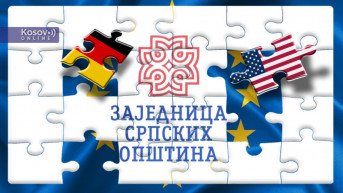
It used to be the question of all questions, the condition of all conditions. And then, silence. The topic of forming the Community of Serb Municipalities was recently brought up again by the German Ambassador to Pristina, Jorn Rohde, and US Special Envoy Alexander Kasanof, but with the claim that it is no longer a key condition for Pristina’s further integration, starting with its membership in the Council of Europe. Interlocutors of Kosovo Online have different views on the messages from the EU and the US, but they agree that the West will not easily abandon this demand.
Written by Arsenije Vuckovic
The German Ambassador to Kosovo, Jorn Rohde, stated that Kosovo is not required to make a final decision on the Community of Serb Municipalities. He emphasized that sending the draft statute of the CSM to the Constitutional Court for review would be sufficient for membership in the Council of Europe.
In response, the Director of the Office for Kosovo and Metohija, Petar Petkovic, said that such a statement was “the culmination of rendering the dialogue and agreements reached in Brussels meaningless.”
"If Rohde thinks he can abolish the achievements of the dialogue and reward Pristina with empty promises, he should say so clearly," Petkovic wrote on the social network "X".
The US Deputy Assistant Secretary of State for the Western Balkans, Alexander Kasanof, after completing his visit to the region, stated that the US "strongly supports the EU-facilitated dialogue between Belgrade and Pristina" and expects them to fulfill all obligations from the Brussels and Ohrid agreements.
For Pristina, Kasanof explained, an additional condition applies – sending the draft statute of the CSM to the Constitutional Court.
However, the formation of the CSM was not mentioned by anyone.
Except by analysts in Pristina.
They claim that establishing the CSM before the February 9 elections would be political suicide for Prime Minister Albin Kurti and his Self-Determination party.
Consistent (in)consistency
Assistant professor at the Faculty of Law, University of North Mitrovica, Dusko Celic, says for Kosovo Online that the EU and the US have not acted consistently in the Brussels negotiations from the start, which is why he does not expect them to be consistent in insisting on the formation of the Community of Serb Municipalities. He believes this presents an opportunity for Serbs in Kosovo to demand substantive autonomy.
"Unfortunately, the EU as a mediator, and even the US as shadow mediators, have not behaved consistently in these Brussels negotiations from the very beginning. Therefore, it was not to be believed that they would consistently insist that the Community of Serb Municipalities be a condition for any further progress in Kosovo's international integration," Celic stated for Kosovo Online.
He believes that the West has decided not to put too much pressure on Prime Minister Albin Kurti regarding the CSM issue because they feel he has already made enough "concessions."
"It is likely that Western circles consider Kurti to have made a sufficient concession by allowing some degree of passage and entry of Serbian goods into the territory of Kosovo and Metohija, although we see that he has done this only partially and has likely decided to avoid insisting on opening the Ibar bridge in northern Kosovska Mitrovica before the elections. I assume the political West has now decided not to put too much pressure on Kurti when it comes to the Community of Serb Municipalities," Celic said.
He stated that the issue of the CSM had been surpassed for several reasons.
"The first reason is that, as it was negotiated, the CSM does not guarantee the protection of the collective rights of Serbs in Kosovo and Metohija because it lacks executive powers. The second reason is Kurti's behavior, consistently over the past two years, from which we can see that Kurti is not interested in any form of collective rights for Serbs. Therefore, this lack of insistence on the CSM might not necessarily be a bad thing for Serbs in Kosovo and Metohija," Celic explained.
This is an opportunity for Serbs to demand substantive autonomy.
"I think that based on their experience over the past two years, with brutal violations of their collective rights, even to the point of elements of apartheid, the Serbian people in Kosovo and Metohija should now raise the political bar and demand substantive autonomy," Celic emphasized.
He added that such demands should not be made before the Kosovo elections because Kurti will continue his pressure and further undermine the remaining collective rights of Serbs.
"The likely next steps from Pristina will be a continuation of systematic violence, primarily aimed at suppressing the remaining collective rights of Serbs in Kosovo and Metohija, especially the right to education, from primary to university level, and the right to healthcare. These are the rights that remain under the system of the Republic of Serbia," Celic said.
He believes that the erosion of local self-government systems where Serbs are the majority will also continue.
"We now have the situation in Strpce, and in Gracanica, where measures are being implemented that, in a way, suffocate the collective rights of Serbs. These measures are directly against the minority rights conventions, including Article 16 of the European Convention on Minority Rights, which states that central authorities cannot take measures that affect the demographic situation in areas where the population is predominantly minority. They are doing this with these measures," warned the law professor.
In this context, Celic sees the halting of the construction of the University building in North Mitrovica, attempts to open the main bridge on the Ibar River, and the repurposing of properties and land without the legal consent and wishes of the majority Serbian population in the north.
"The government there is controlled by 3% of the population without consultations and directly against the will of the majority Serbian population. We can expect similar actions and measures until the elections, and I do not believe that Kurti will make any concessions except for partial trade access or something similar. In fact, I assume he will continue with populist measures that his extreme voter base may see as the right steps for gaining votes before the elections," Celic said.
On the other hand, he does not expect any more concrete steps from the EU or the US either. The EU is facing consolidation of its executive power, and the US has its presidential elections coming up.
"I do not expect them to be consistent in pressuring Albin Kurti, just as they haven’t been so far. I fear this situation is the most favorable for Pristina to continue trying to change the facts on the ground," Celic concluded.
Political "momentum"
Professor of International Law, Besfort Rrecaj, says that the EU and the US have not abandoned their demand that Kosovo's membership in the Council of Europe is directly conditioned on submitting the draft statute of the Community of Serb Municipalities to the Constitutional Court.
"I believe that the EU and its partners have always maintained the position that the government should submit the draft of the community of Serb-majority municipalities to the Constitutional Court for a constitutionality review, as outlined in the previous agreements from 2013 and 2015. Therefore, for membership in the Council of Europe, the government must fulfill its duty, draft the statute of the Association, and submit it to the Constitutional Court. They have now reiterated this demand," Rrecaj said for Kosovo Online.
When asked if this represents a change in the EU's rhetoric, as the CSM was previously considered the "condition of all conditions," but now it seems sufficient to submit the draft statute to the Constitutional Court, Rrecaj explained that establishing the CSM's structure takes time.
"As far as I understand, the requirement has always been for the government to establish the final structure of the CSM, but that will take time. Even if we have a decision (from the Constitutional Court), it will take time," Rrecaj said.
He emphasizes that this Kosovo institution will also make the final decision on the future of the proposed CSM statute.
"Then, the Court will either oblige the government to decide whether to form it or not, or it will highlight the need to remove certain articles if there are conflicts with the Constitution of Kosovo," Rrecaj explained.
He is confident that this condition will be reiterated if Kosovo is once again considered for membership in the Council of Europe.
"We will now see how this process unfolds. If there is a willingness in the Council of Europe to put Kosovo back on the membership agenda, and if this remains a criterion, then that is how it will be, as it was a condition before," Rrecaj believes.
He does not rule out the possibility that Kosovo might face additional criteria beyond the CSM.
"You know, things can change. Sometimes it is better to use the 'momentum' because politics evolve, and there might be different demands in the future. However, I believe this criterion is definitive. Submitting the draft statute to the Constitutional Court is a criterion for Kosovo's membership," Rrecaj emphasized.
He does not interpret the statements made by the German Ambassador to Pristina, Jorn Rohde, and the US Special Envoy for the Western Balkans, Gabriel Escobar, as indicating that the EU and the US are backing down from their demand for Pristina to establish the CSM.
The collapse of the dialogue
Political scientist Ognjen Gogic believes that while the EU and the US are still interested in the formation of the Community of Serb Municipalities, this topic is slowly falling into the background and becoming irrelevant due to the collapse of most previous agreements between Belgrade and Pristina in the dialogue process.
"The calls about the CSM have become irrelevant. Despite persistent calls, there is no progress, and moreover, other agreements are also collapsing. In that sense, it is somewhat expected that this issue is gradually taking a back seat," Gogic said for Kosovo Online.
However, he emphasizes that this does not mean that the EU and the US have abandoned the CSM, not only because they were guarantors of the agreement but also because the formation of the CSM could become a new tool to pressure Serbia.
"There is no doubt that both the EU and the US are interested in seeing the CSM formed. They see it as a solution to a large part of the existing problems. They also feel responsible for the fact that the CSM has not yet been formed, as they were, in a way, its guarantors. They would really like to see this happen because they believe it would open up a new space to pressure Serbia, as once the CSM is formed, they could push for Serbia to agree to Kosovo's membership in international organizations," Gogic explained.
Commenting on the statements by German Ambassador Jorn Rohde and US Special Envoy Gabriel Escobar that it would be sufficient for Pristina to submit the draft statute to the Constitutional Court, Gogic said that the CSM is undoubtedly a condition for Kosovo and that this proposal was the minimum requirement for membership in the Council of Europe.
"This was the bare minimum, that Kosovo does not have to form the CSM, nor can it do so in the short term, but that before joining the Council of Europe, it should submit the statute to the Constitutional Court for review. There is no doubt that the CSM is an obligation Kosovo has, as confirmed by the agreements from 2013 and 2015. Even the Constitutional Court has stated that the CSM is Kosovo's obligation. In that sense, there is no question that the West would like to see the CSM formed, but they may see no room to insist on it right now and are thus trying to gradually push Pristina to make concessions," Gogic added.
He reminds that one of the conditions for Kosovo before the spring session of the Council of Europe was to return land to the Visoki Decani Monastery.
"At the time, Kosovo was told that this was the only condition, but once it fulfilled that, they were told the CSM statute had to be submitted to the Constitutional Court. This might be the tactic they are using, to gradually lead Kosovo toward fulfilling this obligation. For instance, first, submit the statute, and then once the Constitutional Court gives its opinion and confirms that the CSM must be formed, that would then be the next step," Gogic assessed.
The analyst has no doubt that the CSM will continue to be a condition for Pristina's membership in the Council of Europe.
"This condition has already been set by key European countries, and it will certainly remain a condition within the context of the Council of Europe. That is the bare minimum, that the draft statute be sent to the Constitutional Court for review. In that sense, there will be no change in stance regarding the Council of Europe. Of course, Western Europe and the Quint countries will continue to insist on the CSM as part of a comprehensive agreement package. But they cannot enforce compliance with any other agreement, so linking everything to the CSM is pointless when none of the other agreements are being respected," Gogic emphasized.

0 comments