
Petkovic to EU Member State Representatives: Kurti continues the policy of expelling the Serbian people through the laws on vehicles and foreigners
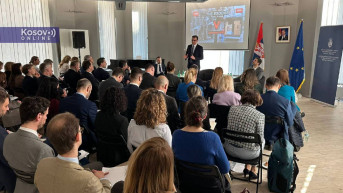
The Director of the Office for Kosovo and Metohija, Petar Petkovic, held a meeting in Brussels with representatives of EU member states and European institutions, during which he pointed to the consequences of the possible implementation of the Law on Vehicles and the Law on Foreigners, as well as the necessity of preserving Serbian institutions in Kosovo – healthcare, education and the University. He stressed that any shutdown or questioning of the functioning or existence of Serbian institutions in Kosovo is absolutely unacceptable.
Following the meeting, Petkovic stated that the discussion focused on the situation in Kosovo, particularly in light of decisions and announcements from Pristina that, as he said, it would begin implementing a highly harmful law starting on March 15.
“This was an opportunity to convey to the participants, representatives of member states and ambassadors here in Brussels, the situation on the ground, to point out all the consequences of the implementation of these extremely harmful and dangerous so-called laws, and to emphasize the necessity of preserving Serbian institutions in Kosovo and Metohija, primarily healthcare, education and our university,” Petkovic said.
He added that specific examples were also discussed.
“We pointed out that more than 10,000 of our people are directly endangered by these escalatory and discriminatory decisions and emphasized that Kurti is doing everything outside the framework of dialogue, trying in that way to actually avoid dialogue, trample it, and through such escalatory moves further jeopardize peace and security, not only in Kosovo and Metohija but throughout the Western Balkans,” Petkovic stated.
He added that the briefing also addressed the policy of President Aleksandar Vucic and the Government of the Republic of Serbia.
“We emphasized that we are committed to preserving peace and stability and to participating in dialogue, and that problems can only and exclusively be resolved through dialogue and compromise solutions. Everything that happens outside that framework demonstrates an anti-Serb policy of Albin Kurti aimed at the ethnic expulsion of the Serbian people from Kosovo and Metohija,” he said.
Petkovic stressed that any shutdown or questioning of the functioning and existence of Serbian institutions in Kosovo – primarily education and healthcare – is absolutely unacceptable, and that every effort will be made to inform the international community about the seriousness of the issue.
“For us, any shutdown or questioning of the functioning or existence of Serbian institutions in Kosovo and Metohija, particularly education and healthcare, is absolutely unacceptable, and we will do everything within our power, here in Brussels and elsewhere – as we have been doing intensively over the past days and weeks – to make the international community aware of the nature of this problem. In fact, Kurti, through these laws and regulations, intends to continue the policy of expelling the Serbian people that has been carried out in Kosovo and Metohija since 1999,” Petkovic said.
He noted that there was considerable interest among the participants.
“In addition to the general political issues and specific questions related to the implementation of these measures coming from Pristina, we prepared a video presentation with the most concrete examples. This was followed by a very lively discussion and questions from the participants, and of course our responses clearly demonstrated what is happening in Kosovo and Metohija. We openly requested the support of EU member states to exert the necessary pressure on Pristina to prevent the humanitarian catastrophe that could occur starting March 15, following Pristina’s announcement that it would proceed with these escalatory and unlawful decisions affecting Serbs, particularly those living in northern Kosovo and Metohija,” Petkovic said.
He emphasized that it is necessary for Pristina to return to dialogue.
“Instead of unilateral escalatory moves, problems must be resolved through dialogue. As the European Union itself has said, the issue of our institutions in Kosovo and Metohija should be resolved through dialogue. We are saying that the survival of our Serbian healthcare and education institutions must be resolved through dialogue within the framework of establishing the Community of Serb-majority Municipalities. Therefore, the urgent establishment of the Community of Serb-majority Municipalities and the urgent submission of the draft statute to Brussels are necessary in order to fully resolve the problem created and generated by Kurti. The whole idea behind this so-called Law on Foreigners is not to implement some law that Kurti claims is in line with European standards, but rather to jeopardize the survival of our institutions, because a large number of people who work in those institutions will not be able to work or come to Kosovo and Metohija if this law is implemented, since those people do not possess so-called Kosovo documents,” Petkovic said.
He added that it is important to find a solution that will allow people to remain, live and work in Kosovo, ensure the survival of Serbian institutions and continue dialogue in search of solutions.
“Peace and stability are what we desperately need. President Aleksandar Vucic constantly insists on this. You see what is happening around the world, the problems, wars and the scale of the catastrophe. We must preserve peace and stability in our own yard, in our own home, and seek solutions for the survival of the Serbian people in Kosovo and Metohija. That is the key,” Petkovic concluded.
The Head of the Mission of Serbia to the EU, Danijel Apostolovic, said that he could not recall such a high level of interest at the Commission in recent times and that the response to the briefing had been excellent.
“All member states attended. Ambassadors of the European Union in the Political and Security Committee were present, as well as representatives of member states in the Council working groups for enlargement and for the Western Balkans, representatives of the European External Action Service, the European Commission, and also representatives of the EU Special Representative for the Dialogue,” he said.
As he noted, the discussion was lively and the conversation open.
“Colleagues were able to ask any questions that interested them, whether they come from recognizing or non-recognizing states. It was a very lively discussion, and I believe that in the coming period we will organize these briefings more frequently, because I consider – and I see – that they are useful. It lasted two hours, which in Brussels terms is more than long for a briefing. Therefore, together with Petar and his team, we will periodically and as needed organize similar events in the future,” Apostolovic said.
0 comments