
Echoes of the Flamingo Revolution: From Turkey to Washington – who is backing the protests against Rama?
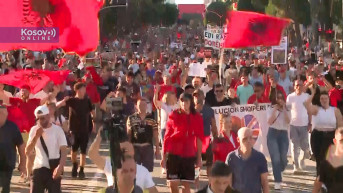
Anti-government protests have continued in Albania for more than a month, with demonstrators demanding the resignation of Prime Minister Edi Rama. According to analysts interviewed by Kosovo Online, civil society groups and new political parties have found allies both in the East and the West, from Turkey to Washington.
Written by: Bledar Kuka
When private security guards assaulted a woman in Zvërnec, near Vlorë, on May 31, perhaps no one in Albania—not Prime Minister Edi Rama nor his opponents—imagined that the incident would trigger nationwide protests directed against the entire old political establishment, protests that would continue for more than a month.
At times, as many as 100,000 people have gathered on the boulevard in Tirana; at other times, the crowds have been smaller. Yet the opposition to the government has persisted, with protesters continuing to demand Rama's resignation, while many are asking who is behind the movement.
Political analyst and journalist Dritan Laçi, editor of the television program In the Crosshairs on News 24 TV, told Kosovo Online that the events in Zvërnec, together with the documents published by the Special Prosecution Office, served as a wake-up call for Albanian citizens.
"The incident in Zvërnec revealed an entirely different side of Albania, one related to property dispossession, with criminal groups that certainly could not have carried out such operations without political backing. Today, Albanian citizens struggle to repay loans and buy apartments, while criminal groups purchase virtually every available property throughout the country, building enormous real estate portfolios in order to launder proceeds from drug trafficking. These are not my claims—they are contained in the files of the Special Prosecution Office. We should not wait for SPAK to come out and demand Rama's resignation. Albanian citizens themselves must read those files, including the information about the meeting in Aruba and how criminal groups summoned cadastral officials to meetings abroad in order to facilitate property seizures. This should raise public awareness and encourage people not to withdraw from the protests," Laçi said.
However, in addition to civil society, so-called "floating voters," and supporters of new political movements such as the Together Movement (Lëvizja Bashkë), Albania Becomes (Shqipëria Bëhet), and Opportunity (Mundësia), it appears that actors beyond Albania's borders have also turned against Rama.
This is the assessment of Ili Pata, political analyst and editor of the daily Tema.
"I see a kind of struggle among the major actors with interests in Albania and the Balkans. I see Turkey's role, I also observe neighboring countries such as Greece, as well as major powers, and it appears that Germany wants Albania to be different from the vision promoted by Edi Rama. Rather than being a very strong ally of Israel and the United States, Germany seems to favor a different course for Albania. Naturally, for that to happen, Rama must be removed," Pata told Kosovo Online.
He elaborated further on the role of Turkey, and indirectly Iran, in attempts to influence the protests.
"Within the protest movement there are organizers financed and supported by other groups and states, primarily Turkey, which may also have activated elements connected with Iran. These actors have consistently opposed the government by employing what is often described as anti-Semitic rhetoric. Albania, and the Balkans in general, have frequently experienced hateful rhetoric, serious political conflicts and fierce political confrontation, but this kind of anti-Semitic discourse had never previously existed. It has now entered political discourse in Albania, North Macedonia, Kosovo and Bosnia, largely through groups of Muslim extremists controlled or financed by organizations directly linked to Turkey and Iran. I mention Turkey and Iran because, after Albania severed diplomatic relations with Iran, Turkey negotiated an agreement with the Albanian government a year later allowing Iran to maintain an office within the Turkish Embassy. It is also a fact that Prime Minister Rama recently met with the Turkish ambassador and provided intelligence gathered by the Albanian intelligence service, which claimed to have uncovered Iranian interference, informing both Foreign Minister Hakan Fidan and President Recep Tayyip Erdoğan, with whom Rama had maintained a long-standing personal friendship that now appears to have cooled," Pata explained.
Political analyst, attorney and founder of the LEAL law firm, Leonard Karaj, shares a similar assessment.
"First of all, Turkey is certainly paying close attention to developments in Albania, because it has long been one of Albania's strongest supporters, both economically and in broader terms. Secondly, Turkey cannot accept an Albanian foreign policy that has adopted such a strongly pro-Israeli orientation. It is well known that the Arab world—and Turkey as well—stands in opposition to Israel, and in this particular case Rama has clearly positioned himself as an unwavering supporter of Israel. Only he knows the reasons behind this, and it is entirely understandable that Erdoğan and Turkey would distance themselves from him and support the protests. If you look at the demonstrations, you will notice an exceptionally large participation by members of Albania's Muslim community, something that had not occurred in the past," Karaj told Kosovo Online.
Karaj also believes that lobbying by the Democratic Party in the United States, together with liberals who once supported Edi Rama, as well as Germany, are playing a significant role.
"German Chancellor Friedrich Merz has strongly influenced, based on the information available to us, the push for Albania to adopt a different course from the one advocated by Rama. The fact that Germany's largest television networks broadcast the protest in Tirana live a week ago speaks for itself and should be understood as a message. I would also like to mention developments in the United States. A few days ago, Senator Jonathan Ossoff, a prominent Democratic senator widely regarded as a potential presidential candidate in the next election cycle or in 2032, openly discussed Kushner's ties to Rama during a meeting with Democrats, even referring to Kushner as an 'American prince' while pointing out that Albania is effectively handing over Sazan Island. According to Senator Ossoff, the island is considered a natural gem and a strategic point in the Mediterranean. He went even further, saying that once Democrats regain control of Congress and the Senate, expected by the end of this year, a comprehensive investigation into the matter will be launched," Karaj said.
Laçi sees support for the protests extending beyond Germany and beyond geopolitics. He argues that the European Union wants Albania, as a future member state, to embody European values—something he believes the current government is failing to do.
"It is not entirely accurate to say that the European Union has remained uninvolved. I have seen Members of the European Parliament begin openly criticizing Rama, even going beyond what would normally be considered their institutional role by attending and effectively joining the protests. They have moved beyond social media and become representatives of the protest movement itself. I could name several of those MEPs. Rama's problem today is that he is also facing opposition from Europe's political left, which no longer sees him as representing its values. That is a major challenge for him. He is making every effort to organize meetings and photo opportunities to convince Albanians that they are mistaken and that he alone represents Albania's image in Europe. The reality is entirely different. Europe itself was not built upon the values that this government currently represents. It is a fundamentally different Europe. At the same time, there appears to be a certain dualism. Rama has become trapped in the middle of a broader confrontation between Europe and the United States. On one side there is what appears to be an American investment, involving the Trump family. On the other, Europe seems to be using this moment to challenge the Trump family. Albania has suddenly found itself at the center of an international dynamic it had never anticipated, attracting global media attention through a protest that is not directed against the Trump family or foreign investment, but rather against autocracy, which runs contrary to the democratic values that should prevail," Laçi said.
Pata sees the current developments as the logical conclusion of Edi Rama's lengthy tenure in power, drawing a comparison with Serbian President Aleksandar Vucic.
"I believe these protests concern a political destiny that goes beyond Edi Rama personally. Ultimately, Rama is a politician serving his fourth term in government, and political logic tells us that a leader entering the final phase of such a long period in office has, in many ways, already written his own political fate. Therefore, we are talking about a political process that extends beyond Rama himself and is linked to major geopolitical interests and the direction that Albania—and perhaps even the Balkans as a whole—will take in a changing world. The Balkans have historically had a profound influence on political developments in both Europe and the wider world," Pata said.
It remains unclear how long the "Flamingo Coalition" protests will continue or how much room for political maneuver Prime Minister Rama still has under the current circumstances.
At present, it does not appear easy for his opponents to displace the country's two dominant political forces—the Socialist Party and the Democratic Party—but with the support of allies beyond Albania's borders, they believe that anything is possible.



0 comments