
Petritsch: If there had been success in Rambouillet, Serbia, Montenegro, and probably Kosovo would already be in the EU

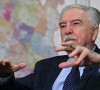
If the negotiations in Rambouillet had been successful, Serbia, Montenegro, and probably Kosovo would have long been members of the European Union, where all Serbs would be united. We should not lose hope that this will happen, Wolfgang Petritsch, a former representative of the European Union in the Contact Group says, which initiated the negotiations in Rambouillet, adding that the talks in Rambouillet were the last opportunity for a peaceful resolution of the Kosovo issue.
Today, 25 years later, Petritsch, speaking to Kosovo Online, stated that Kosovo's independence probably would not have been halted later, but there might have been a "peaceful transition" if Rambouillet had had a happier outcome.
The peace conference to resolve the Kosovo crisis began in the Rambouillet castle in France on February 6, 1999, lasting for 17 days without the delegations of Serbia and Kosovo Albanians coming to a consensus.
Reflecting on those events exactly 25 years later, Petritsch tells Kosovo Online that the Contact Group's compromise, which included a representative from Russia, aimed at returning a high degree of autonomy to Kosovo within the framework of Yugoslavia.
"Without independence, as the Russians were not in favor of it, and even the Europeans said - let's try to do this because the situation has escalated. The decisive point was the massacre in Racak, which is still controversial today. At that time, we determined that they were civilians. We know it's difficult, and we carry this knowledge from the war in the Gaza Strip. Often it's hard to distinguish between civilians and terrorists. There it was established because there were many older people and children. This raised an alarm in Washington and Europe. It must be known, that in 1999, it was about preventing another Srebrenica. It was the fear of the international community, which Slobodan Milosevic was aware of, which is why there was never a similar massacre like Srebrenica, but the international community couldn't be sure," he recalls the context, from the perspective of international intermediaries, in which a solution was sought for the Kosovo crisis a quarter of a century ago.
According to Petritsch, when Racak happened, the Americans said - enough with negotiations.
"For months, Christopher Hill and I were on the road, aiming to find a compromise. The Americans said military intervention should be carried out, but the Europeans were against it and advocated for every possible attempt to find a peaceful solution. And that was Rambouillet," Petritsch says.
In response to why Rambouillet failed, he answers that it is still a valid and tragic question today, which he can personally feel. The reason lies in the failure to adopt a good, already negotiated compromise - autonomy for Kosovo without independence, the disbandment of the KLA, and the withdrawal of the Yugoslav Army from Kosovo. The responsibility for security would be taken over by an international military mission.
"That was the formula that was clear from the beginning and to which we came very close. I published all letters and documents after the failure of Rambouillet and Paris. From them, it is evident that in Rambouillet, the Serbian, or Yugoslav delegation, in a written conclusion, stated that there was significant progress, good negotiations had taken place, and the delegation was ready to discuss the manner and proportion of implementation after returning from Belgrade. That was an important point," Petritsch says.
He also mentions that contrary to later claims, it was not about discussing only the "civil implementation" of the agreement since, after Dayton, it was clear that civil implementation must be supported by peace forces.
"In the letter signed by Professor Dr. Ratko Markovic, head of the Serbian delegation, on the last day of negotiations in Rambouillet at the end of February, it stated what we had previously discussed with the Serbian side. It was clear that we could not, on one hand, disband the KLA, and on the other hand, leave Kosovo to the Yugoslav Army without protection, the army that had caused numerous refugees and suffering. The balance was - both sides had to give up their military forces. Only that way could the civil agenda be implemented, the re-establishment of a high degree of autonomy," Petritsch said.
Petritsch believes that Rambouillet was good for Serbia, and when asked if, had Serbia accepted the Contact Group's proposal, the situation in Kosovo would be as it is today, he says he doesn't believe that independence would have been halted but there would have been a "peaceful transition".
He points out that the proposal implied convening an international conference after three years to assess the progress made towards autonomy in the meantime. The conference would then decide on the further course of action.
"In the last paragraph, we included two important points. On one side, the will of the voters, and on the other, the obligation that everything must be implemented in accordance with the rules of the OSCE, which allow border changes but through peaceful means. This means not through the fighting of the KLA or the Yugoslav Army but through negotiations between Belgrade and Pristina with the assistance of the international community," Petritsch says.
He observes that considering the past 10 years, negotiations are now being conducted based on that formula.
He also points out that in recent months, it has become clear how important the NATO KFOR peace mission is in Kosovo.
"While in Rambouillet, only the Kosovo side was demanding NATO, it is now clear how important KFOR is for protecting the Serbs in Kosovo. Unfortunately, this means, and it is a tragedy, that in Rambouillet, the last chance for peace was squandered," Petritsch emphasized.
He notes that this is not related to the Yugoslav or Serbian delegation, whose members worked excellently and professionally, unlike the Pristina delegation.
"They had great professionals, not like the Kosovo delegation, where Hashim Thaci was just 30 years old, completely inexperienced, and Ibrahim Rugova who had passed the zenith of his political life. There was no professional work there. The Serbian delegation had excellent people. Personally, I often had difficulty understanding a part of the Serbian side, especially with Milan Milutinovic, who seemed too cynical to me. But I had an excellent relationship with Nikola Sainovic, who was the deputy Prime Minister and a member of the delegation. I had numerous personal conversations with him. I noticed that Sainovic was in favor of a solution, but out of loyalty, he couldn't do much. As a witness, I was called to The Hague for the trial of Milutinovic and Sainovic. I openly said then that I had had an excellent personal relationship with Sainovic, and I spoke positively about him. Unfortunately, it didn't help; he received a high sentence since they had a wiretapped phone conversation related to Racak as irrefutable evidence. I emphasized the cooperative aspect of our relationship," he describes relationships and impressions of delegation members.
In response to the question of whether it was a mistake on the part of Serbia or Yugoslavia that there was no success in Rambouillet, he replies that he is not the only one saying this, recalling a conversation with Vuk Draskovic in Belgrade after Rambouillet and before continuing talks in Paris.
"I had a comprehensive conversation with Draskovic. He listened to me, and I explained everything to him about what would happen if we reached a compromise and if Belgrade supported the Rambouillet agreement - that by doing so, the responsibility for compliance would shift to the international community. For everything that would happen in Kosovo, Belgrade could say - we signed it, now it's up to you in the international community to implement it. I don't believe that the international community, in the long run at that time, had a chance to stop the independence movement, but there would have been a peaceful transition," Petritsch is convinced.
He states that what is happening in today's dialogue would have occurred back then, but, he adds, there would not have been war.
"If there had been a positive outcome back then, Serbia, Montenegro, and probably Kosovo would have long been in the European Union. This would have opened the borders between Serbian territories outside Serbia. It's something I've consistently emphasized. Serbia, with Serbs living in multiple states, should be the 'most pro-European'. Only in a united Europe would all Serbs be united. Unfortunately, this hasn't happened so far. But we shouldn't lose hope," Petritsch emphasized.


0 comments