
Popovic: Religious sites destroyed in March 2004 have not been restored, indicating a clear intent to erase every Serbian trace
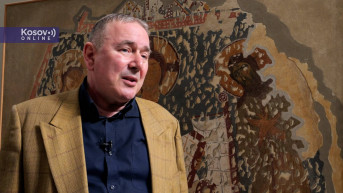
Art historian and Director of the Fresco Gallery of the National Museum of Serbia, Bojan Popovic, stated in an interview with Kosovo Online that religious sites in Kosovo that were destroyed during the March 2004 events, as well as those damaged before and after, have not been restored—particularly smaller churches—pointing to a clear intent to erase every trace of Serbian presence.
“Even for those important sites under UNESCO protection, such as the Church of the Virgin of Ljevis, we cannot say that they have been fully restored. Even there, not all frescoes have yet been cleaned of the damage caused by the 2004 fire. There is a very clear intention to erase every Serbian trace. This is most profoundly done by destroying what is most sacred to a people—religious sites and cemeteries. These are places every individual encounters at key moments in life—at birth and at death,” Popovic emphasized, marking 22 years since the March pogrom against Serbs, during which 35 religious sites were burned, including 18 cultural monuments.
In his view, responsibility for the destruction of Serbian religious sites does not lie with those formally in power in Kosovo, but rather with those who, as he stated, “hold that power.”
“Albanians living in Kosovo are, for the most part, wonderful people—I know them—but the problem is that those at the top who govern are not such, and even they are not truly responsible; responsibility lies with those who hold that power. There are even defined zones of responsibility—American, German, French. We saw how, after 2004, some nations such as Spain and Portugal withdrew their forces upon witnessing what was happening. The Spaniards were appalled—not because they are particularly devout Christians, but because they come from a deep Christian tradition and understand the value of art that is being destroyed. Alongside them, Italians are also to some extent fully aware of what is taking place. What is happening there is directly the responsibility of the major nations I have mentioned,” Popovic stated.
He further noted that, since the Berlin Congress of 1878—and even before—international law has established that after a war, individuals retain ownership of their property regardless of nationality.
“Only in the territory of Kosovo and Metohija and in Cyprus do we have a situation where, as a private individual, as a Serb, you cannot access your own property. How, then, could one even be in a position to restore a church if there is no will among those who are effectively in authority over the Albanians to allow it? The best examples are not necessarily the major churches, but smaller locations where not just one, but dozens of churches have been destroyed, such as Musutiste, where even today there is open anti-Serb propaganda. In a territory striving to present itself as a state, the second-largest community is being actively expelled. I believe Europe has not seen such a case since 1945, or since Cyprus,” he assessed.
Popovic also drew attention to a publication titled “Serbian Barbarism,” printed in Albanian, English, and Arabic, which addresses destroyed mosques in Kosovo, while also noting that damaged mosques have been restored.
“There are indeed some Muslim religious sites that were damaged—some in crossfire, some by neighbors, some likely by paramilitary units. We must be fully aware that most of these sites were looted and vandalized; some were burned, some damaged by artillery. However, all of them have been restored, and numerous new religious sites have been built,” he pointed out.
He expressed confidence that, if there were sufficient political will among international actors to allow experts from central Serbia to come to Kosovo and work on restoring Serbian religious sites one by one, such efforts could be successfully implemented.
“I am fully convinced that this would be easily achievable. Perhaps not immediately, due to inertia and resistance from certain circles, as is always the case. But I am convinced that it would subsequently proceed quite smoothly,” Popovic concluded.
0 comments